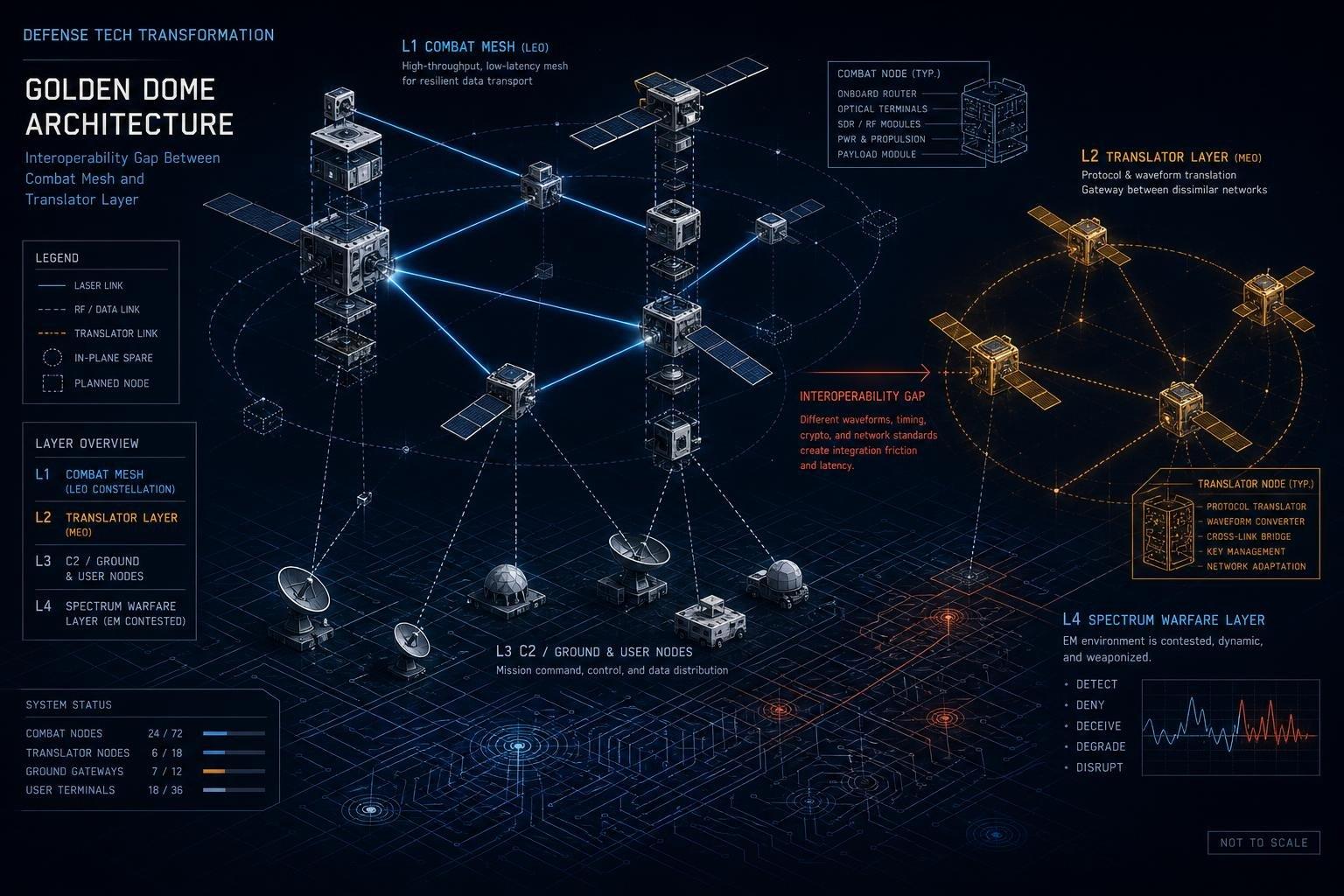

Here's an uncomfortable fact for anyone betting on electronic warfare startups: the Space Force's marquee data network — the one supposed to knit together missile tracking, targeting, and command across the force — can't talk to its own sibling satellites. Breaking Defense reported this week that the Space Development Agency's laser-linked backbone, built by SpaceX under a $2.29 billion contract awarded in May, needs an entirely new set of "translator" satellites — as many as 12 or 13 Space Exchange Point birds — just to bridge optical waveforms between different missile-warning constellations. That's not a startup problem. That's an interoperability problem sitting at the center of the Golden Dome architecture, and it's going to cost roughly another billion dollars to fix, according to Breaking Defense's sourcing.
I was handed a topic this week about AI-driven electronic warfare and spectrum dominance startups racing to field new capability. The honest version of that story, based on what's actually been reported in the last two weeks, is narrower and more interesting than the pitch-deck version. The spectrum fight is real. The adversary pressure is real. But the capital and contracts right now are flowing less toward pure-play AI-EW startups and more toward the unglamorous plumbing underneath them — satellite translation layers, zero-trust comms kits, and AI governance fights that determine whether any of this can be automated at all.
Iran Just Showed Why Spectrum Dominance Isn't Theoretical
Start with the threat side, because it's the part that makes the capability gap urgent rather than academic. A Pentagon intelligence report described to Axios found that Iran, despite the U.S. bombing its space-related facilities, is still regarded as an "emerging" space power — and it's using that capability aggressively. Iran ran land-based jamming systems that degraded GPS signals during Operation Epic Fury, and in September the Transportation Department flagged "significant" interference with navigation systems in the Strait of Hormuz, according to Axios. U.S. Central Command's Adm. Brad Cooper claimed the military achieved "space superiority" over Iran after strikes on its space command in March, but the same report notes defense analysts have doubts given Iran's "persistent electronic warfare and jamming assets," per Axios.
That's the tension that should frame every spectrum-dominance pitch you hear this quarter. Jamming is cheap, asymmetric, and already deployed by a mid-tier adversary. Countering it at scale requires either hardened, redundant architecture — which is what the Space Force translator-satellite fix is really about — or software-defined systems that can detect and route around interference in real time. The second kind is where AI-driven EW startups are supposed to live. The sourcing just doesn't show a company winning a marquee contract to do that yet.
What's Actually Getting Funded Looks More Like Comms Plumbing Than EW Startups
The closest thing to an "AI-driven spectrum" capability actually fielded in recent reporting isn't a startup at all — it's General Dynamics Information Technology's new system called Vion, a suitcase-sized Mission Partner Environment kit unveiled for ground troops. According to Defense News, Vion uses AI and zero-trust architecture to let troops establish secure connections with command centers and coalition partners from contested environments, adapting or patching connections and translating messages across formats. GDIT's Jason Myers described the pitch directly: most comms vendors lock customers into proprietary stacks, and Vion is built with "proven technologies" that get "ripped and replaced" as better options emerge, rather than a sealed system, per Defense News.
That's a legacy prime building something that sounds like what a startup would pitch — modular, AI-assisted, allergic to vendor lock-in — because the Pentagon's Joint Staff-led Olympus Fires demonstration made clear that's what customers actually want from the Coalition Information Environment effort, according to Defense News. If you're an investor looking for the EW-adjacent opportunity, the lesson isn't "primes are stealing startup ideas." It's that the demand signal for adaptive, AI-assisted spectrum and comms tools is strong enough that incumbents are racing to build it themselves, which means any startup competing in this lane needs a genuine technical edge, not just a modular pitch deck.
The AI Governance Fight Is the Hidden Bottleneck
Here's the part that doesn't show up in most spectrum-dominance coverage: none of this autonomy-adjacent capability can scale if the Pentagon can't settle what AI models are allowed to do. ABC News reported in February that the Defense Department gave Anthropic an ultimatum over use of its technology, with Anthropic CEO Dario Amodei drawing red lines around autonomous weapons — AI making final targeting decisions without a human — and domestic surveillance, while Defense Secretary Pete Hegseth reportedly threatened to invoke the Defense Production Act or label the company a "supply chain risk" if it didn't comply, according to ABC News. Elon Musk's xAI was reportedly willing to operate in a classified setting; the rest of the companies in the Pentagon's AI pilot were described as "close" but not there yet.
That dispute matters directly to spectrum dominance because EW is one of the clearest cases where speed favors autonomy. A jamming signal shifts frequencies faster than a human operator can react; the entire value proposition of "AI-driven" electronic warfare is letting a system detect and counter interference without waiting on a human in the loop. If the Pentagon and its AI vendors are still litigating where the human has to stay in that loop, the fielding timeline for autonomous spectrum response slips with it. Reuters reported this month that Pentagon Chief Technology Officer Emil Michael said the government would detail the laws governing domestic AI labs within "the next week or two," framing it as an effort to avoid "535 legislators writing a piece of regulation that could kill the industry," according to Reuters. Until that framework lands, any EW startup selling autonomous spectrum response is selling into regulatory fog, not just technical uncertainty.
Where the Real Dollars Are Landing
Follow the money and you see the pattern holding. Bloomberg reported that Alphabet is in talks to join the $185 billion Golden Dome program specifically on data security — securing the information feeding into the missile-defense software stack, not building EW payloads — as the Pentagon stands up a new industry group around that problem, according to Bloomberg. Separately, Bloomberg reported this week that the Pentagon handed a $9 million, 18-month contract to robotics startup Machina Labs to mass-produce metal airframes for the Low-Cost Uncrewed Combat Attack System, or LUCAS, drone program — a manufacturing bet on cheap autonomy at scale, not a spectrum or EW capability, per Bloomberg. Shield AI, meanwhile, rolled out its first full-scale X-BAT autonomous fighter prototype and is building a Seattle-area factory aimed at roughly 150 aircraft a year by the early 2030s, a bet on autonomous airframes rather than spectrum warfare specifically, according to GeekWire.
Add it up and the capital is diversifying across autonomy, manufacturing, and data security adjacent to Golden Dome — not concentrating in a wave of pure-play AI electronic warfare startups. That doesn't mean the opportunity doesn't exist. It means the opportunity is currently shaped more like infrastructure than like a weapons platform: the translator satellites the Space Force needs, the zero-trust comms kits ground units are demanding, the data-security layer Golden Dome requires before any targeting software can trust its inputs.
What to Watch
The Space Force's translator-satellite solicitation, once it's issued, will tell you whether that roughly billion-dollar fix goes to an established prime or opens a lane for a smaller optical-communications player — worth tracking given how Breaking Defense frames it as still undecided. The AI legal framework Emil Michael promised for "the next week or two" will shape how fast autonomous spectrum-response tools can move from demo to deployment, per Reuters. And whether Anthropic ultimately complies with the Pentagon's terms, rather than the dispute dragging on, will be the clearest signal yet of how much autonomy the Defense Department is actually willing to grant AI systems operating in contested spectrum — the one environment where hesitation has a cost measured in milliseconds, not quarters.


