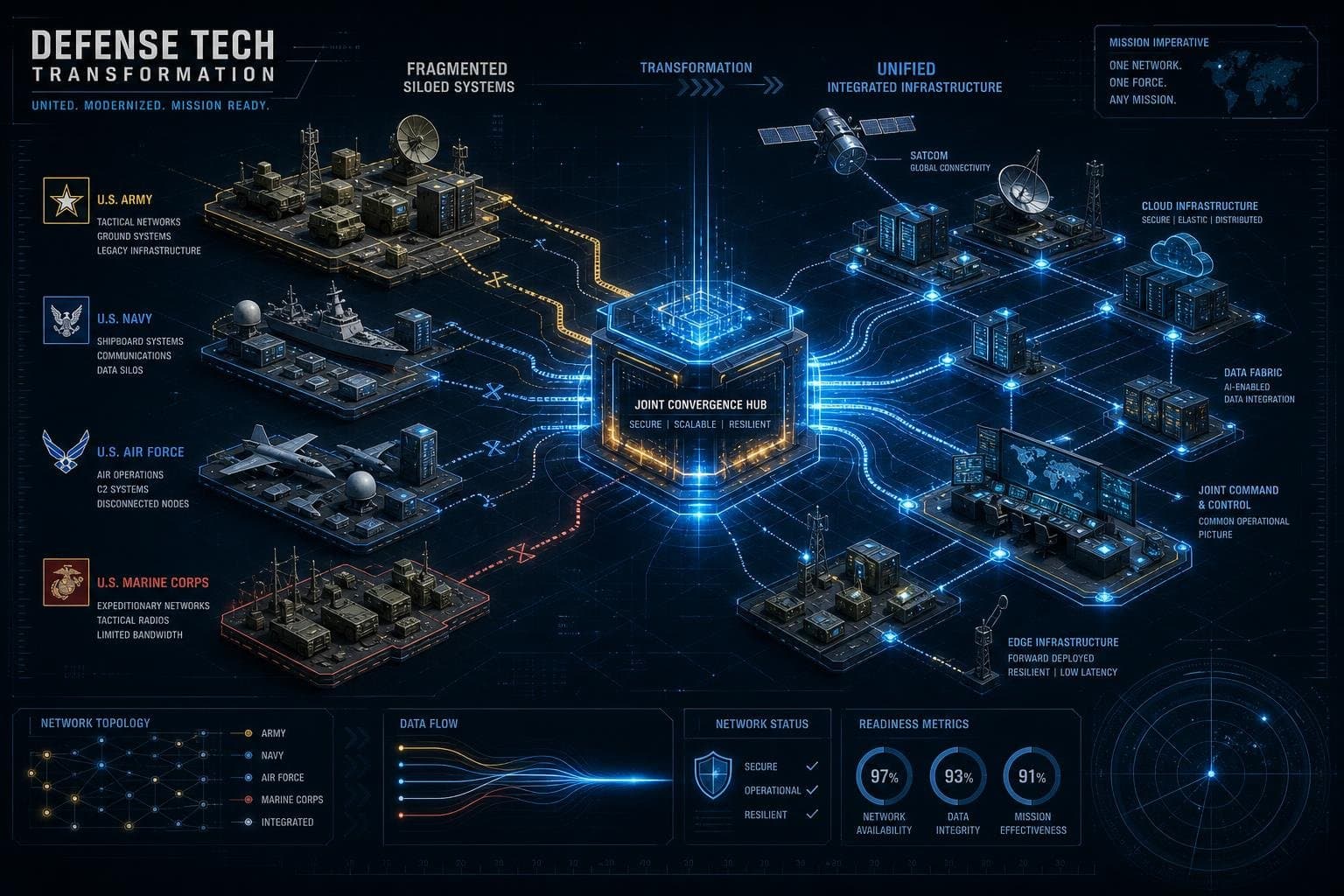

The assigned topic — venture-backed software-defined networking startups modernizing Pentagon tactical communications — is a legitimate area of defense tech investment. But the source pool this week doesn't confirm specific SDN startup contract wins or funding rounds in that space. What the sources do confirm is something arguably more consequential: the Pentagon is making a foundational bet on enterprise software consolidation that will reshape the infrastructure layer beneath every tactical communications system the military runs. That's the story worth telling.
The Pentagon's CIO Is Doing Something Unusual — Admitting the Problem
Most Pentagon procurement stories follow a familiar arc: capability gap identified, program office stood up, RFP issued, prime contractor selected, cost overruns follow. The enterprise software consolidation push underway right now breaks that pattern in an interesting way. Pentagon Chief Information Officer Kirsten Davies isn't pretending the department had a coherent software strategy before. The implicit admission in the Oracle deal announced this week is that the Pentagon spent years buying the same capabilities multiple times, service by service, command by command, with no one accountable for the aggregate bill.
The nearly $7 billion Oracle Enterprise Software Agreement, negotiated by the Department of the Navy and covering the entire Pentagon plus the U.S. Coast Guard and intelligence community, consolidates on-premises compute licenses that had been scattered across the military services. Davies framed it as delivering "at least $441 million in taxpayer savings" — a number worth pausing on. That's not savings from doing something new. That's savings from stopping the department from buying the same thing over and over through different contracting vehicles.
This Oracle deal follows a $9.69 billion Microsoft enterprise agreement struck in May, which consolidated Microsoft and other enterprise software licenses across the same sprawling customer base. Two deals, two months apart, covering the foundational software layer of the entire U.S. defense enterprise. That's not incremental reform — that's a structural reset of how the Pentagon thinks about its software stack.
For anyone tracking where defense tech startups fit into this picture, the consolidation move matters more than it might appear. When the Pentagon standardizes its enterprise software layer, it creates a more predictable integration surface for the tactical applications that sit on top of it. Startups building communications, ISR fusion, or autonomous systems software have historically faced a fragmented integration problem — different services running different middleware, different authentication systems, different data schemas. Enterprise consolidation doesn't solve that problem overnight, but it starts to create the conditions where solving it becomes tractable.
Why the "Savings" Framing Undersells What's Actually Happening
The $441 million savings figure is real and worth claiming. But framing this purely as a cost-cutting exercise misses the strategic logic. What Davies' office is actually building is procurement leverage — the ability to negotiate from a position of unified demand rather than fragmented service-by-service purchasing.
Think about what that means for the next generation of tactical communications infrastructure. The Pentagon's current approach to tactical networking is notoriously fragmented. Different services run different waveforms, different encryption standards, different network management architectures. A Marine Corps radio doesn't automatically talk to an Army network node. An Air Force ISR feed doesn't automatically integrate with a Navy ship's combat management system. The interoperability problem is partly technical, but it's also partly contractual — different services have different vendors, different upgrade cycles, and different incentives to maintain proprietary interfaces.
Enterprise software consolidation creates a template for attacking that problem at the infrastructure layer. If the Pentagon can negotiate a single Oracle agreement covering on-premises compute across all services, the same logic applies to the networking and communications software layer. A unified procurement vehicle for tactical networking software would give the department the same kind of leverage — and the same kind of integration pressure on vendors — that the Oracle and Microsoft deals are creating for enterprise software.
This is where the software-defined networking thesis for defense tech becomes interesting, even if the specific startups doing this work aren't confirmed in this week's source pool. The consolidation moves Davies is making at the enterprise layer are creating the institutional appetite and the procurement template for doing the same thing at the tactical layer. The question for investors isn't whether SDN will modernize Pentagon tactical comms — it's which companies will be positioned when the procurement vehicle for that consolidation gets stood up.
The Parallel Bet: AI-Native Cyber Capabilities Are Getting Funded at Scale
While the Pentagon consolidates its software foundation, a different kind of defense tech investment is happening at the application layer — and this week's news offers a revealing data point.
Cathedral, a startup co-founded by former DOGE staffers Gavin Kliger, Luke Farritor, Marko Elez, and Jack Stein, closed a $160 million funding round at a $1.4 billion valuation, with Andreessen Horowitz and Sequoia Capital leading and taking board seats. The company's stated mission is using AI to expand U.S. military cyber capabilities — both offensive and defensive — against adversaries including China. The plan includes acquiring or partnering with a dedicated data center to provide compute for those cyber operations.
The Cathedral story is interesting for several reasons beyond the headline valuation. First, the founder profile: DOGE alumni who spent 2025 inside the federal government, watching how it actually procures and deploys technology, are now building companies to sell back to that government. That's a different kind of founder-market fit than the typical defense tech pitch. These aren't outsiders trying to navigate Pentagon procurement from scratch — they're people who watched the procurement system operate from the inside and are betting they know where the gaps are.
Second, the investor profile. Andreessen Horowitz has been deepening its defense commitments — the firm recently added defense investor and military veteran Connor Love to its American Dynamism team — and Sequoia taking board seats alongside them in a military cyber startup signals that top-tier venture has fully committed to the defense tech thesis, not just as a portfolio hedge but as a primary bet. When Sequoia takes a board seat, it's not a passive check — it's a signal that the firm expects to help build the company toward a significant outcome. At a $1.4 billion valuation on a $160 million raise, the implied exit target is substantial.
Third, the capability focus: AI-driven offensive and defensive cyber operations against nation-state adversaries is exactly the kind of capability the Pentagon has struggled to develop through traditional acquisition channels. Offensive cyber in particular has historically lived inside NSA and Cyber Command, developed by government employees and cleared contractors under highly classified programs. A venture-backed startup entering that space — even at the edges — represents a meaningful shift in how the government thinks about sourcing those capabilities.
The compute infrastructure angle is worth noting specifically. Cathedral's plan to acquire or partner with a dedicated data center for cyber operations suggests the company is thinking about this as a persistent capability, not a one-time tool. That's the right framing for serious cyber operations, which require sustained compute for training, simulation, and real-time execution. It also creates a potential integration point with the Pentagon's broader cloud and on-premises compute consolidation — the kind of dedicated, mission-specific compute environment that might eventually plug into the enterprise software layer Davies is building. The broader pattern of AI fueling new security architectures is visible even in the commercial sector: Empirical Security's $25 million Series A, raised this month, reflects the same investor thesis that AI can help organizations prepare for and manage novel threat surfaces — a thesis Cathedral is now applying at military scale.
The Hardware Layer Is Moving Too — And It's Changing What Software Needs to Do
The consolidation and cyber investment stories are happening against a backdrop of rapid hardware evolution that's changing the requirements for tactical communications software. Anduril's Thunder drone, unveiled this week at Farnborough, illustrates the point. Thunder is a fully autonomous armed reconnaissance tiltrotor designed to fly in groups of three to six alongside helicopters like the Apache and the future Cheyenne, carrying up to 10 Hellfires or 16 air-launched effects, with counter-UAS capabilities in the nose.
What Thunder represents for tactical communications is a new class of networked autonomous platforms that need to exchange targeting data, situational awareness, and command signals in real time, at low latency, in contested electromagnetic environments. The loyal wingman concept only works if the communications architecture supporting it can handle the data throughput and latency requirements of coordinated autonomous flight. That's a software-defined networking problem — and it's one that legacy military communications infrastructure wasn't designed to solve.
Anduril President Chris Brose noted that Thunder was designed with lessons from Ukraine in mind, where drone operations have driven rapid evolution in both autonomous capabilities and the communications architectures supporting them. Brose specifically cited the "tactical air-ground littoral fight" as the operational context Thunder is designed for — a multi-domain environment where communications resilience and bandwidth efficiency are as important as payload capacity.
The drone industry more broadly is moving in the same direction. Defense News' reporting on the Pentagon's Drone Dominance competition — a $1.1 billion program that ran 49 companies through 12 days of evaluation at Camp Grayling — found that the 19 finalists advancing to August testing represent a diverse ecosystem of capabilities, from airframes to autonomy software to sensors. Defense tech consultant J.R. Mullis, quoted in the piece, made the observation that the finalists are "developing different pieces of the same capability" — and that combining them would produce something genuinely powerful.
That's exactly the integration challenge that software-defined networking is supposed to solve. When you have 19 companies building complementary pieces of a drone capability stack, the communications and networking layer that ties them together becomes the critical dependency. Whoever owns that layer — whether it's a startup, a prime, or a government-developed standard — will have significant leverage over how the broader ecosystem evolves. The satellite imaging startup Extellis, which recently raised over $7 million in seed funding to develop synthetic-aperture radar technology capable of capturing up to 10,000 images per day, is a useful illustration of how sensor proliferation is accelerating the data problem: more platforms generating more data means the networking layer has to handle more throughput, more reliably, in more contested environments.
What the Consolidation Pattern Tells Investors to Watch For
The through-line connecting this week's news is a Pentagon that is, finally and somewhat systematically, trying to build a coherent software foundation beneath its tactical capabilities. The Oracle and Microsoft enterprise agreements are the infrastructure layer. Cathedral and companies like it are the application layer. Anduril's Thunder and the Drone Dominance finalists are the hardware layer generating new requirements. The missing piece — the networking and communications software that ties all of it together in contested environments — is where the next significant procurement action is likely to emerge.
Watch for DIU and SOCOM to issue OTA solicitations specifically targeting tactical networking software over the next


