



If you came looking for the AUKUS Pillar II story this week, the sources aren't there yet. What's actually happening in defense tech procurement right now is quieter and, in some ways, more telling: the Pentagon is opening new markets by rebuilding the industrial base at home and extending its reach into domains it barely acknowledged a year ago — while the legal mechanism that makes any of this possible is under direct congressional attack.
A Laptop Is a Supply Chain Statement
Start with the one that looked, on its face, like a consumer product announcement. Anduril Industries and Qualcomm unveiled a new product line called BlueChip on Tuesday — laptops designed and assembled with a US supply chain, aimed at "government, defense, first responders and public safety" (Bloomberg). The stated goal is an "end-to-end American supply chain" not just for the laptops but for rebuilding US computer manufacturing more broadly.
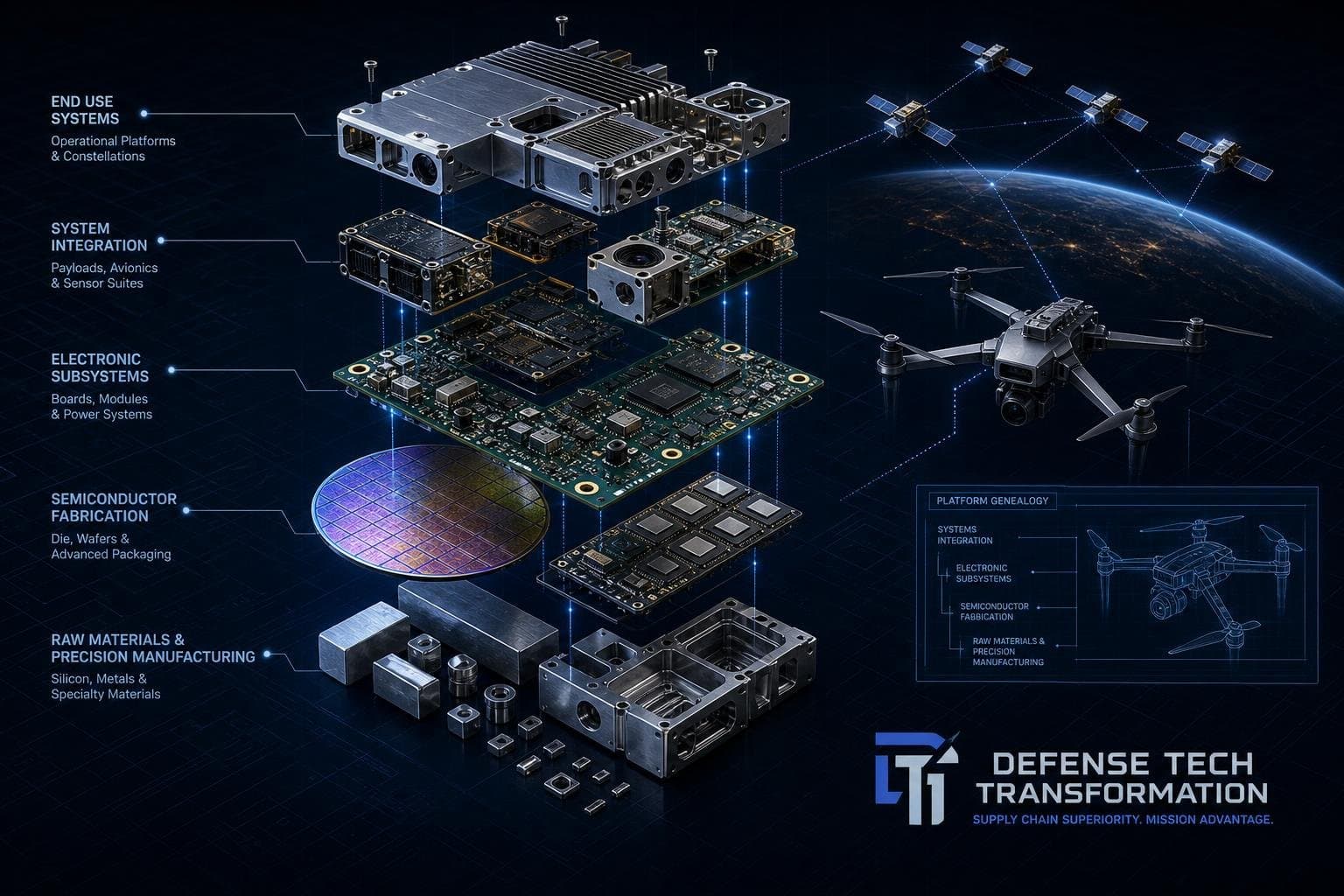
This is the part of defense tech transformation that doesn't get the same attention as autonomy demos or hypersonic test flights, but it's arguably the harder problem. A drone swarm is useless if the chips, batteries, and circuit boards inside it come from a supply chain you don't control. Anduril partnering with a chipmaker to build hardware domestically is a bet that the next competitive advantage isn't just software-defined weapons — it's who can actually manufacture the components at scale without depending on adversary-controlled supply lines. That's a market opening for any startup that can plug into a reshored hardware stack, not just the primes doing the plugging.
Funding Uncertainty Is the Real Gatekeeper
Meanwhile, the Army's marquee next-gen command-and-control effort shows what happens when the market opens on paper but stalls in practice. Lt. Gen. Matt McFarlane, commander of I Corps, told reporters that the timeline for fielding NGC2 across his formation by the end of fiscal 2027 depends on resources "above his pay grade" (Defense News). Anduril has a contract worth up to $1.8 billion to keep building NGC2's software foundation, working alongside Palantir, Raft, and Striveworks — but the Army's $904 million fiscal 2027 request for the program is tied to an NDAA that the Senate hasn't passed, and Congress is currently in recess.
I've written before about how NGC2 keeps generating headlines that outrun its funding reality (see my August piece on the Army's software sandbox). This is the same pattern again: the vendors are lined up, the architecture exists, and the bottleneck is congressional appropriations sitting in limbo. For startups eyeing NGC2 as a market, the lesson is that a program of record doesn't guarantee a check — it guarantees a queue.
The Legal Tool Behind Every Fast Contract Is Now on Trial
None of this speed — not NGC2, not the rapid commercial contracting the Space Force wants to do — happens without Other Transaction Authority, the fiscal tool originally built for NASA in 1958 that now underpins most major weapons prototyping deals. A Breaking Defense analysis argues the Pentagon has leaned on OTAs so heavily that contractors can effectively set prices with little government recourse, and that the department doesn't even track whether OT-based contracts deliver capability faster than traditional FAR contracts (Breaking Defense). The piece calls for narrowing OT use to research and development only.
That's a meaningful threat to the whole thesis of nimble-startups-over-legacy-primes. OTAs are the reason a company without a decade of FAR compliance infrastructure can win Pentagon work at all. If Congress narrows that authority, the barrier to entry for new vendors goes back up — not because the technology got worse, but because the paperwork got harder.
Even the Newest Domain Needs the Same Playbook
The Space Force's push into cislunar warfare shows the opening-market dynamic in its purest form. Maj. Gen. Stephen Purdy said the service plans to issue RFIs seeking commercially available cislunar technology and autonomous spacecraft software, with a goal of fielding capability by the end of fiscal 2029 (Breaking Defense). A year ago, Purdy said, he was told to stop talking about cislunar entirely. Now the defense secretary is calling it a decisive warfighting domain.
That's a market that didn't exist in any procurement conversation twelve months ago, now opening specifically to commercial vendors rather than traditional primes — driven, Purdy said bluntly, by the fact that China is already moving in the space.
Watch two things in the coming weeks: whether the Senate moves on the NDAA before NGC2's funding window closes, and whether the Space Force's cislunar RFIs actually land before year-end. Both will tell you more about how fast new defense markets really open than any framework announcement will.