
China's DF-17 doesn't politely announce itself. Equipped with a hypersonic glide vehicle, it flies at lower altitudes and in unpredictable directions — characteristics that Defense News reports analysts describe as making it "very hard to defend against, especially for large surface targets." When China's state media showcased the DF-17 in June — timing it deliberately against RIMPAC exercises near Hawaii — the message wasn't subtle. The PLA wanted the U.S. to know that its missile defense architecture, built around expensive exquisite interceptors, might simply be overwhelmed.
That's the threat environment in which a new generation of defense tech startups is operating. And the interesting story isn't just that they're raising money — it's that the institutional pressure they're creating is forcing the Pentagon to confront problems it has spent years deferring.
The Procurement Machine Is Broken in Exactly the Ways That Matter Most
Before getting to who's fixing things, it's worth being precise about what's broken. The Government Accountability Office's 2026 annual report on major defense acquisition programs is damning in a specific way: the Pentagon's top weapons programs are now averaging over 12 years to deliver capability. Twelve years. The GAO examined 104 of the Pentagon's most expensive programs and found that "schedule delays persisted across MDAPs, signaling overly optimistic time frames."
What makes this particularly relevant to hypersonic defense is where the delays are concentrating. The GAO flagged the Middle Tier of Acquisition pathway — specifically designed to fast-track fielding within two to five years — as increasingly dysfunctional. Of eight current MTA projects examined, GAO deemed seven technologically immature. The list includes the Hypersonic Attack Cruise Missile and the Next Generation Persistent Overhead Infrared sensor. Both are directly relevant to hypersonic threat detection and response.
"This is why we are not seeing capabilities fielded any faster," GAO's director for contracting and national security acquisitions, Shelby Oakley, told Defense News. Programs are using the fast-track pathway to mature technologies that aren't ready for it — which defeats the entire purpose.
The sensor piece matters especially. Real-time detection of a hypersonic glide vehicle requires persistent overhead infrared coverage, rapid data fusion, and decision timelines measured in seconds rather than minutes. If the Next Generation Persistent Overhead Infrared sensor is stuck in immaturity limbo inside the very pathway designed to accelerate it, the Pentagon's hypersonic defense architecture has a foundational gap — and the traditional acquisition system is not closing it on any reasonable timeline.
The Propulsion Breakthrough That Changed the Startup Calculus
Into this gap comes a genuinely interesting technical development. Venus Aerospace's $90 million Series B, announced this week, is worth examining not just as a funding event but as a signal about where the hypersonic propulsion problem actually stands.
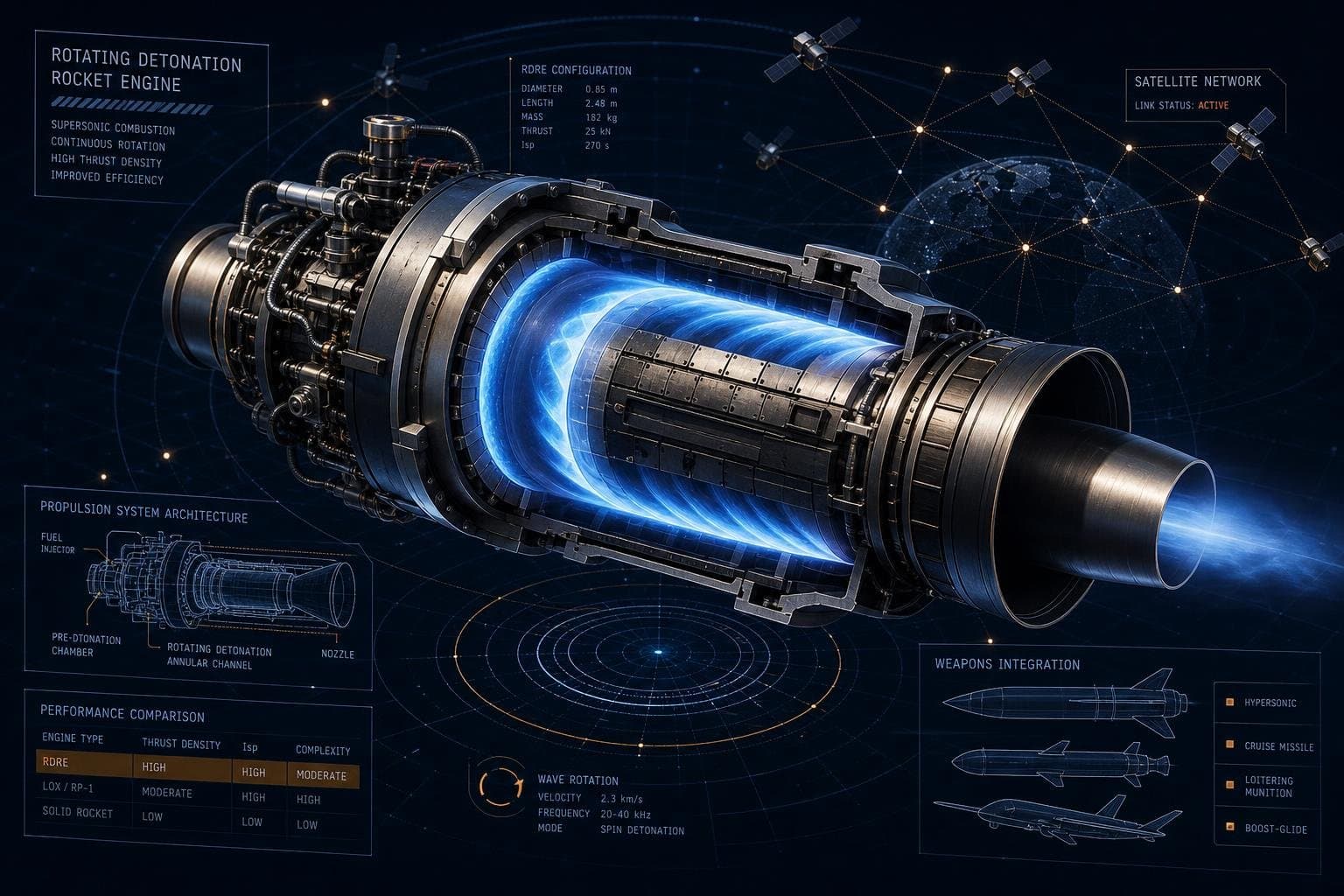
Venus was founded in 2020 by CEO Sassie Duggleby and CTO Andrew Duggleby with the original goal of building hypersonic passenger jets. Their core technology — a Rotating Detonation Rocket Engine — is a concept that dates to the mid-20th century but proved practically impossible to build until recently. Instead of burning propellants in a conventional chamber, the RDRE creates a continuous supersonic combustion wave rotating through a circular channel, promising higher efficiency with less propellant waste. The physics were understood; controlling them wasn't.
What changed was manufacturing. 3D printing and improved simulations made the RDRE buildable. NASA demonstrated one on the ground in 2022. Japan's JAXA fired one briefly in space in 2021. Venus's 2025 test was the first time an RDRE launched a rocket into actual flight.
"What happened when we flew last May is the world looked at us and said, 'oh my gosh, you have a working RDRE, would you sell us one?'" CEO Sassie Duggleby told TechCrunch. The company's plans pivoted accordingly — now focused on hypersonic weapons development, replacing solid rocket motors in missiles with its own thruster, and high-speed space vehicles for military applications.
The funding round was led by Mercury Fund with participation from Lockheed Martin Ventures, Draper Associates, and several other investors. Lockheed's presence is notable: a legacy prime contractor taking a position in a startup that could eventually supply propulsion components is exactly the kind of ecosystem integration that defense tech optimists have been predicting. It also suggests Lockheed sees the RDRE as potentially complementary to its own hypersonic programs rather than purely competitive.
The investor-pragmatist read here: Venus isn't selling a product yet, it's selling a demonstrated capability that the defense establishment desperately needs and hasn't been able to build internally. The $90M buys testing and development work on specific vehicle designs with potential customers. That's the right use of capital at this stage — de-risking the technology enough that program offices can justify writing contracts.
The Interceptor Economics Problem Is Forcing a Rethink
Here's where the threat detection and sensor fusion angle becomes concrete. The Pentagon's hypersonic defense challenge has two distinct components that are often conflated: intercepting hypersonic threats, and detecting and tracking them in the first place. The detection problem is arguably harder, and it's where the institutional pressure from startups is most acute.
The Army's newly launched Low Cost Interceptor program — analyzed by Breaking Defense this week — illuminates the economics driving the whole discussion. The U.S. military is burning through exquisite interceptors like PAC-3 Missile Segment Enhancers and SM-3 and SM-6 missiles at unsustainable rates against low-cost Iranian Shahed drones. The solution the Army is pursuing: cheaper interceptors that can be produced in mass quantities.
"The existing threat is actually low-end systems," Stacie Pettyjohn, director of the defense program at the Center for a New American Security, told Breaking Defense. "We need more, cheaper missiles, we can't just focus on the high-end threat anymore."
John Ferrari, a senior fellow at the American Enterprise Institute and former two-star Army general who served as the Army's director of program analysis and evaluation, went further: he believes the Army can produce LCIs at scale by working with venture capital-backed firms that use commercial manufacturing practices rather than bespoke defense facilities. "I think what you're going to see actually is new firms up to the market, right, like the Andurils and other firms," Ferrari said. "They can just buy commercial equipment, like you just need a factory floor, a big factory floor. Then you buy commercial equipment, and then you start producing these things."
This is the cost-curve logic applied to interceptors — the same argument that's been reshaping drone procurement. But it has a direct implication for sensor fusion: cheap interceptors are only useful if you can cue them accurately and quickly. A $50,000 interceptor fired at a ghost track is still a $50,000 miss. The economics of mass-produced interceptors only work if the detection and tracking architecture feeding them is fast, reliable, and capable of handling hypersonic glide vehicle flight profiles.
That's the pressure point. The LCI program implicitly demands better sensor fusion upstream. And the traditional acquisition system — which just demonstrated it can't deliver the Next Generation Persistent Overhead Infrared sensor on any reasonable timeline — isn't positioned to provide it.
The Geopolitical Clock Is Running Faster Than the Acquisition Calendar
The strategic context isn't abstract. China's decision to showcase the DF-17 publicly in June — described by Defense News as the first time it appeared in official Chinese media — was a calculated move. Analysts cited in the reporting were direct about the intent: the DF-17's hypersonic glide vehicle makes it "very hard to defend against, especially for large surface targets," and China wants the U.S. to internalize that its carrier-centric force projection model is vulnerable.
"This signaling is intended to underscore the PLA's growing confidence in its capacity to overwhelm regional missile-defense systems and complicate operational planning," Chen Yi-fan, assistant professor at Taiwan's Tamkang University, told Defense News.
Meanwhile, the broader geopolitical environment is generating real operational data on missile defense performance. The ongoing U.S.-Iran tensions over the Strait of Hormuz — Axios reports the White House is preparing for what could be a multi-week exchange of fire — are stress-testing air defense systems in live conditions. Iran's attacks on commercial ships and U.S. bases in Kuwait and Bahrain are generating exactly the kind of saturation-strike data that informs hypersonic defense architecture decisions.
The operational lesson from both theaters is the same one the LCI program is trying to address: exquisite systems are finite, adversaries know it, and saturation is a viable strategy against an inventory-constrained defender. Hypersonic glide vehicles are the premium version of this problem — faster, less predictable, and harder to track than Shaheds, but exploiting the same fundamental vulnerability.
What the Next 18 Months Actually Reveal
The convergence of these threads points to a specific set of decisions worth watching.
Venus Aerospace's Series B buys roughly 18-24 months of development runway toward specific vehicle demonstrations with potential customers. The question is whether those demonstrations happen fast enough to influence active procurement programs — or whether the traditional acquisition timeline absorbs them into the 12-year average the GAO just documented. Watch for whether Venus secures any OTA (Other Transaction Authority) contracts, which would signal the Pentagon is treating RDRE propulsion as mature enough to fast-track outside the standard MDAP process.
The Army's LCI program faces a more immediate test: Breaking Defense's analysis flagged production bottlenecks, budget constraints, and technology maturity standards as the likely friction points. If venture-backed manufacturers can actually stand up production capacity faster than traditional defense primes — Ferrari's thesis — the LCI program becomes a proof of concept for the broader model. If they can't, it validates the skeptics who argue that commercial manufacturing practices don't translate cleanly to weapons production.
And the sensor fusion gap remains the hardest problem. The GAO's finding that the Next Generation Persistent Overhead Infrared sensor is stuck in immaturity inside the MTA pathway is a structural problem that no single startup solves. But the pressure created by cheap interceptors demanding better cuing, combined with the DF-17's demonstrated ability to complicate existing detection architectures, creates a demand signal that the Pentagon can no longer defer. The question is whether that demand signal reaches startups through procurement mechanisms fast enough to matter — or whether it gets absorbed into the same institutional inertia that produced the 12-year average in the first place.
The DF-17 doesn't wait for acquisition reform to catch up. That's the clock the whole ecosystem is running against.


