


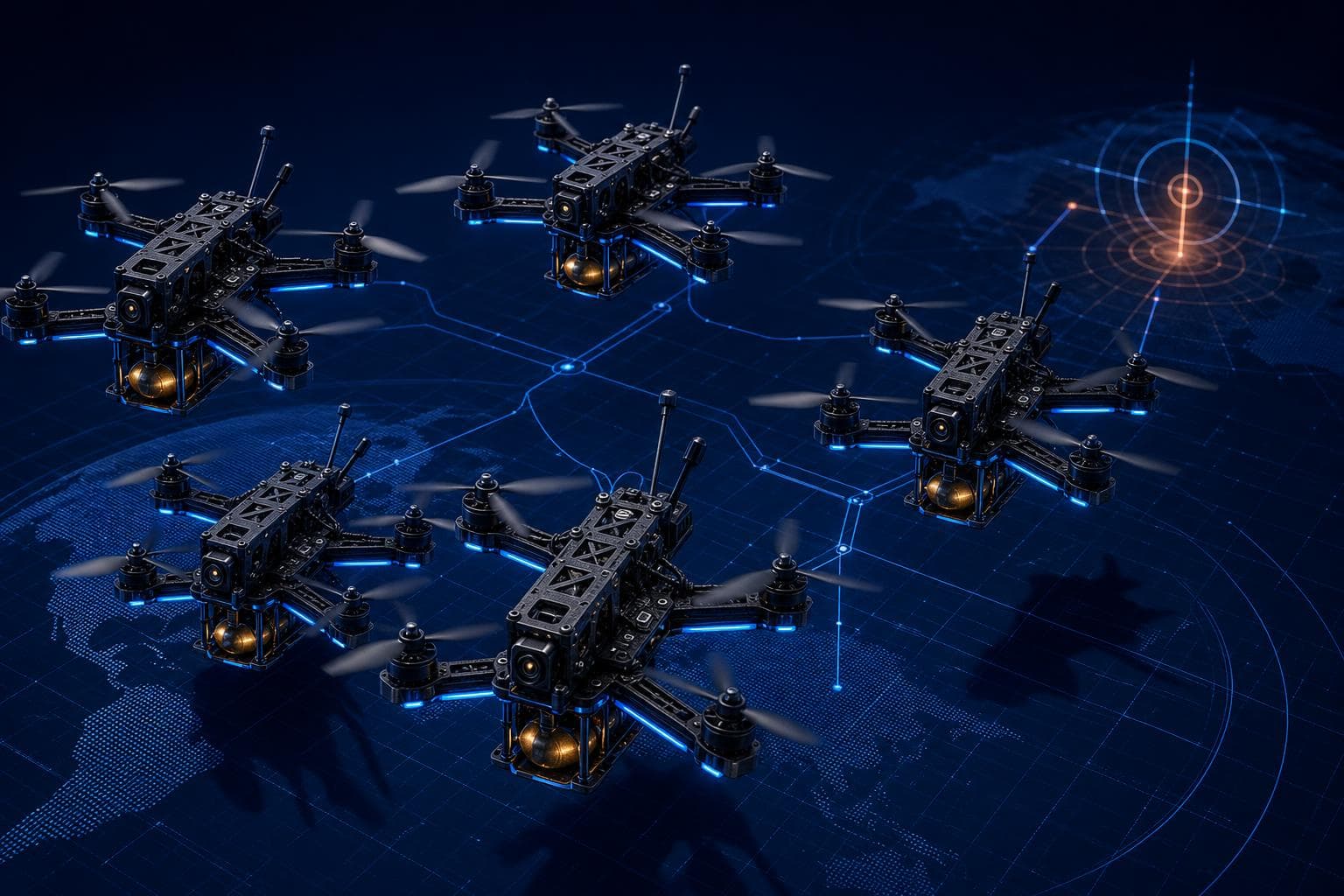

Eleven companies. Most of them fewer than three years old. One of them a British-Ukrainian partnership that almost nobody had heard of before February. These are the Pentagon's new preferred builders of first-person view combat drones — and the fact that Lockheed Martin and Anduril weren't even in the running tells you everything about where this particular competition is heading.
The Gauntlet Results Rewrite the Supplier Map
Phase 1 of the Pentagon's Drone Dominance Gauntlet ran from mid-February through early March at Fort Moore, Georgia. Twenty-six small and medium-sized contractors submitted FPV quadcopters for competitive trials, and the top scorers walked away with orders of up to 30,000 drones between them — the first buys explicitly designed to build an indigenous U.S. FPV industry from scratch.
The scoring methodology was deliberately operational: military personnel received two hours of training, then ran strike missions against fixed targets at up to 6.6 miles in open terrain and 1.2 miles in congested urban environments. The DDP calculated a 0–100 score combining those two mission categories, soldier-operator evaluations, and estimated production capacity. A majority of participants scored between 70 and 73 — passing, but barely. The top scorers separated themselves on production capacity as much as flight performance.
That production emphasis matters. The Pentagon isn't running an air show. It's trying to answer a specific question: which companies can actually manufacture at scale without Chinese components? NDAA regulations forbid Chinese parts, which eliminates the cheapest supply chain on earth — the same one that makes commercial FPV drones so inexpensive. Every company on that leaderboard found a compliant path. Most of them did it in under three years of existence.
The Munitions Problem Gets Its Own Competition
Winning the drone frame competition is only half the problem. The other half is what the drone carries.
The Pentagon's Drone Dominance Program ran a parallel Lethality Prize Challenge to identify preferred warhead manufacturers for FPV strike drones. Five companies emerged: Bravo Ordnance, Kala Defense, Kraken Kinetics, Mountain Horse Solutions, and Northrop Grumman. The first four are startups. Northrop is the one legacy name on the list — and it's worth noting that even here, the majors are sharing the stage with companies that didn't exist a decade ago.
The winning munitions will feed directly into Phase II of the Gauntlet, likely held this June or July. The DDP plans to conduct explosive arena and penetration tests between June and August, and may extend production contracts directly to some winners via OTA, FAR, or experimental funding. The program is also assisting drone vendors with integrating the winning warheads before that competition — essentially pre-qualifying the munition-drone combinations so Phase II evaluations can focus on operational performance rather than integration headaches.
The context for all of this is Ukraine. FPV drones and gravity-drop platforms have accounted for over 70% of combat casualties since 2024, according to Inside Unmanned Systems. Russia and Ukraine are producing millions of these systems annually. The Pentagon looked at that math and decided the answer wasn't to hand the problem to a prime contractor — it was to build a competitive ecosystem of small manufacturers who could iterate fast and scale hard.
What the LASSO Competition Adds to the Picture
The Army's separate LASSO (Low-Altitude Stalking and Strike Ordnance) program is running a similar multi-competitor prototyping structure for loitering munitions. AeroVironment's Switchblade 400 joined Uvision's Hero 90 and Textron's Damocles in the competition this week, with the Army budgeting $109.5 million to acquire 95 LASSO systems in FY27. All three solutions use modular open-systems architecture — meaning the Army is explicitly preserving the ability to swap payloads and avoid lock-in.
The pattern across Gauntlet, the Lethality Prize, and LASSO is consistent: the Pentagon is running competitive prototyping pools rather than picking winners early. That's a structural shift from the traditional single-award development contract. It keeps more companies funded through the evaluation phase, generates real operational data before committing to production, and — not incidentally — creates leverage against any single supplier.
The companies watching Phase II of the Gauntlet most closely aren't the eleven on the current leaderboard. They're the six that scored between 70 and 73 and know exactly what they need to fix before the next evaluation window opens.