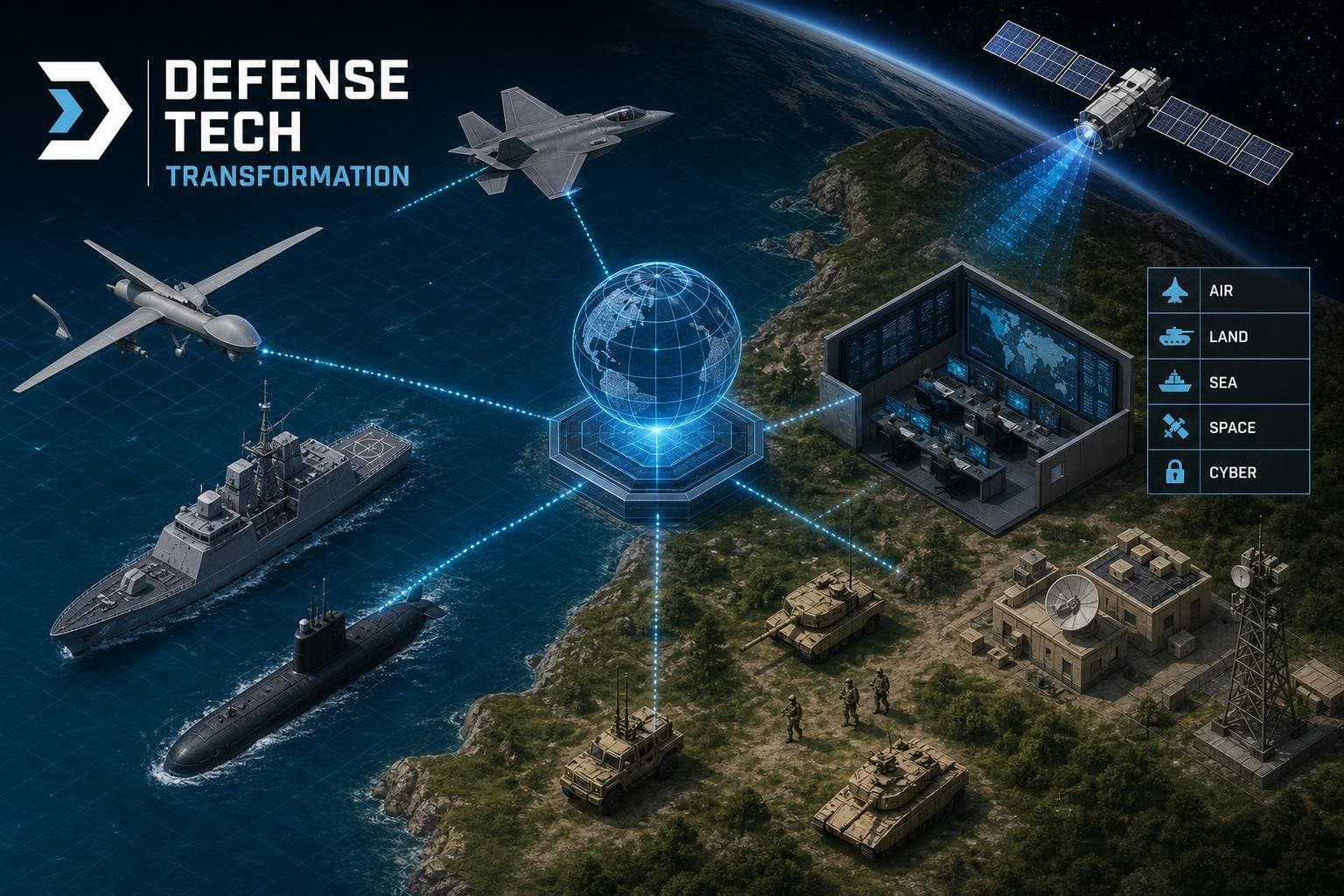

Small drones now account for roughly 80% of battlefield casualties in Ukraine. That single statistic should end most arguments about whether the Pentagon's air defense doctrine needs rethinking. It doesn't need tweaking around the edges. It needs a structural overhaul — and the companies forcing that overhaul aren't Raytheon or Northrop Grumman. They're venture-backed startups pitching at YC Demo Day and winning DIU contracts measured in months, not years.
The shift happening right now is less about any single platform and more about a compounding pressure: drone swarms are breaking the cost math of traditional air defense, procurement timelines that made sense for exquisite platforms are catastrophically mismatched to attritable mass, and interoperability standards written for legacy systems can't accommodate the software-defined autonomy these new companies are building. Each of those three problems is a startup opportunity. Together, they represent the most significant restructuring of Pentagon air defense thinking since the introduction of surface-to-air missiles.
The Cost Math Is the Doctrine Problem
Traditional air defense was designed around a relatively simple premise: intercept high-value, low-volume threats. A cruise missile costs millions. An interceptor that costs a few hundred thousand dollars to destroy it is a reasonable trade. The math holds.
Drone swarms break the math entirely. When a threat costs a few hundred dollars and you're responding with a Patriot interceptor, you've already lost the economic exchange — regardless of whether you hit the target. Ukraine has demonstrated this at scale. Ukrainian commanders have focused on medium-range strike drones with autonomous targeting capabilities that can hit fuel depots, ammunition dumps, and command posts up to 150 kilometers beyond the front lines, and the latest models are more resistant to electronic jamming. The Russians are doing the same thing in reverse, launching thousands of UAVs daily.
Speaking at the Defense One Tech Summit, Pentagon Assistant Defense Secretary for Science and Technology Joseph Jewell made the implication explicit: Ukraine took the Russian Navy "out of the fight" in the Black Sea without possessing a traditional fleet, attributing the effect to small, relatively undetectable weapon systems fielded in large quantities. His framing was pointed — high-end, expensive systems still matter, but they will increasingly be complemented by massed drones, potentially "a hundred or a thousand" platforms, with AI-enabled control replacing today's human-in-the-loop FPV model as the "natural evolution."
That's not a think-tank prediction. That's the Pentagon's S&T chief describing current operational reality and telling the defense industry to catch up. The doctrine implication is that air defense can no longer be conceived purely as a kinetic intercept problem. It has to become an economic and algorithmic problem: how do you defeat swarms at a cost per kill that doesn't bankrupt the force?
This is exactly the question startups are positioned to answer — and the reason counter-drone companies are commanding valuations that would have seemed absurd two years ago.
Venture Capital Is Pricing the Doctrine Shift Before the Pentagon Does
The YC Spring 2026 cohort included 9 Mothers, a counter-drone startup that claims to have developed a more affordable robot capable of tracking and killing drones traveling at 60 miles per hour. The company had already booked $1.6 million in sales at Demo Day, with a single contract expected to expand to $35 million. One investor told TechCrunch it was the most highly valued startup in the batch — at upwards of $200 million — and possibly one of the most valuable in YC history.
Think about what that valuation is actually pricing. It's not current revenue. It's the market's read on how urgently the Pentagon needs affordable counter-drone capability at scale, and how few companies have a credible answer. The $200 million figure is a bet that the doctrine problem described above is real, that the government will pay to solve it, and that 9 Mothers has a technical approach that works against the specific threat profile — low-altitude, swarm-pattern, jamming-resistant — that existing solutions handle poorly.
That's the investor thesis made visible. And it's consistent with what the Pentagon itself is signaling. The Defense Autonomous Warfare Group has outlined plans to spend $50 billion on drone development and production, with explicit intent to bring in new companies, help them develop systems, and scale production. Defense Undersecretary Emil Michael described expanding the approved drone purchasing list so unit commanders can buy more easily — acknowledging that the previous "Blue List" was so restrictive that vendors couldn't get on it. That's a procurement reform designed specifically to let startups compete.
The venture community is reading these signals correctly. When the Pentagon signals it wants attritable mass and the existing vendor base can't deliver it affordably, the gap between what the military needs and what legacy contractors provide becomes a funding thesis.
The DIU Is Becoming the Procurement Architecture for the Swarm Era
The Defense Innovation Unit's recent moves reveal how seriously the Pentagon is taking the speed mismatch between commercial drone development and traditional acquisition timelines. DIU is making riskier bets on new military equipment as it tries to further slash the time it takes to send commercial products to the field, with explicit direction from leadership to "lean forward and take acquisition risk" to find the best capability and field it as quickly as possible.
The results are becoming concrete. The Corsair drone, built by Saronic Technologies, grew from idea to reality in four months — and was used in the June 8 rescue of two downed Apache helicopter pilots near the Strait of Hormuz, the first combat use of an unmanned surface vessel. That's not a pilot program. That's operational deployment on a timeline that traditional procurement couldn't approach.
The RIMES program tells a similar story on the strike side. DIU awarded Mach Industries a contract for the Runway Independent Maritime Expeditionary Strike program, seeking a drone with a one-way range of at least 1,400 nautical miles that can be outfitted with 1,000-pound munitions and launched from ships without large flight decks — including Arleigh Burke-class destroyers. Mach is partnering with propulsion startup Whisper Aero, whose JetFoil system enables the Atlas aircraft to operate from unimproved rotary-wing landing zones while maintaining fixed-wing control simplicity and dramatically reduced acoustic signature.
The capability unlock here is significant. Naval surface combatants have historically been constrained in their ability to support long-range strikes — they need carrier air wings or land-based aviation to project power at range. A destroyer-launched, runway-independent strike drone with 1,400-nautical-mile reach changes the calculus for distributed maritime operations in contested environments like the South China Sea or the Western Pacific. That's not an incremental improvement. That's a new operational option that didn't exist before.
DIU's institutional posture is evolving to match this ambition. The question its maritime portfolio director is now asking — not "can the boats drive themselves?" but "what missions can these boats be adapted to do?" — reflects a maturation from technology demonstration to operational integration. That's the right question, and it's the question startups need to be able to answer to win follow-on contracts.
The Interoperability Problem Is the Next Competitive Moat
Here's the part of the drone swarm story that doesn't get enough attention: the platforms are getting solved faster than the command-and-control architecture that makes them militarily useful at scale.
Ukraine's experience illustrates both the opportunity and the challenge. Ukraine's defense AI chief Danylo Tsvok told Reuters that the goal is to create a single operating system to recommend battlefield decisions from individual frontline units all the way up to strategic command — what he describes as a "war of operating systems" with Russia in the next three to five years. The system that possesses more data and better understands it gains the advantage. Ukraine is already using AI for drone flight, combat planning, and missile attack analysis, but these functions remain siloed. Unifying them is the hard problem.
The Pentagon faces the same challenge at larger scale and with more institutional friction. Jewell's framing at the Tech Summit — that autonomy and AI-enabled control will replace human-in-the-loop FPV as the natural evolution — implies a C2 architecture that doesn't fully exist yet. Massed drones controlled by AI require data links, kill chain software, and rules-of-engagement frameworks that can operate under jamming and electronic warfare pressure. That's a software and systems integration problem as much as a hardware problem.
This is where interoperability standards become a competitive moat. The startups that figure out how to make their platforms talk to existing DoD C2 systems — and to each other — will have a durable advantage over companies that build great hardware but treat integration as someone else's problem. The Office of Naval Research's forthcoming strategy, described by Chief of Naval Research Rachel Riley as "Feed S&T at Speed to the Fleet and Force," explicitly calls for closer collaboration with DIU and warfighters to push technology to the fleet faster. The subtext: ONR wants to hand off mature technology to industry, not maintain it indefinitely. Startups that can receive that handoff and integrate it into deployable systems are the ones that will scale.
The Pentagon's patent holiday initiative — allowing private firms to license DoD-held patents at no fee — is a direct attempt to lower the barrier to that integration. With 145 additional applications submitted as of mid-June, the pipeline suggests real commercial interest. The startups that move quickly on relevant IP will have a head start on building the interoperable stack the Pentagon needs.
What the Next Twelve Months Will Reveal
The doctrine is being written in real time, and the next year will clarify several things worth watching closely.
The Senate Armed Services Committee's NDAA proposal to create a new command overseeing military drones is the institutional signal to track. If that command gets stood up with real budget authority, it becomes the single largest procurement accelerant for drone swarm startups since DIU was founded. Watch which companies get early contracts from that command — they'll be the ones that solved the interoperability problem first.
On the counter-drone side, the 9 Mothers trajectory is the leading indicator. If that $35 million contract materializes and the company can demonstrate performance against realistic swarm scenarios, it validates the entire YC-to-DoD pipeline for counter-drone companies. If it stalls on integration or testing timelines, it will be a cautionary tale about the gap between Demo Day valuations and operational deployment.
The deeper bet is on the AI kill chain. Ukraine's experience suggests that the force with the better operating system wins — not the force with the most platforms. Tsvok's prediction of a "war of operating systems" isn't metaphorical. It's a description of where autonomous warfare is heading. The startups building the software layer that makes drone swarms militarily coherent — not just individually capable — are the ones making the most important long-term bet. The Pentagon is only beginning to understand what it needs to buy.


