


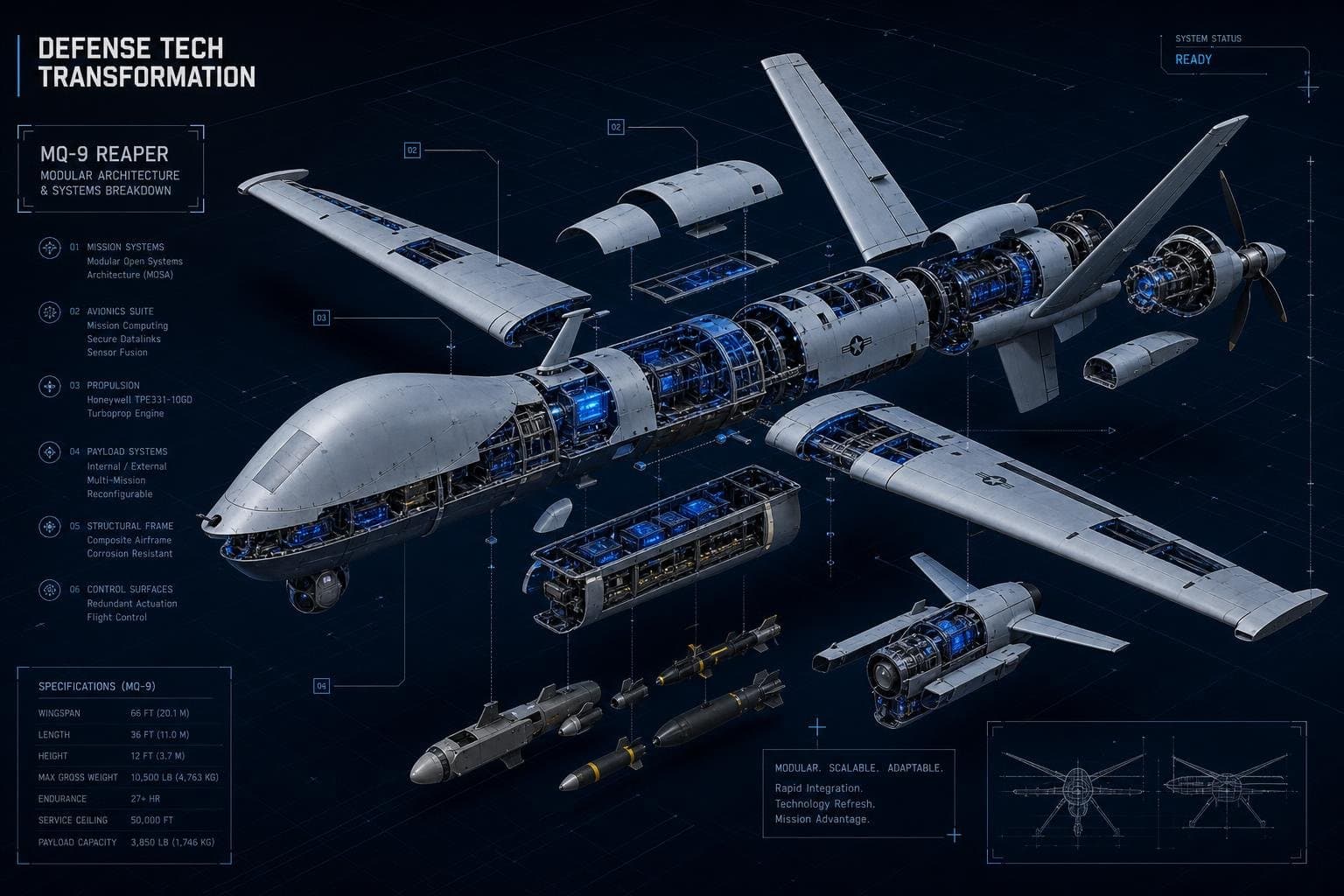

General Atomics CEO Dave Alexander didn't mince words at Farnborough this week. Asked about the Defense Innovation Unit's cost targets for the Massed Modular Aircraft program — the Pentagon's effort to find a cheaper, more capable replacement for the MQ-9 Reaper — he told Breaking Defense that the low-end price goal was "a silly goal" and that "anybody that bids that number is very suspicious." He's "1,000 percent confident" General Atomics can hit somewhere in the range, but the bluntness is notable: a 30-year incumbent in the drone business is publicly warning the Pentagon that its own solicitation may be inviting lowball bids that can't survive contact with reality.
The MMA solicitation asks for a drone with at least 2,800 pounds of payload capacity, a 2,300 nautical mile range under load, and an 8,000 nautical mile range for one-way missions — all at a price tag significantly below the Reaper's roughly $30 million per aircraft. Winners would build a full-scale prototype within 21 months of award, with initial fielding targeted for fiscal 2031.
The Startup Pressure Is Real — But So Are the Physics
Alexander's skepticism lands against a backdrop where the Pentagon is actively betting on younger companies to reshape its drone fleet. Defense News reported this week that 19 companies advanced through the latest round of the Drone Dominance competition — a $1.1 billion program evaluating commercially developed small UAS — with most finalists being relatively young, privately held firms. The message from the Pentagon has been consistent: incumbency is not a moat.
But MMA is a different problem than small UAS. Payload, range, and survivability at that scale involve engineering constraints that don't compress easily under competitive pressure. Alexander's point about certified bid requirements is the real tell: if the Pentagon wants commercial pricing, it needs to accept commercial procurement terms. Mixing defense acquisition overhead with startup cost structures is where programs go to die slowly.
The more interesting signal here is what General Atomics is doing regardless of the pricing debate — the company has already started manufacturing FQ-42A collaborative combat aircraft, with roughly 30 aircraft in some stage of build following the Air Force's June CCA production awards. That's a company that has learned to move before the contract fully clears. The