



Anduril is building a drone factory in Ohio the size of 87 football fields. That single data point tells you more about where military procurement is heading than any five-year defense budget projection.
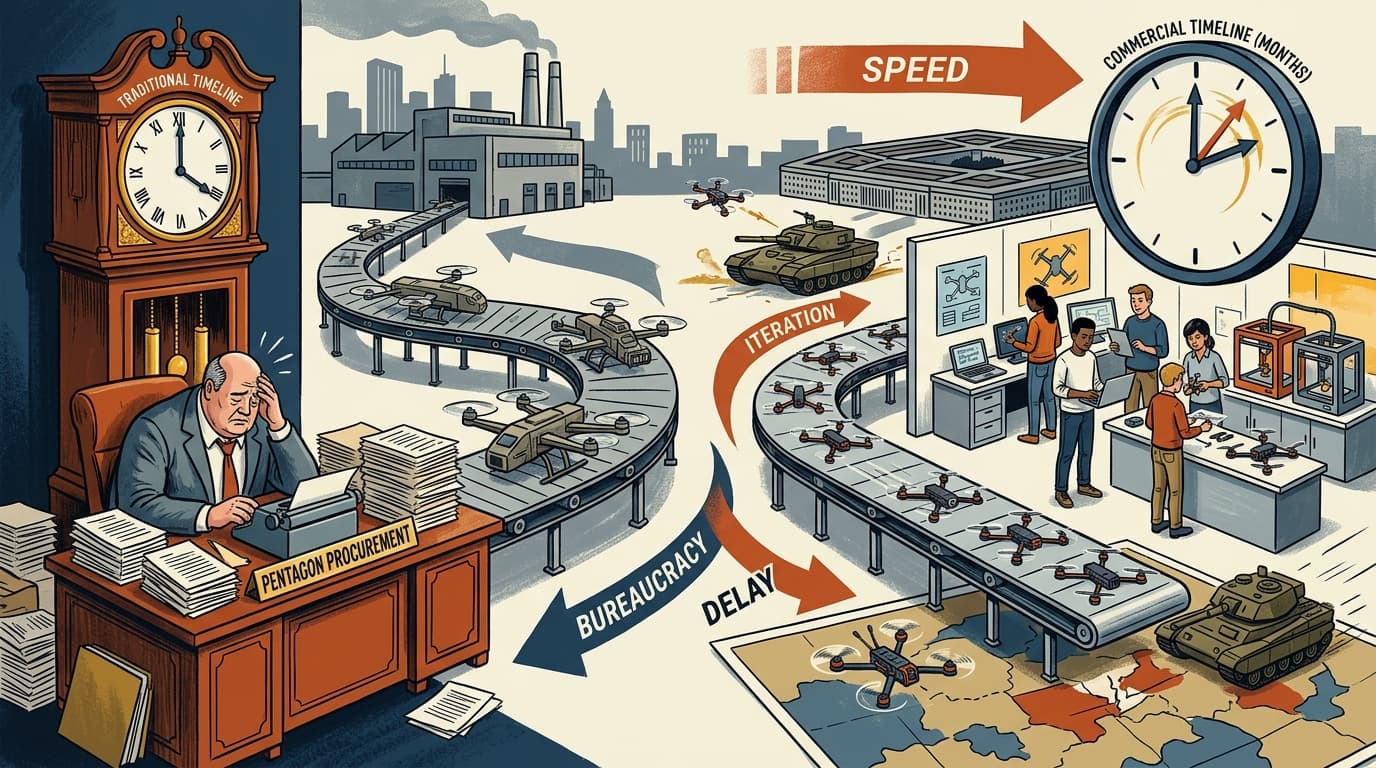
The shift isn't subtle. Commercial drone technology — built on rapid iteration cycles, consumer-grade components, and software-defined hardware — has compressed what used to be decade-long development timelines into months. The Pentagon's procurement machinery wasn't designed for that tempo, and the gap between what's commercially available and what's actually fielded is becoming a genuine operational liability.
The pressure point is Ukraine. Battlefield footage of cheap FPV drones defeating armored vehicles rewired how defense planners think about mass, cost, and attrition. A $500 drone killing a $2 million vehicle isn't a curiosity — it's a procurement signal. The DoD heard it. DIU and SOCOM have both accelerated drone-related contract activity in the past 18 months, explicitly prioritizing vendors who can deliver at commercial speed rather than traditional defense timelines.
That's where the old acquisition model breaks. Legacy contractors optimize for unit cost at scale and long-term sustainment contracts. Commercial drone vendors optimize for iteration — pushing software updates, swapping sensor payloads, and responding to field feedback in weeks. Those are fundamentally different business models, and the Pentagon is now trying to buy from both simultaneously while its contracting infrastructure was built for only one of them.
Anduril's enterprise contract consolidation — collapsing more than 120 separate procurement actions into a single vehicle — is one attempt to solve this structurally. It's not glamorous, but it matters. Procurement fragmentation is one of the main reasons commercial technology stalls between demonstration and fielding. Fewer contract actions means faster movement from prototype to operational deployment.
The deeper implication: drone procurement is becoming the test case for whether the Pentagon can actually reform how it buys hardware. If DIU and SOCOM can build repeatable pathways for commercial drone vendors — fast contracts, open architectures, software upgrade rights — that model scales to autonomous systems broadly. If they can't, the U.S. ends up with a drone industrial base that's impressive on paper and perpetually 18 months behind the threat.
Lux Capital's $1.5 billion raise for a fund explicitly targeting national security companies signals that venture capital has already made its bet on which way this resolves. The money is moving. The question is whether procurement reform moves fast enough to meet it.