


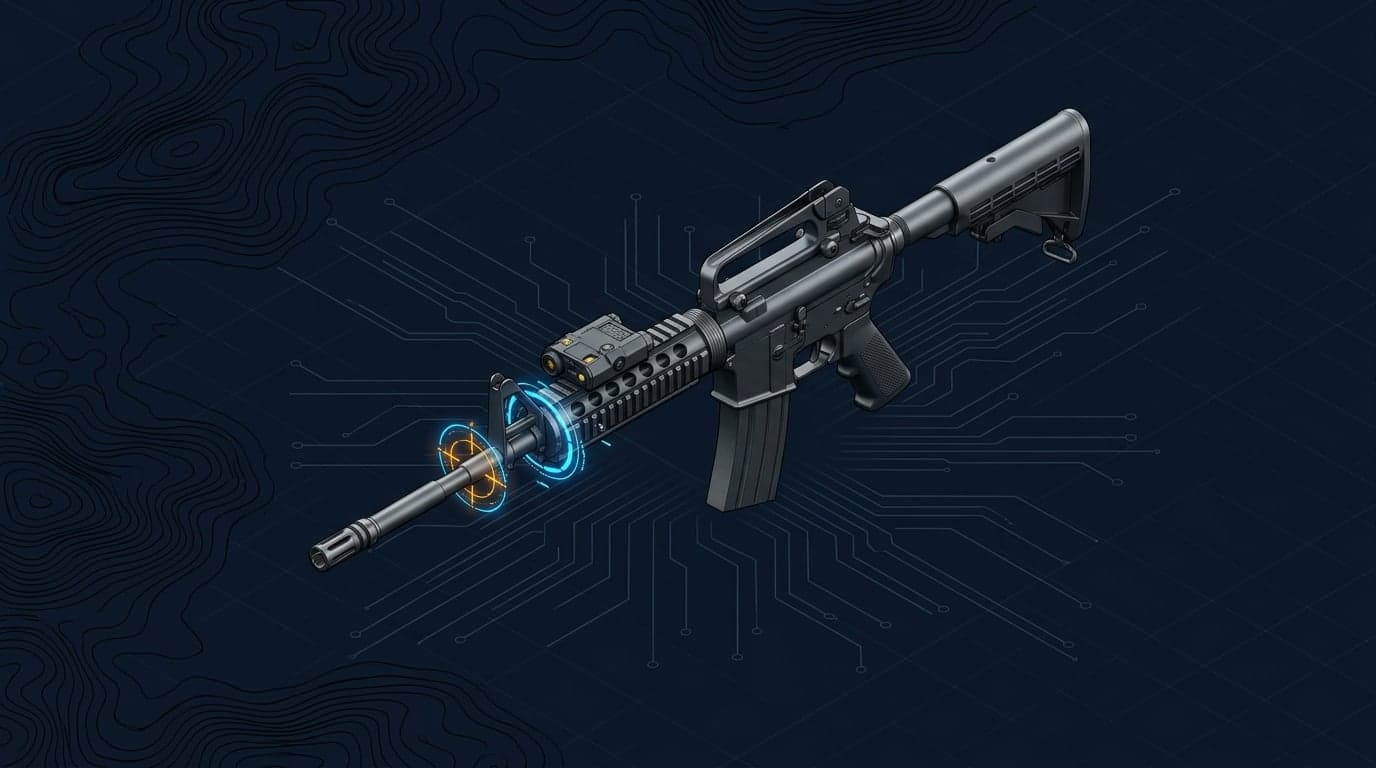

The DIU's C-UAS Close-In Kinetic Defeat Enhancement solicitation — deadline May 15 — is the kind of requirement that reveals exactly where the military thinks its drone problem actually lives. Not in hardware. In the kill chain itself.
The spec is precise: AI-aided target recognition on CROWS turrets, detection beyond 600 meters, engagement at a minimum of 100 meters, effective against drones moving at 30 meters per second. Then it goes further — phase three wants the same aided targeting on dismounted small arms. A soldier's rifle, networked into a sensor grid, semi-automatically deflecting rounds toward a drone moving at 7 meters per second. That's not incremental. That's a different theory of infantry combat.
What's interesting is what this solicitation implies about where the bottleneck is. The Pentagon isn't asking for a new weapon. It's asking for software that makes existing weapons — CROWS turrets, standard-issue rifles — dramatically more effective against a threat class that didn't exist at scale five years ago. The hardware is already in the field. The targeting intelligence isn't.
That's the same logic driving Firestorm's $30M APFIT contract to deliver 3D-printed drones and mobile xCell microfactories to an undisclosed Indo-Pacific customer. Five containerized manufacturing units, 200-plus Tempest drones, operator training — all forward-deployed into the theater where contested logistics make resupply from the continental U.S. increasingly unreliable. The company's co-founder put it plainly: if a blockade happens, "the machine doesn't stop." That's not a sales pitch. That's a procurement philosophy.
Both contracts point at the same underlying problem: the Pentagon is trying to distribute lethality and manufacturing capacity to the edge simultaneously. SOCOM's prototyping contract with SkyFi — building a sovereign intelligence platform with an ATAK plugin to push satellite imagery directly to operators in the field — is the intelligence layer of that same architecture. Eyes at the edge. Drones at the edge. Kill chains at the edge.
The pattern here isn't a single contract story. It's a distributed-force thesis being validated through procurement, one task order at a time. Watch whether the DIU C-UAS award on May 15 goes to an established integrator or a software-first startup — that outcome will say a lot about how seriously the Pentagon is taking the new model.