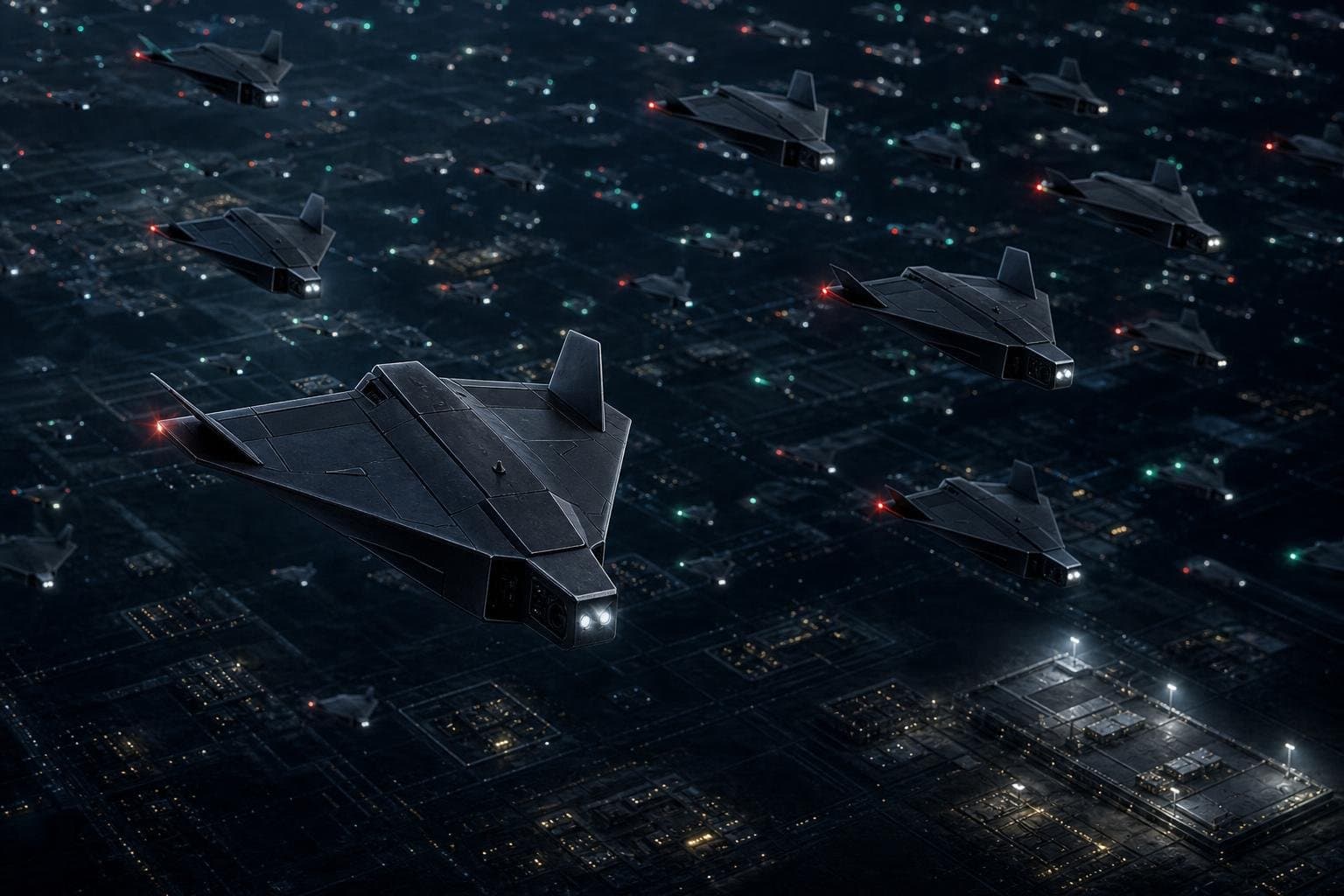

There's a number worth sitting with: 49 companies showed up to Camp Grayling in Michigan to test 79 unique drone designs in a single qualifier event. Each brought 20 aircraft. The scenarios included close-quarters tactical assaults and long-range strikes. This wasn't a traditional defense acquisition program. It was closer to a tournament — and the Pentagon designed it that way on purpose.
That event, the Gauntlet Phase II qualifier for the Defense Department's Drone Dominance Program, is one data point in a much larger structural shift. The program is a two-year, $1.1 billion initiative aimed at deploying more than 200,000 AI-enabled drones by 2027, scaling procurement from 30,000 units per phase while driving target unit costs from $5,000 down to roughly $3,000. Those aren't the economics of legacy defense contracting. They're the economics of consumer hardware at scale — and they're forcing every layer of Pentagon doctrine, procurement architecture, and interoperability planning to adapt faster than the institution was built to move.
The Funding Surge Is Real, and It's Structural
Defense tech venture capital crossed $14.6 billion in the first five months of 2026, according to Crunchbase — surpassing the previous full-year record of $9.6 billion set in 2025. For context, the sector raised just $1.6 billion in 2020. That trajectory reflects something more durable than a funding cycle: it reflects a genuine reappraisal of what military capability looks like and who can build it.
The catalyst is well-documented by now. Ukraine demonstrated, at operational scale, that autonomous drones and software-defined systems could outperform legacy hardware at a fraction of the cost. Ukrainian commanders have focused on upgrading medium-range strike drones whose latest models are more resistant to electronic jamming and carry autonomous targeting capabilities that allow them to hit fuel depots, ammunition dumps, and command posts up to 150 kilometers beyond the front lines. That's not a prototype capability. It's operational, iterating in real time, and being watched closely by every serious defense establishment on the planet.
The investment community noticed. Defense tech funding totaled $3.9 billion in 2021, held roughly flat through 2024, then broke sharply higher. The jump to $9.6 billion in 2025 looked like a generational break. The 2026 numbers have made 2025 look like a warm-up.
What's different about this wave is where the money is going. Anduril's $5 billion Series H, which valued the company at $61 billion, is the headline figure — but the more revealing signal is the proliferation of smaller companies solving specific tactical problems. At YC's Spring 2026 Demo Day, 9 Mothers — a counter-drone startup founded in 2024 — emerged as reportedly the most highly valued company in the batch, at upwards of $200 million, on the strength of a system designed to track and kill drones traveling at 60 miles per hour. The company had already booked $1.6 million in sales, with a single contract expected to expand to $35 million. The pitch: existing counter-drone solutions are expensive and often useless against swarms flying at low altitudes. The Russia-Ukraine conflict, TechCrunch noted, has shown small drones now account for roughly 80% of casualties.
That last figure is the one that should reframe how you think about air defense doctrine.
Air Defense Doctrine Has a Swarm Problem It Hasn't Solved
The traditional air defense paradigm was built around discrete, trackable threats: aircraft, ballistic missiles, cruise missiles. Each threat had a signature, a trajectory, and a cost that justified expensive interceptors. The math worked because the attacker's cost was also high.
Drone swarms break that math. When the attacker can field hundreds of small, low-cost autonomous systems simultaneously, the defender faces an asymmetric cost problem that legacy interceptor systems weren't designed to solve. A Patriot missile battery is extraordinarily capable against the threats it was designed to defeat. Against a coordinated swarm of $3,000 drones, it's the wrong tool — and an expensive one.
This is precisely why the Pentagon's Drone Dominance Program is structured the way it is. DIU Director Owen West has emphasized moving quickly, and the program's challenge-based acquisition model — four gauntlet phases, evaluated in realistic mission scenarios — is designed to compress the traditional development-to-deployment timeline. The next phase of Gauntlet II will expand to night operations and more complex urban and confined environments, with companies required to bring 120 drones each. The Pentagon is essentially running a continuous competitive evaluation rather than a fixed acquisition program, which lets it update its vendor pool as technology evolves.
The doctrinal implication is significant. If you're building an air defense architecture around drone swarms as a primary threat vector, you need layered, software-defined, rapidly updatable systems — not fixed-cost hardware platforms on 10-year procurement cycles. That's a structural advantage for startups building on open architectures, and a genuine challenge for legacy contractors whose business models depend on long-term platform contracts.
Ukraine's experience reinforces this. Danylo Tsvok, head of Ukraine's defense ministry AI center, told Reuters that AI systems would eventually unify into a single network overseeing the battlefield — what he called a "war of operating systems" with Russia in the next three to five years. The system that possesses more data and better understands it, he argued, will gain the advantage. That framing maps almost exactly onto what Anduril has built with Lattice: a decentralized mesh network of sensors, AI processing layers, and effectors that treats the battlefield as a software problem.
The Procurement Architecture Is Catching Up — Unevenly
The Pentagon's response to this pressure has been to build parallel procurement tracks that can move at different speeds. The DIU's challenge-based model is one. The expansion of the "Blue List" of approved drone vendors is another. Defense Undersecretary Emil Michael described the old system at SOF Week: units could experiment with drones, but only from a small approved list that was very hard for new vendors to enter. The new approach enables larger purchases and brings in new companies to develop systems and scale production.
The $50 billion drone warfare budget request — described by Defense One as representing more than 200 times the Defense Autonomous Warfare Group's 2026 budget — is the financial signal that this isn't a pilot program. Some of that money goes to buying existing platforms at scale. Some goes to new entrants. Saronic, the autonomous surface vessel maker, is cited as an example of a company that built a body of evidence through experimentation and is now helping the Navy procure at volume.
The Senate Armed Services Committee's proposed NDAA adds another layer. The legislation would create a new four-star Robotic and Autonomous Systems Combatant Command — a proposal inspired in part by drone warfare in Ukraine and a Saronic vessel's role in rescuing Army crew members from a downed Apache helicopter near the Strait of Hormuz. A dedicated combatant command for autonomous systems would represent a doctrinal commitment, not just a procurement preference. It would create a unified demand signal, a single institutional customer with authority to set interoperability standards and drive procurement at scale.
That's the missing piece in the current architecture. Right now, drone procurement is still somewhat fragmented across services, with different requirements, different approval processes, and different integration standards. A dedicated command would consolidate that — and in doing so, would dramatically clarify which vendors are positioned to win at scale versus which ones are optimized for the current fragmented environment.
The Interoperability Problem Is Where Startups Either Win or Stall
Here's the tension that doesn't get enough attention in the funding coverage: the same proliferation of drone startups that's driving innovation is also creating an interoperability nightmare. Forty-nine companies at Camp Grayling with 79 unique drone designs is exciting as a demonstration of industrial capacity. It's a potential integration disaster if those systems can't communicate, share targeting data, or operate within a unified command-and-control architecture.
This is where the platform plays — Anduril's Lattice, specifically — have a structural advantage over point-solution hardware vendors. A drone that performs brilliantly in isolation but can't plug into a mesh sensor network or share kill-chain data with adjacent systems is tactically limited. The Pentagon's push toward open-architecture standards is partly an attempt to solve this, but standards take time to establish and enforce.
The European parallel is instructive. Reuters reported that Germany and France are developing a drone system and data network after cancelling their joint fighter jet program — a recognition that the interoperability layer matters as much as the hardware. Boeing's MQ-28 Ghost Bat could enter German Luftwaffe service by 2029; Airbus' U760b Ravenstorm isn't ready until the 2030s. The gap between those timelines and the pace of drone warfare evolution in Ukraine is itself a strategic problem.
The Mach Industries RIMES contract from DIU illustrates both the opportunity and the challenge. Mach's Atlas drone, developed with propulsion provider Whisper Aero, is designed to operate from destroyers without large flight decks and strike targets at ranges of at least 1,400 nautical miles — carrying the same 1,000-pound munitions that arm the F/A-18 Super Hornet. That's a genuine capability unlock: naval surface combatants currently constrained in their ability to support long-range strikes would gain a new offensive option without requiring carrier-class infrastructure. But Atlas still needs to integrate into shipboard command systems, communicate within a fleet's sensor architecture, and operate within rules of engagement frameworks that weren't written for autonomous strike platforms.
The companies that solve the integration problem — not just the hardware problem — are the ones that will scale. The ones that build impressive drones but treat interoperability as someone else's concern will find themselves cycling through pilot contracts without ever reaching volume procurement.
What the Next Six Months Will Tell You
Watch three things. First, which vendors emerge from Gauntlet II's expanded phase — night operations and complex urban environments are where software-defined autonomy either proves out or exposes its limits. Second, whether the Senate's Robotic and Autonomous Systems Combatant Command proposal survives the NDAA process; if it does, the resulting command will become the most important new customer in defense tech almost immediately. Third, how the interoperability standards conversation develops within the Defense Autonomous Warfare Group — the specific technical requirements they publish will be a more reliable signal of which platform architectures win long-term than any individual contract announcement.
The funding surge is real. The doctrinal shift is real. The procurement machinery is moving faster than it has in decades. The question worth tracking now is whether the interoperability layer gets solved at the speed the threat demands — or whether the Pentagon ends up with 200,000 drones that can't fully talk to each other.


