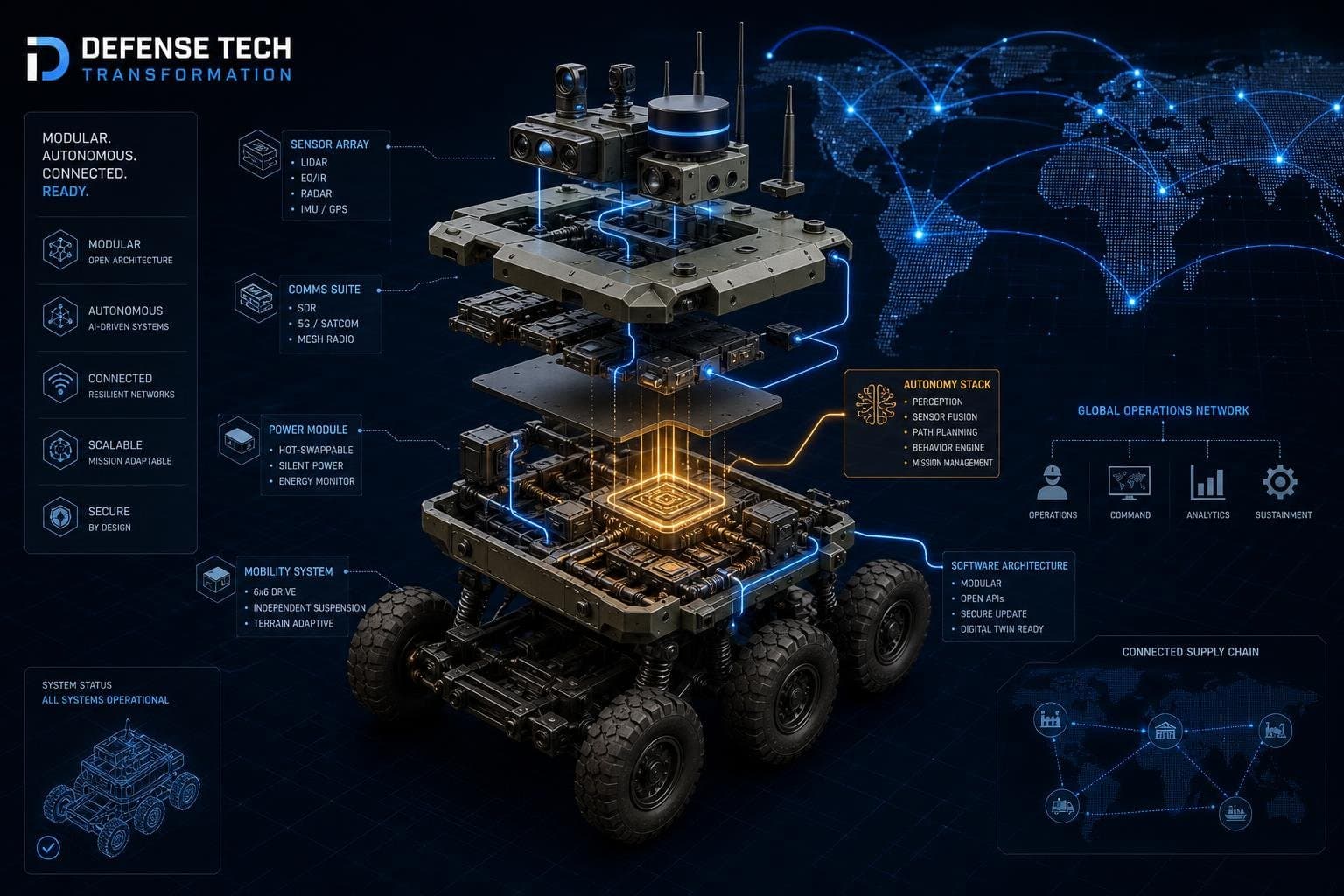

A Seattle robotics startup just did something no ground autonomy company had done before: it won a Pentagon production contract as the prime contractor, not as a subsystem supplier tucked under a legacy defense firm.
Overland AI's $19.7 million Marine Corps deal, announced June 29, calls for delivery of more than a dozen autonomous ground vehicles along with the software stack that runs them. The vehicles will handle resupply for Marine Corps counter-drone crews — not glamorous work, but exactly the kind of unglamorous, high-risk logistics task that gets people killed in contested environments. Initial deliveries are expected to begin in early 2027.
The dollar figure is modest. The structural fact is not.
Prime Contractor Status Changes the Whole Equation
The distinction Overland is claiming matters more than the contract value. Maryland-based Forterra won a larger, $92 million Marine Corps production deal earlier in June — but as the autonomy supplier under prime contractor Oshkosh Defense. Forterra's technology is in the field; Oshkosh owns the customer relationship, the integration responsibility, and the follow-on leverage.
Overland's deal inverts that structure. The startup holds the contract, owns the delivery obligation, and controls the software. That's a fundamentally different position in the procurement food chain — one that gives Overland direct accountability to the military customer and, critically, direct access to operational feedback that shapes the next product iteration.
This is the model the defense tech reform movement has been arguing for since the DIU's earliest days: get the innovator into the prime seat so the technology roadmap isn't filtered through a legacy integrator's priorities. Overland got there through APFIT — the Pentagon's Accelerate the Procurement and Fielding of Innovative Technologies program, which is specifically designed to fast-track promising prototypes into production without the full traditional acquisition gauntlet. Defense tech venture funding has been accelerating in parallel, creating the capital conditions that let startups like Overland build production infrastructure before a contract arrives rather than after.
The Autonomy Czar Memo Makes This Timing Significant
Overland's contract didn't land in a vacuum. On July 1, Defense Secretary Hegseth signed a memo creating a Direct Reporting Portfolio Manager for autonomy — a new "czar" role that consolidates all ground vehicles, all small air vehicles, and almost all sea vehicles under a single joint integrator reporting directly to Deputy Defense Secretary Stephen Feinberg.
The memo is explicit about the urgency: "Adversaries collectively produce millions of unmanned systems each year across all domains. While global military unmanned systems production has skyrocketed over the last three years, the United States has been slow to field these capabilities at scale."
That framing matters for how to read Overland's contract. The DRPM-UxS structure is designed to accelerate exactly the kind of production pipeline Overland just entered. All autonomous ground vehicles fall under the new office's portfolio. Per the memo, the Defense Innovation Unit will serve as the primary industry engagement interface between the Pentagon and commercial industry for all programs in that portfolio — which means the procurement pathway Overland used is about to get more institutionalized, not less.
For a startup that has raised over $140 million in venture funding — including a $100 million round in February led by 8VC — and built a 22,000-square-foot production facility in Seattle, the timing is close to ideal. The institutional infrastructure is catching up to where the technology already is.
What the Supply Chain Innovators Are Proving
There's a broader pattern worth tracking here. Defense startups are increasingly sourcing components from automotive and industrial sectors — not because aerospace-grade parts aren't available, but because commercial supply chains move faster and cost less. Castelion, for instance, uses automotive Field-Programmable Gate Arrays that can be obtained six times faster and at a tenth the cost of comparable aerospace versions, according to Reuters reporting via Defense News. The same logic applies to Overland's software-first approach: machine learning research from the University of Washington, not traditional defense engineering lineages, is the core competitive asset.
That's why prime contractor status matters so much. The value is in the autonomy stack, and holding the prime contract means Overland controls how that stack evolves in response to real operational feedback. The consolidation happening elsewhere in the autonomous systems market — Ondas's $875.8 million acquisition of drone and counter-drone company DYZNE being the most recent example — shows what the alternative looks like: technology absorbed into a larger portfolio, roadmap subordinated to an integrator's vision.
The Army, Marine Corps, and SOCOM have all been working with Overland. The Marine Corps just handed them a production contract. Watch for whether the new DRPM-UxS office accelerates follow-on awards — and whether Forterra or other ground autonomy players can replicate Overland's prime contractor position in the next round of competitions. The race to own the autonomous logistics layer of the U.S. military just got a clearer front-runner.


