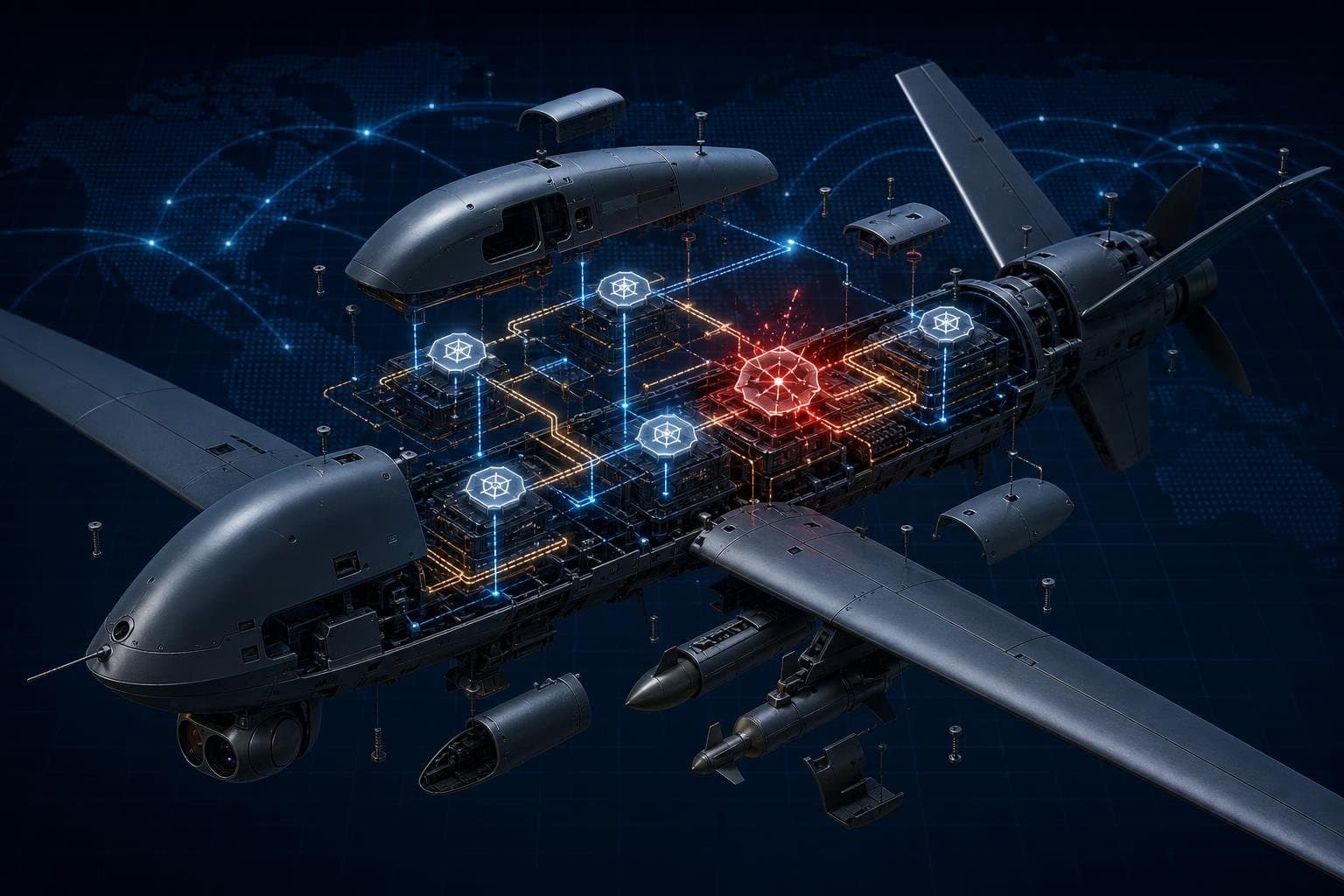

The drone doesn't need to be hacked in real time. An adversary just needs to be patient.
That's the uncomfortable logic at the center of what security professionals call "harvest now, decrypt later" — and it's the reason the quantum encryption debate isn't really about 2030. The threat is already live. Every command-and-control packet flowing between an operator and an autonomous system, every targeting update pushed to a loitering munition, every authentication handshake that tells a drone an order is genuine — all of it can be intercepted and stored today, cheaply, and decrypted retroactively the moment a cryptographically relevant quantum computer comes online. Experts widely expect that threshold to arrive sometime in the 2030s.
For most government data, that's a serious problem. For autonomous weapons, it's a different category of danger entirely.
The Signature Is the Chain of Command
Here's what makes autonomous systems uniquely exposed: cryptography in military platforms doesn't just protect secrets. It establishes authority.
An autonomous drone obeys orders because it can verify that those orders came from a legitimate controller — not an adversary spoofing the signal. That verification is a cryptographic signature. Break the signature scheme, and you don't just read the mail. You can potentially issue orders the system will obey. A quantum computer capable of forging authentication doesn't compromise yesterday's secrets — it compromises tomorrow's command integrity.
This is the part of the quantum threat that gets lost in the coverage of qubit counts and processor milestones. The race to build quantum computers is real and well-funded. The race to protect against them is less glamorous, less capitalized, and arguably more urgent for anyone whose systems need to stay trustworthy into the 2030s.
Washington Is Finally Treating This as an Engineering Problem, Not a Policy Problem
The good news is that the standards work is done. In August 2024, NIST finalized its first three post-quantum cryptography standards — FIPS 203, 204, and 205 — giving government and industry vetted, quantum-resistant algorithms to replace the RSA and elliptic-curve schemes that secure nearly everything today. The migration deadlines are now following.
A draft executive order reported by Nextgov/FCW would require all federal agencies to transition their digital signatures for high-impact systems to a post-quantum cryptography standard by December 31, 2031, and to use post-quantum cryptography for key establishment by December 31, 2030. Covered contractors working with federal agencies face the same 2030 deadline for key establishment compliance.
That contractor deadline is where this gets interesting for defense tech investors. The Pentagon's supply chain — including the startups now winning drone contracts, autonomous systems deals, and AI-enabled command software — will need to demonstrate PQC compliance on a timeline that's closer than it looks. A company closing a production contract today has roughly four years to migrate its cryptographic architecture before it becomes non-compliant with federal standards.
Separately, the Department of Commerce announced $2 billion in CHIPS Act incentives for nine quantum computing companies — including two domestic foundries (GlobalFoundries and IBM) — to accelerate fault-tolerant quantum development. The investment is framed around U.S. leadership, but it also compresses the timeline. Every dollar that accelerates quantum capability is an argument for moving faster on the defensive side.
The Defense Startup Field Hasn't Priced This In
Defense tech funding is at an all-time record — more than $14.6 billion invested in 2026 alone, already past the full-year record of $9.6 billion set in 2025. The money is flowing into autonomous systems, AI-enabled platforms, and space infrastructure. Almost none of the public conversation around these rounds focuses on cryptographic architecture.
That's a gap worth watching. As Ross Fubini of XYZ Venture Capital noted — the investor who wrote Anduril's first check — most defense startups will get lost in the Valley of Death between prototype contract and real production deal. Compliance requirements are one of the quiet killers in that valley. A startup that wins a SOCOM contract in 2026 and hasn't planned for PQC migration by 2030 isn't just facing a technical retrofit — it's facing a potential disqualification from the contracts it's trying to scale into.
The companies that treat post-quantum migration as a first-principles engineering decision now — not a compliance checkbox later — will have a structural advantage when the 2030 deadline arrives and the field has to show its work.
Watch for which defense software and autonomous systems startups begin disclosing PQC roadmaps in their next funding rounds. That disclosure, or the absence of it, will say more about long-term contract viability than almost any other technical detail in the deck.


