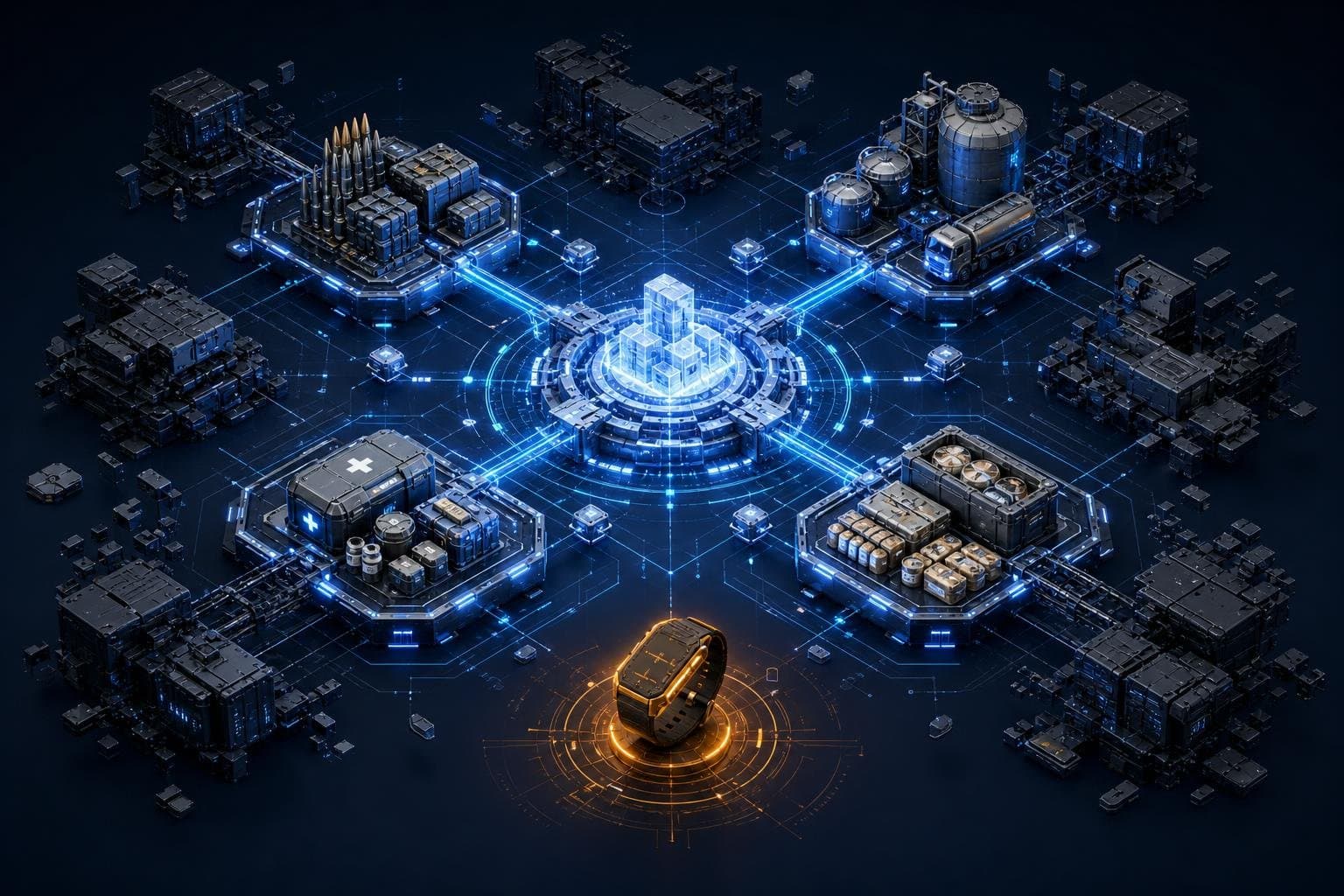

The U.S. military has a logistics problem that no amount of additional personnel can solve. Across the Pacific Command, the Defense Logistics Agency, Army Europe and Africa, and Northern Command, commanders are working with data spread across dozens of incompatible systems — each class of supply running its own siloed chain, each combatant command generating its own reporting formats. The result is a planning process that is fundamentally reactive: you find out you have a problem when the problem arrives.
That's the gap the Pentagon is now trying to close with AI. And the story of how it's doing so — and which companies are positioned to win — is more nuanced than the standard "startups disrupting defense" narrative suggests.
The Problem Is Data Synchronization, Not Just Prediction
The Defense Innovation Unit awarded two contracts in January to begin building prototypes for the Joint Sustainment Decision Tool, or JDST — a platform designed to aggregate logistics-relevant data from the military services and functional combatant commands, including U.S. Transportation Command, and apply AI to produce a more complete operational picture than human analysts can generate, and to produce it faster.
The framing from the people actually using it is instructive. Lt. Col. James Toomey, the future operations branch chief in the logistics directorate at Northern Command, described the tool's value not primarily in terms of prediction, but in terms of synthesis and bias removal. "Really what JDST has been helping us to do is speed up that process — and without human bias, bring out the 'so what' of the data, and then not only look at where we have shortfalls and gaps or vulnerabilities, but then also provide recommendations and solutions," Toomey told Federal News Network. "So it's really helping us get from reactive to predictive when it comes to logistics planning."
That phrase — reactive to predictive — is the actual thesis here. The goal isn't to build a smarter spreadsheet. It's to change the temporal relationship between military planners and supply chain risk. Right now, commanders learn about shortfalls when they materialize. The JDST prototype is designed to surface those shortfalls weeks or months earlier, when there's still time to route around them.
The complexity of the underlying problem is worth sitting with. Every "class of supply" — food, clothing, fuel, ammunition, medical equipment — runs its own distinct supply chain with its own data systems, vendors, and reporting cadences. Synchronizing those inputs across multiple combatant commands, in real time, and then applying AI to identify patterns and anomalies, is genuinely hard engineering. The DIU's decision to award two separate prototype contracts rather than a single winner suggests the Pentagon isn't yet certain which technical approach will scale.
The Smack Signal: Decentralization Is the Real Driver
The JDST story is about strategic-level logistics planning. But a parallel development this week points toward a different and arguably more urgent problem: what happens to AI-enabled decision-making when communications infrastructure goes down?
Reuters reported that Smack Technologies closed a $61 million Series B round to accelerate production of its flagship AI decision-making tools and develop wearable AI hardware for battlefield use. The company's co-founder and CEO Andy Markoff was direct about what's driving Pentagon urgency: a future conflict with a peer adversary would be fought in a decentralized, communications-degraded environment where troops cannot rely on constantly relaying data back to well-connected operations centers.
"The future of war ... will be more decentralized than any conflict that we've ever fought," Markoff told Reuters, noting that most tactical AI systems currently assume connectivity that won't exist in a high-end fight.
The timing of the round is also revealing. The $61 million raise came months after the Defense Department declared Anthropic a "supply-chain risk" in March — a rupture that sent military branches scrambling to diversify their AI vendors. That fallout led to conversations in the spring with the Marine Corps and Navy, both of which pressed Smack to speed production. The Anthropic episode is a useful reminder that the Pentagon's AI supply chain problem isn't just about logistics software — it extends to the foundational models and infrastructure that defense AI systems run on. A startup that builds on a single commercial AI provider inherits that provider's political and contractual risk.
Smack's wearable Alpha hardware — a wrist-worn AI computer designed for battlefield use — targets the specific scenario where a soldier or small unit needs AI-assisted decision support but has no reliable uplink. That's a meaningfully different product category than cloud-based logistics optimization, and it speaks to a different procurement pathway: SOCOM and the Marine Corps, rather than the Army's logistics commands.
The two threads — JDST for strategic supply chain visibility, Smack for edge AI in degraded environments — aren't competing. They're addressing different layers of the same problem: how do you maintain decision advantage across the full spectrum of a modern conflict, from the depot to the forward line of troops?
Where the Venture Capital Story Gets Complicated
Here's the tension that doesn't show up in most defense tech coverage: the broader venture capital environment for logistics technology is deteriorating, not improving.
Per PitchBook data reported by Axios, VC investments in logistics tech startups fell again in Q2 to their lowest mark in a decade. The industry has now gone five straight quarters with fewer than 100 deals. Investors are concentrating on later-stage bets and pulling back from early-stage logistics plays amid geopolitical uncertainty.
This creates an interesting bifurcation. Defense-adjacent logistics AI — companies with Pentagon contracts or clear pathways to them — is attracting capital. Commercial logistics tech, which had a massive run during the pandemic-era supply chain crisis, is getting squeezed. The implication for defense tech investors is that the moat around companies like those competing for JDST isn't just technical; it's structural. Getting inside the DoD procurement system, building relationships with combatant commands, and earning the security clearances required to handle sensitive logistics data creates barriers that purely commercial competitors can't easily replicate.
The Smack round illustrates the dynamic. The company isn't raising because the commercial AI market is hot — it's raising because the Marine Corps and Navy are actively pressing for faster production. That's a different kind of demand signal than a commercial sales pipeline, and it's more durable. Pentagon urgency, once activated, tends to sustain funding across budget cycles in ways that commercial contracts don't.
The flip side is that defense procurement timelines remain brutal. The JDST prototypes are being tested between now and March, with feedback loops running through Pacific Command, the Defense Logistics Agency, Army Europe and Africa, and Northern Command. That's a serious testing footprint — but it also means the path from prototype to program of record could stretch years. Startups competing for that contract need enough runway to survive the gap between initial award and full deployment.
The Army's Broader Modernization Signals Are Mixed
The Army's logistics AI push doesn't exist in isolation. This week also brought news that the Army is ending its experimental drone battalion in Europe less than a year after standing it up — a reminder that not every modernization experiment survives contact with institutional priorities. Acting Chief of Staff Gen. Christopher LaNeve's "Army Azimuth" strategic roadmap emphasizes returning to fundamentals of soldiering alongside the push for drone and autonomous systems capability. That tension — between transformation and institutional continuity — runs through every Army modernization program, including logistics AI.
The howitzer modernization story is instructive by contrast. Breaking Defense reported that the Army awarded Hanwha Defense USA a deal worth up to $233 million to deliver K9 mobile howitzer prototypes — a program that has been in various forms of development for decades, through the cancelled Crusader, the scrapped Non-Line-of-Sight Cannon, and the ill-fated Extended Range Cannon Artillery. The Army eventually got to a contract, but the path was littered with failed programs and wasted capital.
Logistics AI doesn't carry the same physical manufacturing complexity as a self-propelled howitzer, but it carries its own institutional inertia. Every combatant command has its own data systems, its own reporting cultures, and its own resistance to tools that surface uncomfortable truths about supply chain vulnerabilities. The JDST's success will depend not just on whether the AI works, but on whether logistics officers across multiple commands actually use it — and whether they trust its recommendations enough to act on them before a crisis materializes.
Lt. Col. Toomey's framing about removing "human bias" from logistics planning is the most interesting signal in that regard. He's describing a tool that doesn't just speed up analysis — it challenges the intuitions of experienced planners. That's a harder sell than a faster dashboard, and it's the kind of organizational change that takes years to embed.
What to Watch Before Year-End
Three milestones will tell you whether the defense AI logistics thesis is tracking or stalling.
First, watch the JDST prototype evaluation results. The testing window runs through March, with feedback from four major commands. If the Pentagon moves quickly from prototype to a formal program of record — or if one of the two initial contractors pulls significantly ahead — that's a strong signal that the technology is working and the institutional buy-in is real. A quiet extension of the prototype phase, or a third-party evaluation that produces inconclusive results, would suggest the data synchronization problem is harder than advertised.
Second, watch Smack's Alpha hardware timeline. The company is targeting 10 to 20 prototype units over the next six months, per Reuters. Whether the Marine Corps and Navy move from "pressing for faster production" to actual procurement contracts will determine whether the edge AI thesis translates into revenue — or remains a compelling demo.
Third, watch whether the broader VC pullback from logistics tech creates acquisition opportunities. If early-stage logistics AI startups that built commercial products find themselves underfunded, the companies with DoD contracts and cleared workforces become natural acquirers — or acquisition targets for the primes. The concentration of later-stage capital that PitchBook is tracking could accelerate consolidation in ways that reshape who actually delivers on the Pentagon's predictive logistics ambitions.
The JDST and Smack stories together sketch the contours of what military AI logistics modernization actually looks like in 2026: not a clean startup-disrupts-incumbent narrative, but a messier, more interesting process of institutional adaptation, vendor diversification driven by supply chain shocks, and hard engineering problems that don't yield to hype. The Pentagon is serious about getting from reactive to predictive. The question is which companies will still be standing when the prototype phase ends and the real contracts begin.


