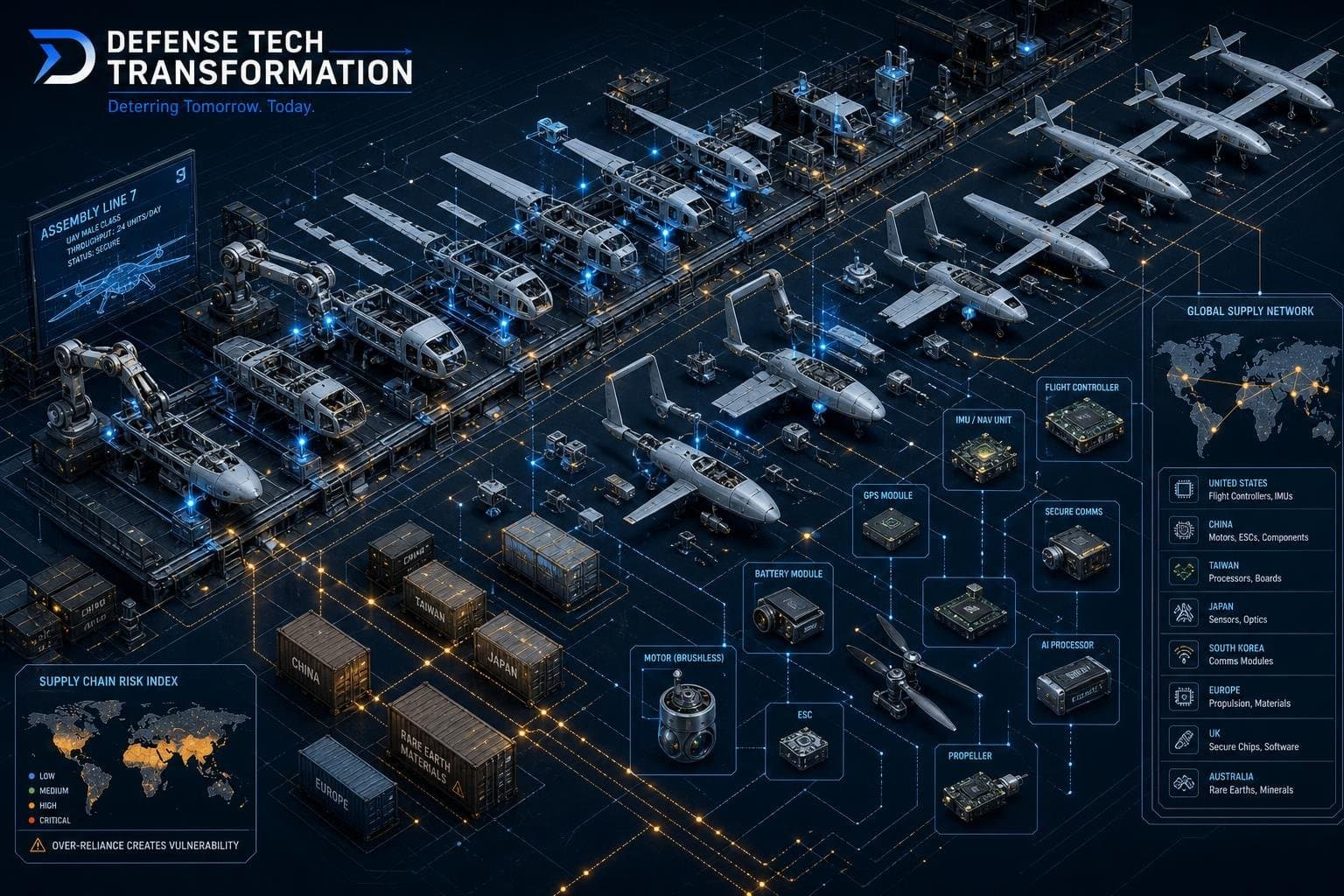

Here's the number that should stop every defense investor cold: Secretary of Defense Pete Hegseth told attendees at AUSA's Project Agincourt panel last week that the Pentagon is dealing with "hundreds of thousands of one-way attack systems this year and into the millions in years to come at a pace that this department's never ever seen before" — and that it needs roughly $50 billion in reconciliation funding, separate from the normal budget, just to get the industrial base there (Defense News).
That's not a procurement request. That's an admission that the United States doesn't currently have a drone manufacturing base capable of producing at the scale modern warfare demands — and building one fast enough to matter means wrestling with a supply chain that, as of this month, was still routing sensitive F-35 parts through Hong Kong via a commercial UPS shipment that ended up in the hands of the Chinese government (Bloomberg).
Those two stories aren't unrelated. They're the same fight, viewed from opposite ends: the Pentagon wants to scale autonomous systems production by orders of magnitude, and the industrial base it's scaling sits on top of a global sourcing network that even the Joint Strike Fighter program — the most scrutinized weapons program in American history — couldn't fully secure. If Lockheed and the Pentagon can lose track of F-35 parts, the idea that a thousand drone startups will magically onshore their rare-earth magnets, motors, and flight controllers deserves real skepticism.
The Money Is Real, and It's Arriving From Multiple Directions
Start with what's actually been obligated, not just requested. The Army's Drone Dominance program committed roughly $1 billion toward approximately 340,000 small unmanned aircraft systems for combat units over two years, with delivery ramping from tens of thousands in 2026 to hundreds of thousands by 2027 (Defense News). Acting Army Secretary Adam Telle has framed this explicitly as an effort to widen the aperture beyond traditional prime contractors — the Army, in his telling, has to make room for new entrants while keeping the established suppliers in the mix.
On the defensive side, the numbers are even bigger. Under the Domestic Shield initiative, the Army distributed $4.15 billion across ten companies building counter-drone technology, with a contract ceiling that could grow to $7 billion (Wilson's Media). Seven companies — Allen Control Systems, Digital Force Technologies, DroneShield, L3Harris WESCAM, Napatree Technology, RADA Technologies, and SRC — each picked up $500 million base awards, while Echodyne and PVP Advanced EO Systems landed $250 million apiece and Smart Shooter got $150 million. The mandate requires open architecture so radars, optical trackers, and command-and-control software from different vendors can talk to each other without proprietary lock-in — which is the right instinct if you actually want a competitive marketplace instead of another decade of sole-source dependency.
Layer the FY2027 budget request on top — $53.6 billion for the broader Drone Dominance initiative, split across unmanned-system procurement, counter-unmanned systems, contested logistics, and collaborative autonomy — and you get a department that is, for the first time in a generation, treating drone mass production as a line item comparable to munitions stockpiles, not a side bet (Defense News). It's worth being precise here: the budget documents don't establish that Hegseth's $50 billion reconciliation ask is the same pool of money as the FY2027 request, or that all of it is earmarked for drone purchases specifically. That ambiguity matters — it's the kind of thing that turns a clean investment thesis into a messier one once appropriators start marking up the bill.
Scale Doesn't Mean Stockpile — It Means an Industrial Base That Can Iterate
The more interesting argument happening inside the Pentagon right now isn't about dollars at all. It's about what "mass production" should actually produce: inventory, or throughput. Col. Dustin Thomas of the Defense Contract Management Agency made the case in Breaking Defense that the services shouldn't be hoarding drones in warehouses, because the technology, threats, and tactics are moving too fast — today's best system becomes tomorrow's obsolete stockpile (Breaking Defense). He cites DIU Deputy Director Travis Metz's testimony to the Senate Armed Services Committee that training should consume drones "in the hundreds of thousands per year" — treating attrition not as waste but as the mechanism that forces vendors to iterate under real operational pressure.
This is the part of the onshoring debate that gets lost in budget-line coverage. An industrial base that can produce 340,000 units once isn't the same as one that can redesign, rebuild, and redeliver a system every six months because last quarter's version got outmaneuvered by new countermeasures. Thomas points to the Drone Dominance Gauntlet exercises as early evidence this is working — he describes vendors and operators starting to function "less like customer and supplier and more like a single tactical-technical team," with better checklists, clearer requirements, and faster iteration cycles between the first two events. That's the capability unlock that should actually excite investors: not raw unit counts, but a feedback loop between operators and manufacturers that most legacy primes have never built because their contracts never rewarded speed.
The Onshoring Problem Is Downstream From a Supply Chain Nobody Fully Controls
Here's where the fight gets real, though, and where the triumphant budget numbers run into friction. The F-35 parts shipment that was diverted through Hong Kong and ended up accessible to Chinese authorities happened in May, and US officials are still investigating how a component tied to America's most sensitive fighter jet program moved through commercial freight without the kind of chain-of-custody controls you'd assume already existed (Bloomberg). Lawmakers are now pushing for a review of how the Pentagon oversees its global supply chain for weapons components generally.
That incident involves Lockheed and a mature, decades-old program — not a Series B drone startup sourcing motors and flight controllers from wherever is cheapest. If the F-35 supply chain, with all its security clearances and export-control infrastructure, can leak this badly, the assumption that newer, faster-moving drone manufacturers have fully onshored their component sourcing deserves scrutiny rather than applause. Hegseth's framing — that the Pentagon needs to make it easier for new companies to compete against legacy platforms — is the right instinct for cost and speed. But cost and speed are exactly the pressures that push startups toward the same overseas suppliers (particularly for magnets, batteries, and certain electronics) that created the F-35 problem in the first place. Nobody in the source record has yet quantified how much of the new drone money is contingent on verified domestic sourcing versus simply domestic final assembly, and that gap is the one worth watching.
Adjacent Evidence the Base Is Still Catching Up
Two smaller data points round out the picture. The Coast Guard's first purchase of MQ-9B drones — four aircraft for just under $250 million, funded through the 2025 reconciliation package and built by General Atomics — shows that even well-established platforms are still working through acquisition queues years after funding was authorized (Breaking Defense). And President Trump's announcement of a new "super range" in Montana for testing autonomous weapons, space systems, and hypersonics signals the Pentagon is also investing in test infrastructure, not just factory capacity — a tacit admission that scaling production without scaling test and validation capacity just moves the bottleneck downstream (Reuters).
What to Watch
The $50 billion reconciliation request still has to clear Congress, and how lawmakers mark it up — whether they tie funding to domestic-sourcing requirements or leave it open to whatever's fastest to deliver — will tell you more about the real onshoring commitment than any speech at AUSA. Keep an eye on the Domestic Shield program's remaining awards, expected before the end of October, for whether smaller, newer entrants keep winning alongside the seven $500-million incumbents. And watch whether the F-35 parts investigation produces any actual supply-chain-verification mandate that gets extended to the drone programs riding this wave of money — because right now, the industrial base getting billions to scale up is operating on the same porous sourcing assumptions that just embarrassed the most scrutinized weapons program in the country.


