


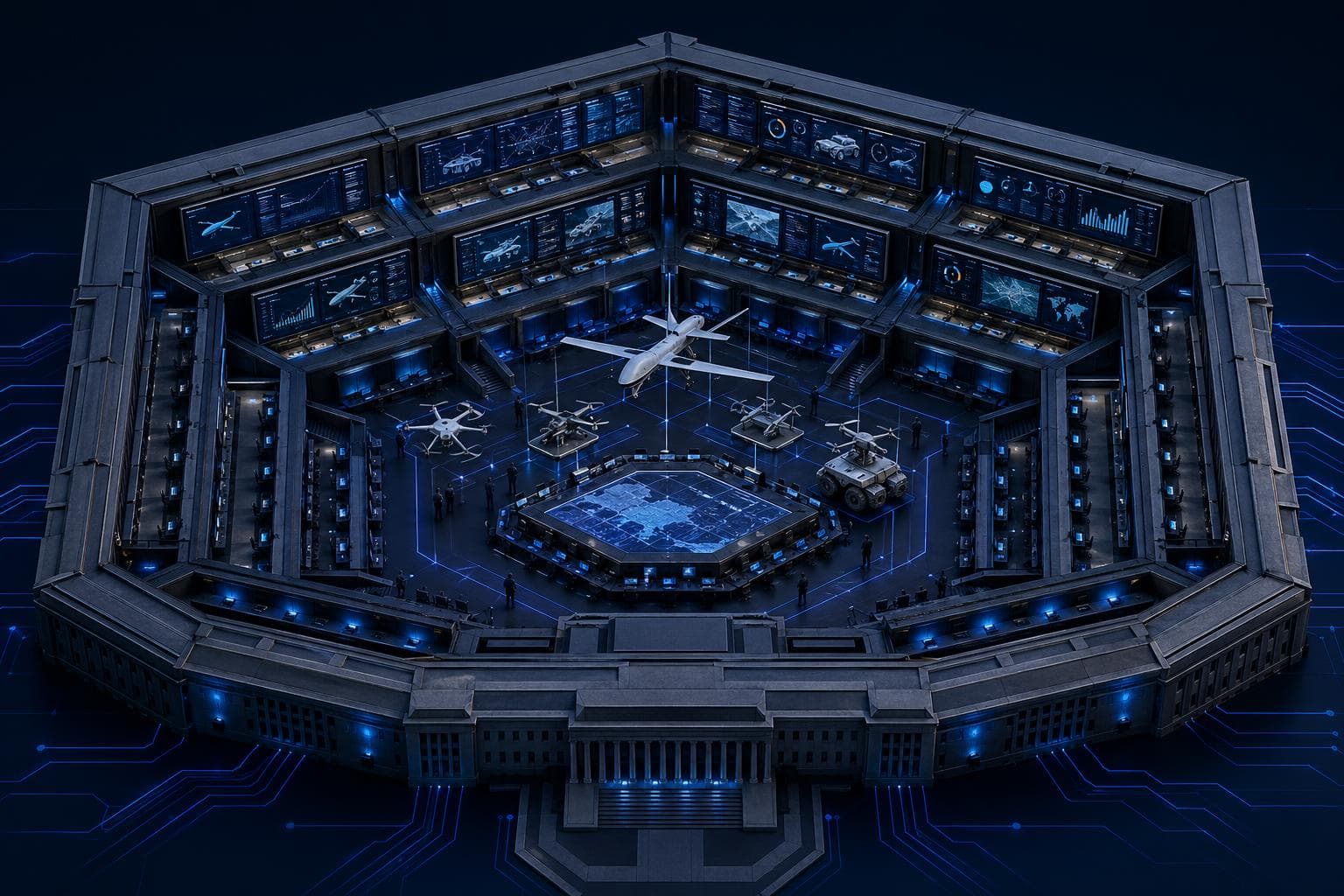

Emil Michael has met with more than 100 startups in six months. That's not a procurement strategy. That's a deal pipeline.
The Pentagon's undersecretary of research and engineering is explicitly framing his job as incubating a new generation of defense companies to rival Lockheed and Northrop — and he's deploying $200 billion in loans enabled by the recent GOP mega-bill to make it happen. The targets: biotechnology, AI, mineral mining, and autonomous systems. The logic: government capital crowds in private capital, which reduces R&D spend while accelerating capability development. "The taxpayer wins, the company wins, and then the warfighter wins," Michael told the Washington Post.
That framing is seductive. It's also where the risk lives.
The Transparency Gap Is the Real Story
The DAWG budget request — $54.6 billion for autonomous systems development in FY27, up from $225.9 million this year — is the largest single-year funding surge for any defense program or office in recent memory. That money flows through an office that works directly with SOCOM operators, tests systems in the field, and gives live feedback to manufacturers. It's a genuinely smart model for rapid capability development.
But the selection process for who gets access to that pipeline is drawing scrutiny. Critics cited in the Washington Post reporting note that the process for choosing which companies receive loans lacks transparency — and at least one early recipient had direct ties to officials involved in the selection. When the Pentagon operates like a venture firm, it inherits venture's conflicts of interest alongside its speed advantages.
Booz Allen's strategic investment in NODA AI — an autonomy orchestration company already selected as the coordinator for the Department of War's multi-domain collaborative autonomy efforts — illustrates how quickly the lines blur. NODA is a Series A company. It already has a prime contractor as an investor and a Pentagon program as a customer. That's not corruption; that's how the new defense tech ecosystem is designed to work. But it means the difference between "best technology wins" and "best-connected technology wins" depends entirely on process integrity that currently isn't visible from the outside.
The DAWG model is genuinely promising. Real operators testing real systems and feeding results back to manufacturers is exactly the procurement reform this industry has needed for decades. The question worth watching: whether Congress, already primed to scrutinize a 24,000-percent budget increase, forces the transparency that the current process lacks — or whether the speed advantage gets traded away in the oversight fight.
The Pentagon going VC is the right instinct. The execution is what determines whether it's a transformation or a feeding frenzy.