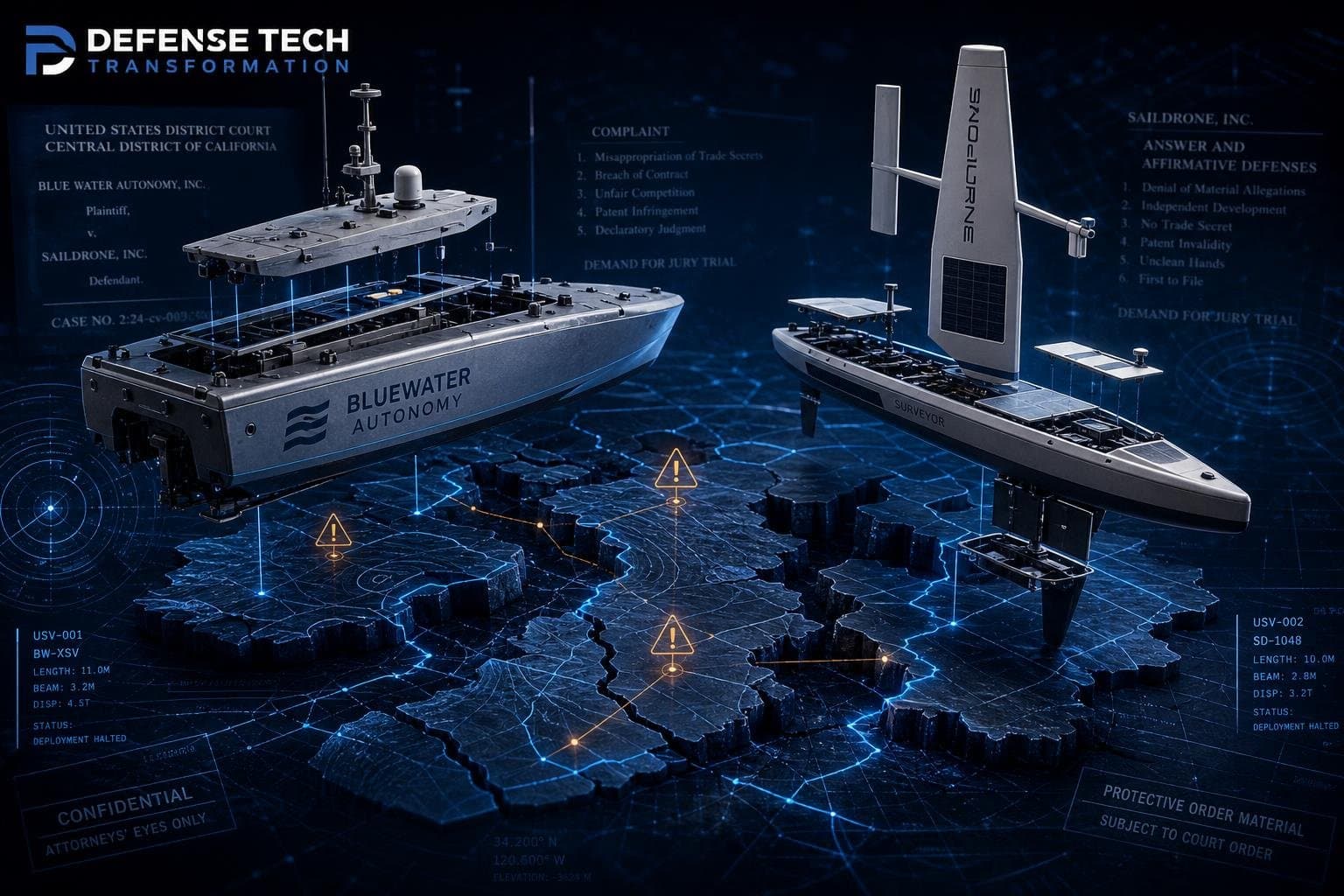

The Navy's push to field autonomous surface vessels just got complicated in federal court. Two venture-backed maritime drone companies — Blue Water Autonomy and Saildrone — filed lawsuits against the Navy after being excluded from the Medium Unmanned Surface Vessel program's at-sea testing phase. The legal filings are messy and the redactions are thick. But read as a signal rather than a grievance, they tell you something important about where autonomous fleet coordination actually stands — and why the competition for these contracts is getting sharper.
The MUSV Marketplace Is Real, and the Stakes Are High Enough to Sue Over
The Navy's MUSV program isn't a study or a pilot. It's a structured acquisition pathway for the next generation of autonomous surface vessels, and the companies that make it through at-sea testing are positioned for follow-on production contracts. That's why losing your slot in the competition is worth litigating.
Breaking Defense reports that both Blue Water Autonomy and Saildrone allege the Navy didn't follow its own RFP guidance when it eliminated them — and Blue Water's complaint goes further, asking courts to freeze the at-sea testing entirely until the Navy reassesses its proposal. That's an aggressive ask. It also signals that Blue Water's investors, which the complaint identifies as including Google Ventures, made substantial bets on this program and aren't walking away quietly.
The seven companies the Navy did select to advance to at-sea testing include Saronic Technologies, Sea Machines, and Leidos, among others — a mix of venture-backed startups and established defense primes competing on the same track. That's exactly the kind of program structure that makes defense tech investors pay attention.
Saronic Is Already Past the Lawsuit Phase — It's Building
While Blue Water and Saildrone are fighting for a seat at the table, Saronic is building a shipyard. The Austin-based startup — whose maritime drones were used by the U.S. military in combat for the first time this week — plans to construct a $3.2 billion facility called Port Alpha at the Port of Brownsville, Texas, projected to create 10,000 jobs.
I covered Saronic's trajectory back in July, when the shipyard announcement landed alongside news of their first combat deployment. What the MUSV lawsuit story adds to that picture: Saronic's selection for at-sea testing wasn't a given. Other credible, well-funded companies competed for those slots and lost. The fact that Saronic made the cut — and is now scaling manufacturing infrastructure — suggests the Navy sees something in their vessel design and autonomy stack worth advancing.
That's the pattern worth tracking here. The MUSV program isn't just picking boats; it's picking companies that can scale production in a surge scenario. The Navy has made clear it wants contractors who can support "rapid scaling and elasticity" in a conflict — language that runs through its autonomous platform requirements whether the vessel launches from a destroyer or a mobile sea base. A $3.2 billion shipyard is a credible answer to that question. For context on how defense tech capital is concentrating around exactly these kinds of scale bets, Helsing's $1.8 billion Series E at an $18 billion valuation — backed by Goldman Sachs, JPMorgan, and the Canada Pension Plan — reflects the same investor logic playing out on the European side: the companies building production infrastructure, not just prototypes, are capturing the serious money.
The Navy's Autonomous Ambitions Are Expanding Faster Than the Acquisition System Can Handle
The MUSV drama is happening alongside a separate, broader Navy push. A July 14 Request for Information asks industry to help design an entirely new carrier-based drone family — the Air Wing of the Future — capable of eight distinct mission types, from anti-submarine warfare to aerial refueling, with a minimum 1,000-nautical-mile strike range. The RFI also asks for VTOL variants that can operate from destroyers and mobile sea bases — not just carriers.
That's an enormous capability ask, and the August 13 response deadline suggests the Navy is moving quickly. Meanwhile, the Air Force's parallel autonomous aircraft push is already producing live-fire results: Anduril's YFQ-44A Collaborative Combat Aircraft recently fired a live AMRAAM — tracking a target over the Mojave Desert in a beyond-line-of-sight strike test — marking the first time a U.S. wingman drone has fired a live munition. The services are racing each other as much as they're racing adversaries.
The lawsuits are a symptom of that acceleration. When programs move fast and evaluation criteria get compressed, companies that invested heavily based on earlier program signals get caught in the gap. Blue Water Autonomy was selected for the predecessor MASC program before it was canceled; the MUSV marketplace replaced it with different criteria. That's a real institutional problem, and the courts may force the Navy to address it.
Watch for the at-sea testing results expected by end of fiscal year — and whether the court grants Blue Water's injunction request before then. If it does, the MUSV timeline slips, and the companies already building shipyards gain even more runway to pull ahead.


