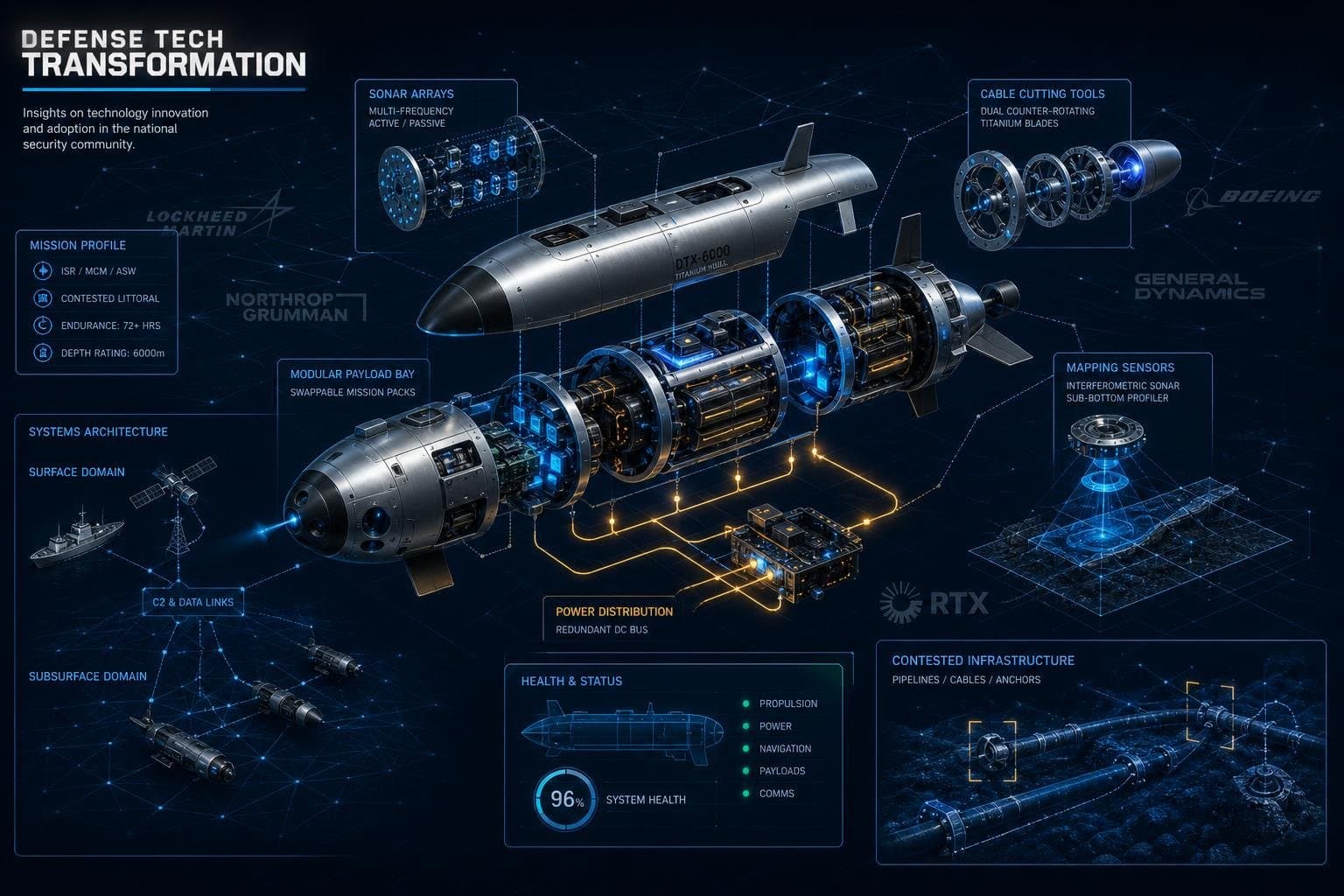

The assigned topic — venture-backed autonomous underwater vehicle startups winning Navy subsurface warfare contracts — is a compelling thesis. The source pool tells a more complicated story.
What actually happened in the past two weeks is instructive precisely because of where the money went.
Three Acquisitions, One Signal
On July 6, three legacy defense firms made nearly simultaneous moves into undersea warfare. Lockheed Martin announced a $3.5 billion acquisition of undersea specialist Ultra Maritime. French company Thales announced a 36 percent stake in Exail Technologies at an implied $4.5 billion enterprise valuation, with plans to acquire the firm entirely. And Italy's Fincantieri announced a nearly $700 million investment in four maritime drone and undersea engineering firms.
That's roughly $8.7 billion in undersea-focused commitments in a single day — not from venture capital, but from established primes moving to consolidate specialist capability before the window closes.
The CSIS analysts who flagged this pattern in Breaking Defense frame it as a strategic response to two converging threats: China's systematic ocean-floor mapping program — described by US Vice Adm. Richard Seif as an "underwater Great Wall" of sensors, uncrewed systems, and data fusion capabilities — and Russia's ongoing operations targeting undersea cables and pipelines using its GUGI submarine fleet. When three major defense primes reach the same conclusion on the same timeline, that's not coincidence. That's a threat assessment becoming a capital allocation.
The honest read: the undersea modernization story right now is a legacy-prime story, not a startup story. The venture-backed AUV thesis exists, but the contracts confirming it at scale aren't in this week's source pool.
Where Startups Are Actually Winning
That doesn't mean new entrants are absent from the Navy's autonomous systems push — they're just winning in adjacent domains first.
Blue Water Autonomy, a Boston-based company, was selected for a multiple-award IDIQ contract with a ceiling value of $40 million from the Naval Oceanographic Office to provide high-resolution ocean floor mapping using long-endurance uncrewed surface vessels. The contract supports deep open-ocean survey missions requiring vessels to operate hundreds to thousands of nautical miles offshore — work that traditionally required crewed ships running tens of thousands of dollars per day in operating costs.
CEO Rylan Hamilton's framing is worth noting: "This selection puts our autonomy to work across the Indian and Pacific oceans, well beyond the range of a crewed survey ship." That's not just a cost argument. Persistent presence in contested maritime zones — the Indian and Pacific oceans specifically — is an intelligence and operational readiness argument. The Navy isn't just trying to save money on surveys; it's trying to map the same ocean floor that China has been systematically charting with at least 42 research vessels over five years.
The Blue Water Autonomy contract is a multiple-award vehicle, meaning the company competes for individual task orders rather than holding a guaranteed revenue stream. That structure is typical for how the Pentagon de-risks new entrants — you get a seat at the table, not a guaranteed meal. But getting the seat is the hard part, and it's the proof point that matters for the investment thesis.
The Fabrication-at-Sea Parallel
The more disruptive startup story in naval autonomy this week came from above the waterline. Firestorm Labs manufactured more than 1,000 parts and 12 of its 3D-printable Squall first-person-view drones aboard the Wasp-class amphibious assault ship USS Essex as it transited toward RIMPAC 2026 — using a containerized microfactory called the xCell, in seas with waves as high as 12 feet.
The operational logic here applies directly to undersea systems: if you can manufacture and repair autonomous platforms at sea without shore resupply, you eliminate one of the core vulnerabilities of deploying uncrewed systems in contested environments. The drones built aboard Essex were later flown as adversary aircraft in a counter-drone exercise. That's a full loop — fabrication, deployment, and operational testing — completed without touching a port.
Chief of Naval Operations Adm. Daryl Caudle's "containerized capability campaign plan," announced in March, is the doctrinal framework that makes this possible. The same logic that applies to aerial drones applies to undersea vehicles: if you can containerize the manufacturing capability, you can push it forward. That's the capability unlock that matters, not just the platform itself.
What to Watch
The undersea startup thesis isn't wrong — it's early. The $76.6 billion in Navy contracts awarded to General Dynamics Electric Boat and HII's Newport News Shipbuilding for Virginia- and Columbia-class submarines confirms that the crewed undersea fleet remains the Pentagon's primary investment. Autonomous undersea vehicles are the complement, not the replacement — and the complement contracts are still being structured.
The pattern to track: NAVOCEANO's IDIQ vehicle for Blue Water Autonomy is the template. Watch for similar multiple-award structures covering mine countermeasures, undersea ISR, and anti-submarine warfare support — those are the task orders where venture-backed AUV companies will either prove the thesis or expose its limits. The legacy primes just spent $8.7 billion signaling where they think the domain is heading. The startups need to show they can execute before the consolidation window closes around them.


