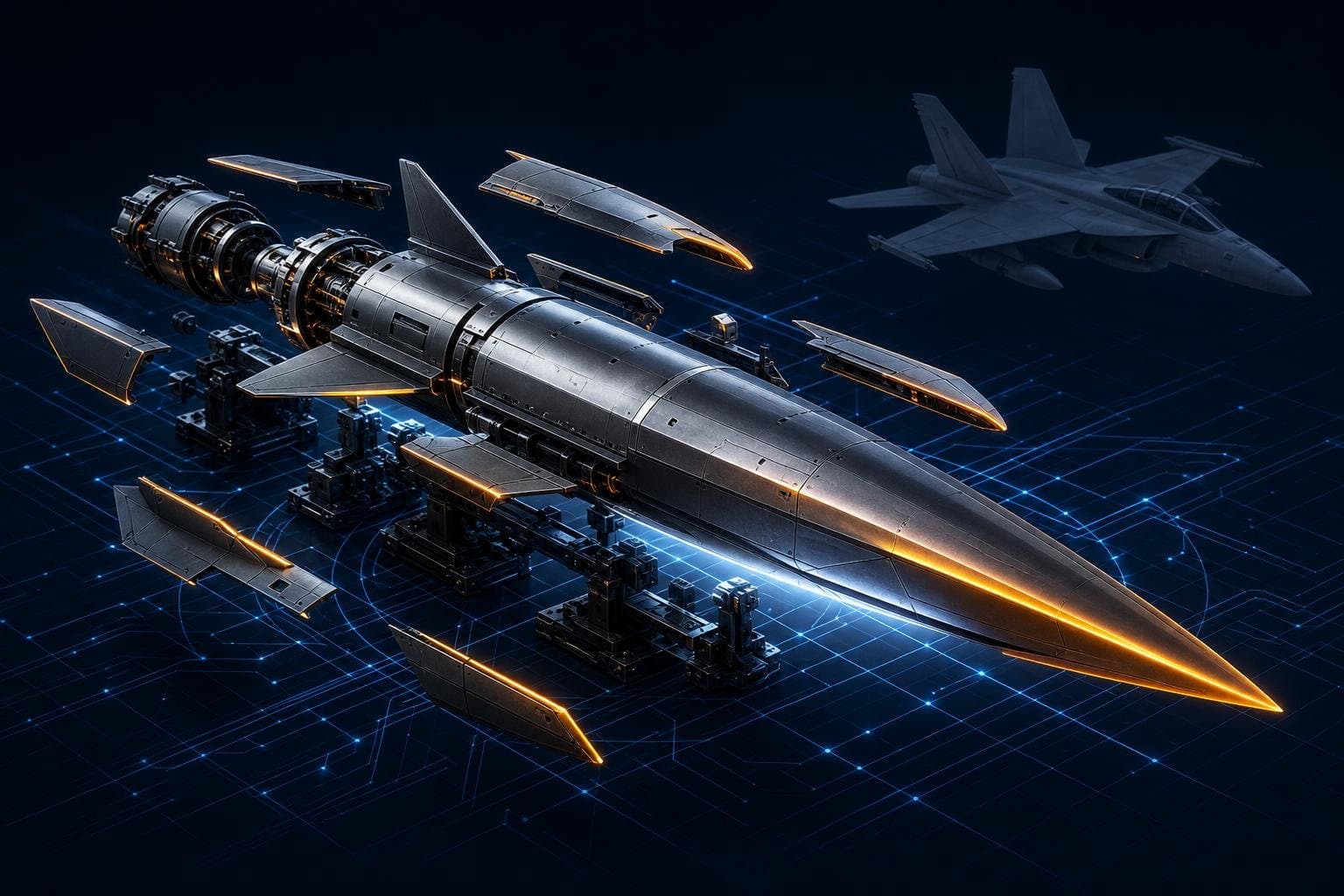

The U.S. Navy wants to fire a Mach 5 missile from an F/A-18 Super Hornet by 2027. The company building it was founded by former SpaceX engineers. The design philosophy is explicitly about cost. None of this is accidental.
Castelion's Blackbeard, a low-cost hypersonic missile designed for high-volume production, sits at the center of the Navy's MACE program — a roughly $379 million commitment that also has the Army eyeing a HIMARS-launched variant. The pitch isn't that Blackbeard is more capable than what Lockheed or Raytheon would build. The pitch is that it costs a fraction of what they'd charge, and that you can make a lot of them.
That distinction matters more than it used to.
The Stockpile Problem Made the Cost Argument Unavoidable
Venture investment in hypersonics reached $1.2 billion in 2025, up from $220 million the year before, with another $446 million raised in early 2026 — and the driver isn't just geopolitical anxiety. It's a manufacturing reality that the US-Iran conflict this spring made impossible to ignore: stockpiles burn through faster than production lines can replenish them. The hypersonics race, as PitchBook's analyst note framed it, has become a manufacturing race.
That reframe changes what you look for in a defense startup. The old model rewarded companies that could build the most sophisticated single system. The new model rewards companies that can build the 50th unit as efficiently as the first. Castelion's SpaceX lineage is relevant here not because of rocket science but because of production philosophy — SpaceX's core competitive advantage was always about driving down the cost per launch through manufacturing discipline, not just engineering novelty.
The Navy appears to have internalized this. A $379 million commitment to a startup's hypersonic program, structured around a 2027 live-fire demonstration from a carrier-based fighter, is a demand signal that says: we want this capability at scale, not as a trophy system.
DIU Is Running the Same Playbook One Speed Band Higher
Castelion isn't the only data point. Hermeus received a $159 million contract modification from the Defense Innovation Unit in late May to demonstrate high-Mach flight and high-speed payload carry and release — pushing the total ceiling of its HyCAT program contract to $219 million. The HyCAT initiative, which DIU launched in November 2023, is explicitly a testbed program: qualify new weapon system technologies in flight, at speed, repeatedly.
What's new in the latest extension is the service branch participation. Both the Air Force and the Navy are now partnered on the contract, which Hermeus Chairman AJ Piplica described as providing "a clear demand signal and then a clear path for transition." DIU Military Deputy Maj. Gen. Joe Kunkel was more direct: "If we can mass-produce this, then it becomes a game-changing warfighting capability, where we use it as a weapon instead of a test platform."
Hermeus is targeting Mach 3+ flight testing in 2027 and 2028, with a propulsion system that integrates a precooler, turbine, and ramburner. The company is also analyzing options for mass-producing the materials and components for a weaponized version — explicitly targeting a cost in the "tens of millions of dollars" range rather than the north-of-$100-million cost of a fighter-class system.
Two programs, two startups, same underlying logic: high-Mach capability is only strategically useful if you can produce enough of it to matter.
The Valley of Death Is Still Real — But the Demand Signal Has Changed
The money is flowing. The contracts are real. The question Ross Fubini, the venture investor who wrote Anduril's first check, raised on TechCrunch's Equity podcast is whether most of these companies can survive the gap between prototype contract and actual production deal. His firm, XYZ Venture Capital — built on the Palantir alumni network and approaching $2 billion AUM — has seen this movie before. Most startups that win a prototype contract don't make it to the production phase.
What's different in the hypersonics space right now is that the demand signal is unusually explicit. The Navy isn't just funding research; it's scheduling a live-fire demonstration from a specific airframe in a specific year. DIU isn't just running a testbed program; it's brought two services onto the contract and had its military deputy publicly endorse weaponization. That's not the ambiguous "we're interested" language that leaves startups stranded in the valley. That's a transition path.
Whether Castelion hits its 2027 timeline and whether Hermeus clears its flight test milestones will tell us a lot about whether the new hypersonics production model actually works — or whether the demand signal was clearer than the execution path. Watch for the Blackbeard F/A-18 integration test and Hermeus' first Mach 3+ flight as the two near-term proof points that will either validate this thesis or complicate it considerably.


