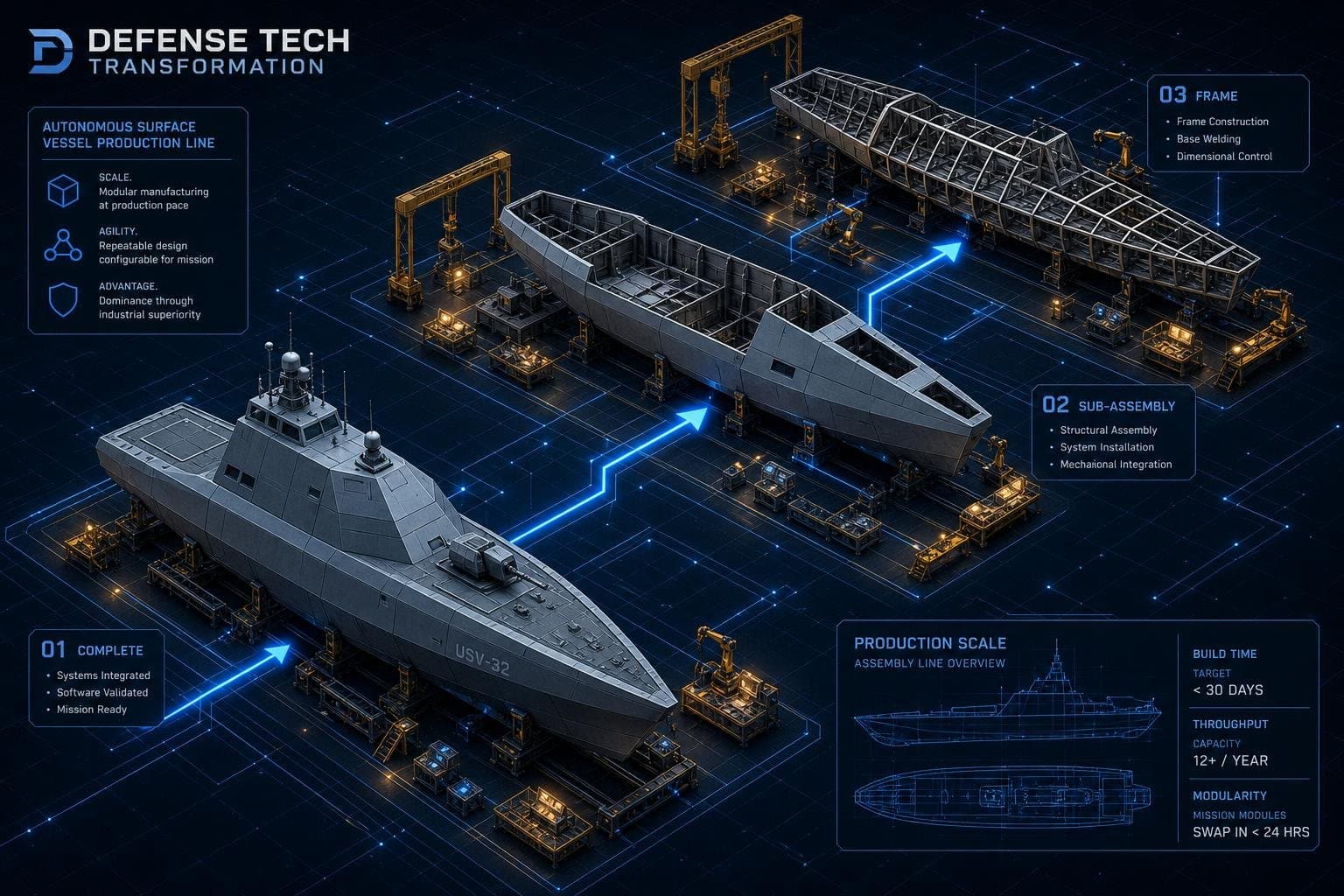

Ask any investor who's been watching defense tech since 2023 and they'll tell you the same thing: unmanned surface vessels were supposed to be the easy win. Cheap hulls, commercial sensors, software-defined autonomy — no exotic propulsion, no classified payloads, nothing that takes a decade to mature. The theory was that USVs would be the first category where startups actually out-executed the primes at scale. This month's news cycle tests that theory against the thing that actually matters for a Taiwan contingency: can any of this move from pilot money to a fielded fleet before the window closes?
The signals are genuinely mixed, and they cluster around three separate Navy programs that tell three different stories about where the money actually goes once a prototype works.
DIU Is Still Writing Prize Checks, Not Production Contracts
The Defense Innovation Unit just opened the second phase of its Suitable Warfighting Adaptive Payloads competition for unmanned surface vessels — SWAP-USV — and the requirements tell you exactly what the Navy is worried about. Sprint 2 wants boats carrying "mature hard-kill Counter-Air effectors and clutter-resilient sensor suites" that can hold at least 200 nautical miles of range at a sustained 10 knots, built to intercept the smallest classes of hostile drones and, ideally, larger ones too, according to the DIU solicitation reported by Breaking Defense. The language in the solicitation is unusually blunt about why this matters: "current force packages lack sufficient persistent, distributed capability to search for, track, and defeat these threats at an economically sustainable cost."
That's the whole thesis of the low-cost-mass argument in one sentence, and it's coming from the Pentagon's own innovation shop, not a startup pitch deck.
But look at the money. Sprint 2 offers up to $40 million in prize funding, the same ceiling as Sprint 1, with Sprint 3 capping out at $20 million next spring, per Breaking Defense. That's a twelve-month, three-phase, roughly $100 million competition — real money for a startup's balance sheet, basically a rounding error for the Navy's shipbuilding account. In-water testing for Sprint 2 doesn't even start until early 2027, with Sprint 3 testing wrapping that summer. If China moves on Taiwan on any timeline shorter than three years, SWAP-USV isn't the program that answers it. It's the program that tells you which vendors might be ready for the program that answers it.
The MUSV Marketplace Is Where the Real Contracts Are — And a Startup Actually Won
This is the part that should make investors sit up. While DIU runs its prize sprints, the Navy's Medium Uncrewed Surface Vessel Marketplace has already moved to production awards — and the winners aren't just the usual shipbuilders. HII, America's dominant military shipbuilder, took a contract for 10 Romulus USVs, but Saronic Technologies, a comparatively young autonomous-vessel developer, won its own 10-vessel order for its 180-foot Marauder, with Galliano Marine Services also picked under the same structure, according to Shephard Media.
What matters here is the framing, not just the vendor list: the Navy structured this marketplace to buy from whoever could build and test before a contract was even signed, rewarding readiness over incumbency. Saronic's Marauder reportedly went from initial design to sea trials in under a year, per the same Shephard Media reporting — a timeline that would be unremarkable in commercial shipbuilding and borderline unprecedented in Navy procurement. That's the kind of velocity that makes the "nimble startup beats legacy prime" argument something other than a talking point. It's also a name I'd flag for continuity: Saronic's Corsair vessel was already reported involved in strikes on an Iranian submarine and ship-maintenance facility during CENTCOM operations, per imagery credited in the DIU coverage from Breaking Defense — meaning this isn't a company waiting for its first combat data point. It already has one.
The MUSV Marketplace is the clearest evidence yet that the Navy can run a startup-friendly production process when it wants to. The open question is whether 10-vessel orders constitute "scale" in any sense that matters for a contested Pacific fight, or whether they're still pilot quantities dressed up as production contracts.
The Aevex Story Is the Cautionary Tale Nobody Wanted
Here's where the picture gets uncomfortable. Aevex Corp. this week confirmed its existing Navy contract for Global Autonomous Reconnaissance Craft — small drone speedboats already fielded with the fleet — has been modified upward to roughly $350 million, with the term extended through June 2027, according to Bloomberg. Read that sentence again: the contract got bigger, but the announcement itself was a response to Bloomberg's own reporting that the Navy is planning no new orders for the boats. Aevex isn't celebrating a new win here. It's defending the size of a deal it already has, after reporters surfaced that the pipeline behind it might be drying up.
This is precisely the scaling risk I flagged back in July when writing about the Navy's unmanned surface vessel lawsuit — that competitive tension in USV procurement could produce winners and losers faster than the industrial base could absorb the churn. Aevex isn't losing, exactly. But "we're enhancing what we already built because nobody's buying more" is not the sentence a company wants attached to its name when the Pentagon is simultaneously telling bidders in the DIU solicitation that it needs persistent, distributed, economically sustainable mass at the water's edge, per Breaking Defense. If the Navy can't commit to follow-on orders for a platform that's already fielded and already proven, that's a harder signal about appetite than any prize competition language.
Interoperability Is the Capability Nobody's Pricing In
There's a fourth data point worth weighing, because it changes what "ready" even means. The U.S., Australia, and the UK just ran a multinational maritime demonstration — Maritime Big Play Pacific — in San Diego from early October through this week, testing how crewed ships, USVs and autonomous systems from three allied navies can actually operate together, not just individually, per The Defense Watch. More than 40 technologies from the three countries participated. The Royal Navy led the anti-submarine warfare component, bringing uncrewed surface vessels, underwater gliders and subsea vehicles into the mix.
The point of the exercise wasn't to show off any single boat. It was to find the places where a British USV can't talk to an American command node, or where an Australian glider's data doesn't make it into a shared operational picture fast enough to matter. That's the unglamorous, unfunded-by-headline-contract work that determines whether a fleet of startup-built drone boats is actually useful in a Taiwan scenario, where the fight would be inherently allied and inherently distributed. The same persistent-awareness challenge shows up in how industry talks about the mission: building a sensing network rather than fielding individual unmanned boats is the framing Lyntris executives used in describing INDOPACOM gray-zone threats, per Breaking Defense. A Saronic Marauder that works beautifully in isolation but can't feed a targeting picture to a Royal Navy frigate is a demo, not a deterrent.
What Scaling Actually Requires From Here
Put these four threads together and the picture for investors is less a green light than a checklist. DIU's SWAP-USV sprints are proving which vendors can hit a spec — watch the Sprint 2 submission deadline of November 30 and early-2027 in-water testing as the next real checkpoints, per Breaking Defense. The MUSV Marketplace shows the Navy is capable of converting that proof into actual production orders, and Saronic's win there, as reported by Shephard Media, is the single most investable data point in this entire cycle. But Aevex's experience, surfaced through Bloomberg's reporting, is the warning: fielded and proven doesn't guarantee follow-on orders, and "contract modified" headlines can mask a pipeline that's quietly closing. And the AUKUS demonstration covered by The Defense Watch is a reminder that the capability the Pentagon actually needs isn't a faster boat — it's a boat that plugs into a coalition picture without a software integration project attached.
None of this resolves the Taiwan-contingency question on its own terms. What it does is sharpen the diligence question for anyone writing checks into this category: don't ask whether a company can build a USV. Ask whether the Navy has shown it will buy the fifth one, the fiftieth one, and whether that boat can hand off a track to an ally's destroyer without a phone call to engineering.


