


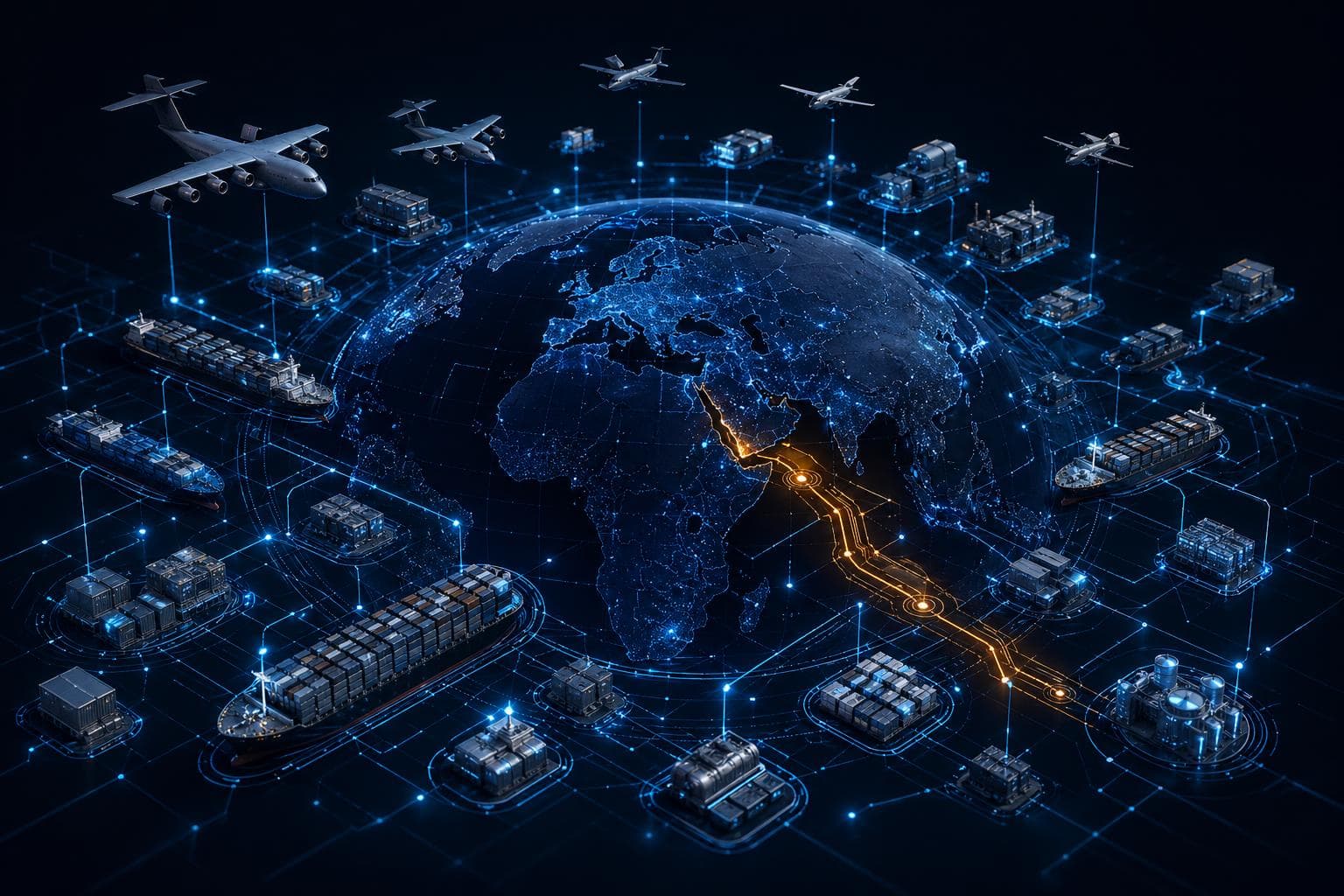

The Strait of Hormuz doesn't just choke oil. When Iran moved to disrupt maritime traffic there following the launch of Operation Epic Fury in late February, it also put pressure on the global logistics network that the U.S. military depends on to move everything — troops, fuel, ammunition, spare parts, medical evacuees. The disruption was real. What's interesting is what happened next.
According to Air Force Gen. Randall Reed, commander of U.S. Transportation Command, the crisis didn't break Transcom's operations. It accelerated them. DefenseScoop reported that Reed told reporters at the Sea-Air-Space symposium that real-time data tools and AI-enabled visualization assets are now actively helping the command maintain visibility across contributing combatant commands, speed up option development, and coordinate decisions under pressure. His framing was deliberate: "We respond, we don't react."
That distinction — respond versus react — is the whole thesis of AI-powered logistics. And it's finally being tested in a real operational environment.
Readiness Isn't a Snapshot Anymore
The traditional model of military readiness assessment is essentially a periodic audit: how many aircraft are mission-capable, how many ships are at sea, how many units are at full strength. It's backward-looking by design. You measure what you have, report it up the chain, and plan accordingly.
What Transcom is describing is something structurally different. Reed specifically cited the use of "smart systems" to maintain a common operating picture across multiple combatant commands simultaneously — not after the fact, but in real time, as the Middle East situation evolved. The goal isn't to know what readiness looked like last week. It's to know what it looks like right now, and what it will look like if you make decision A versus decision B.
That's a capability shift, not just a speed improvement. When you can model logistics options dynamically — rerouting cargo around a blockaded strait, rebalancing airlift capacity as drone strikes take out regional infrastructure — readiness stops being a static number and becomes a live variable. The question changes from "are we ready?" to "ready for what, and by when?"
I'd argue this is the most underappreciated application of AI in the current defense tech cycle. Everyone focuses on autonomous weapons and AI-enabled targeting. The logistics layer is less photogenic but arguably more foundational. An autonomous drone that can't be resupplied is just expensive debris.
The Platform Question Is Getting Answered
The broader context here matters. Reuters reported that Google has signed a classified AI deal with the Pentagon, joining a growing list of technology firms providing AI models for defense work — this after Anthropic declined to allow the DoD to use its AI for certain applications, including autonomous weapons, according to TechCrunch.
The platform consolidation happening at the top of the stack — Palantir as a core military AI system per a Pentagon memo Reuters covered in March, now Google entering classified work — creates the infrastructure layer that makes tools like Transcom's logistics visualization possible at scale. You can't run real-time multi-command logistics coordination on ad hoc systems. You need persistent, classified, integrated data infrastructure. That's what's being assembled right now, contract by contract.
The defense tech VC community has been tracking this. PitchBook's Q2 2026 analyst note on defense tech funding identifies dual-use software and hardware as one of the two dominant areas of fund exposure — alongside aerospace systems — in the capital stack that's been building since 2019. Logistics AI sits squarely in that dual-use category: the same tools that help Transcom reroute cargo around a blockade can optimize commercial supply chains. That's not a bug; it's why the capital keeps flowing.
What the Stress Test Reveals
Operation Epic Fury is, among other things, an unplanned live exercise for every logistics AI system the Pentagon has been quietly deploying. Reed's comments suggest the early results are directionally positive — the command maintained visibility, kept options open, avoided overextension. But the real data is still being collected.
The next 60 to 90 days will matter. If Transcom can demonstrate that AI-enabled logistics coordination held up under sustained operational pressure — not just a spike, but a prolonged campaign with active maritime disruption — that becomes the proof-of-concept that accelerates procurement across every combatant command. Watch for Reed's next public appearance and whether the language shifts from "we're integrating and refining" to something more declarative.
The logistics war is quiet. It always is. But right now it's also the most important test of whether the Pentagon's AI investments are actually changing what the military can do — or just changing how it files paperwork.