
The assigned topic this week — venture-backed hypersonic missile defense startups reshaping Air Force threat detection and interception — is a real and important subject. I've covered adjacent territory before: the Pentagon's hypersonic defense problem being solved from the bottom up, and the DIU's $250K price ceiling on cheap long-range strike. But this week's source pool doesn't deliver the specific companies, contracts, or Air Force capability announcements that would let me write that piece with any rigor. What it does deliver is something arguably more important: a clear picture of why the hypersonic defense problem remains unsolved, and what the current wave of defense investment is actually prioritizing instead.
The honest version of this week's story is about industrial capacity — the unglamorous prerequisite that makes any advanced interceptor program possible. And one company just raised a round that makes the argument better than any think-tank paper could.
The Glamour Problem in Defense Tech Coverage
Hypersonic interception is the sexiest problem in defense tech right now. The threat is real: maneuvering hypersonic glide vehicles fly at speeds that compress decision timelines to seconds, and existing intercept architectures weren't designed for them. The Air Force's detection and kill-chain challenges are well-documented. Startups working on novel sensor fusion, directed energy intercept, and AI-driven fire control are genuinely interesting companies doing genuinely hard work.
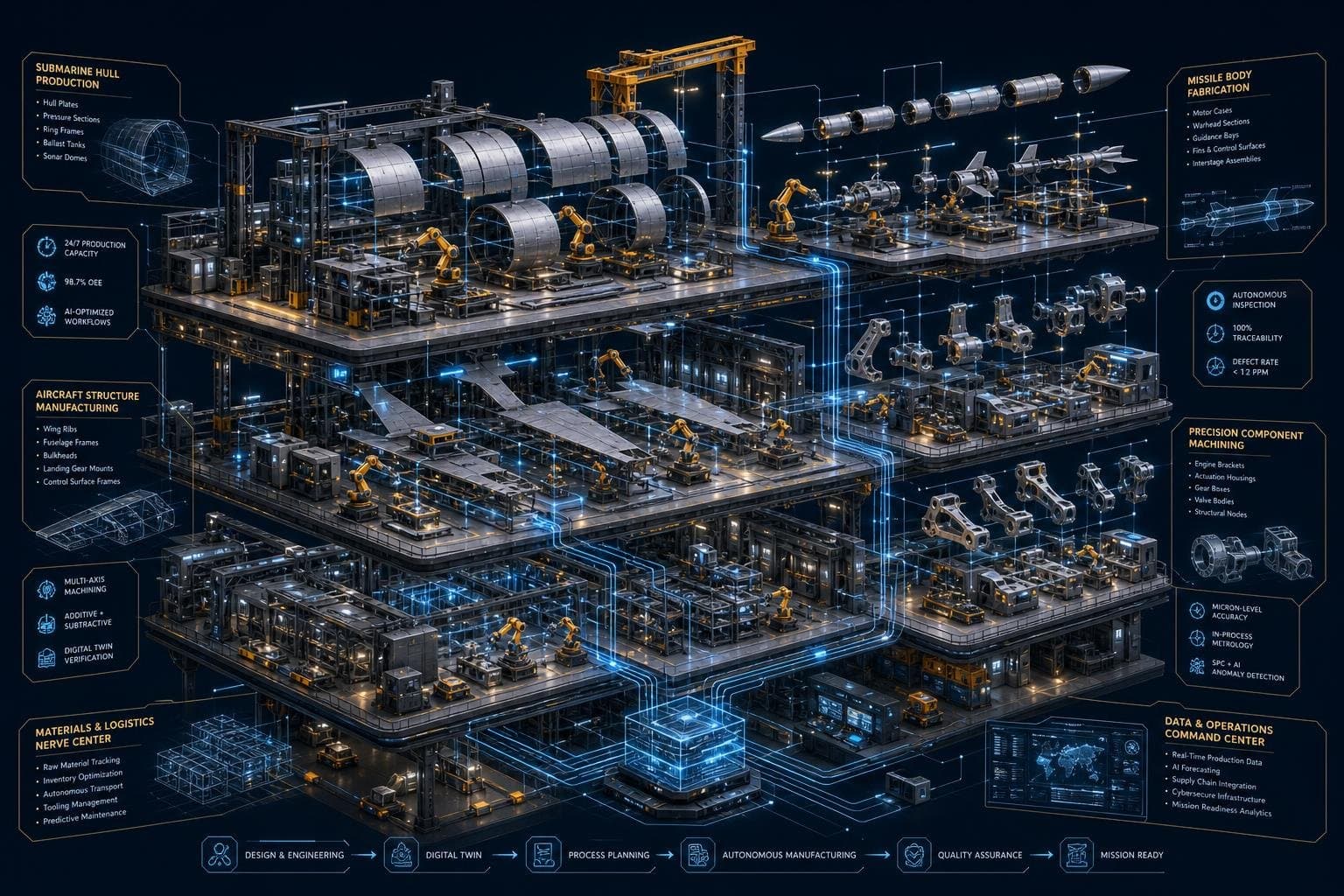
But here's the investor-lens reality check: the most important defense tech story of the past week has nothing to do with intercept algorithms or sensor apertures. It's about a company that makes parts — precision-machined components for submarines, aircraft, and missiles — and just raised $1.37 billion at a $7.87 billion valuation.
Hadrian's Series D, anchored by JPMorgan Chase's Strategic Investment Group with participation from Andreessen Horowitz, Founders Fund, Valor Equity Partners, and Baillie Gifford, is the kind of round that reframes what "defense tech" actually means in 2026. The company doesn't build weapons. It builds the factories that build the weapons — automated, AI-augmented, design-agnostic manufacturing facilities that can surge production of whatever the Pentagon needs next.
That distinction matters enormously for anyone trying to understand where the real investment thesis lives.
Why Industrial Capacity Is the Actual Bottleneck
The hypersonic defense problem, like most advanced weapons problems, eventually runs into the same wall: you can design a brilliant interceptor, but if you can't manufacture it at scale, the design is a PowerPoint. The Pentagon has been confronting this reality with increasing urgency as the war with Iran has drawn down munitions stockpiles faster than legacy suppliers can replenish them.
The Army's move this week to award Other Transaction Authority prototype agreements to four companies — Firehawk, iRocket, Nammo Perry, and Albers — to boost Hydra-70 rocket warhead production is a small but telling data point. The Hydra-70 is a 70mm unguided rocket, not a hypersonic interceptor. But the procurement logic is identical: the existing single-supplier model (General Dynamics Ordnance and Tactical Systems, in this case) can't surge fast enough, so the Pentagon is deliberately seeding competitive industrial capacity through OTA agreements before it needs to pull the trigger on full production. The goal, per the Army's own release, is "competitive pricing and surging industrial capacity" — not a new capability, but the ability to produce an existing one at volume.
This is the pattern that Hadrian is betting its entire business model on, at a much higher level of abstraction. Rather than competing for a single program's production contract, Hadrian is building what its CEO Chris Power describes as "highly automated, design-agnostic factories" — facilities that can pivot between submarine components, missile parts, and aircraft structures depending on what the demand signal requires. Per Axios, the company already works with Lockheed Martin, RTX, and Anduril, and in March the Navy announced Hadrian would mass-produce components for Virginia-class attack submarines and Columbia-class ballistic missile submarines at its Alabama facility.
That's not a niche play. That's a bet on becoming critical infrastructure for the entire defense industrial base.
The Private Equity Logic Now Running the Pentagon
The Hadrian round didn't happen in a vacuum. It's happening inside a procurement environment that is being deliberately restructured to favor exactly this kind of company.
Bloomberg's reporting on Deputy Secretary of Defense Stephen Feinberg — the Cerberus Capital co-founder now running the Pentagon's acquisition overhaul — describes a transformation that looks less like government reform and more like a portfolio restructuring. Feinberg's Economic Defense Unit, which reports directly to him, was explicitly modeled on private equity operating principles: "move capital rapidly," avoid bureaucracy, reward contractors who adapt and eliminate those who don't. His warning to legacy contractors was unambiguous: "Those who don't and resist it will be gone."
The Office of Strategic Capital, which Feinberg also controls, carries a $200 billion lending budget. That's not a rounding error. That's a structural mechanism for directing capital toward companies the Pentagon wants to exist — companies like Hadrian, which combine the manufacturing credibility of a traditional prime with the automation and software sophistication of a tech startup.
For investors watching this space, the Feinberg framework is the most important policy development of the year. It means the Pentagon is no longer just a customer — it's increasingly acting as a co-investor, using lending authority and OTA vehicles to shape the industrial base it wants to have in five years. The companies that understand this dynamic and position themselves accordingly are the ones that will win the largest contracts when advanced interceptor programs finally reach production scale.
This is the context that makes Hadrian's valuation legible. At $7.87 billion, the market is pricing in not just current Navy submarine contracts, but the probability that Hadrian becomes the default precision manufacturing partner for the next generation of Pentagon programs — including, eventually, hypersonic interceptors that don't yet exist at production scale.
What RIMPAC Revealed About the Real Integration Challenge
While the funding story dominated this week's headlines, Breaking Defense's reporting on RIMPAC 2026 offers a useful operational counterpoint. The exercise — 30 nations, 30 surface ships, five submarines, nearly 200 aircraft, 30,000 personnel — served as what Rear Adm. Suzanne Bailey called "our primary laboratory for operationalizing these platforms and concepts."
The experiments that matter for the hypersonic defense discussion aren't the flashy ones. Yes, RIMPAC included an armed unmanned surface vessel launching missiles against a surface target, and the largest advanced manufacturing demonstration the Department of War has ever conducted. But the harder problem Bailey kept returning to was integration: how do you combine manned and unmanned platforms into a single, cohesive defensive force? How do you build kill chains that work across coalition partners with different systems, different data standards, and different rules of engagement?
These are the questions that make hypersonic interception genuinely hard — not the physics of the intercept itself, but the command-and-control architecture that has to work in the seconds between detection and engagement. RIMPAC's approximately 40 Fleet Experimentation initiatives were explicitly designed to stress-test these integration problems in a real operational environment, with real warfighter feedback. That feedback loop — from exercise to procurement requirement to contract — is where the next generation of defense tech startups will find their opening.
The companies that win hypersonic defense contracts won't necessarily be the ones with the best intercept algorithm. They'll be the ones that can integrate their capability into existing fleet architectures, survive the RIMPAC-style stress test, and then be manufactured at scale by facilities like Hadrian's.
The Through-Line That Connects Everything
There's a coherent investment thesis running through all of this, and it's worth stating plainly: the Pentagon is building a new industrial ecosystem from the ground up, and it's doing so with private equity discipline applied to public procurement.
The Hydra-70 OTA awards show the Army seeding competitive capacity in commodity munitions. Hadrian's Series D shows venture capital betting on automated manufacturing as the critical path for all advanced weapons programs. RIMPAC shows the operational requirements that will drive the next wave of procurement. And Feinberg's EDU shows the institutional mechanism that will direct capital toward companies that can execute.
What's missing from this week's source pool — and what I won't fabricate to fill the gap — is the specific startup story about hypersonic interceptors. That story exists; companies are working on it. But the sourced reality this week points somewhere more fundamental: before you can intercept a hypersonic glide vehicle, you need a defense industrial base capable of producing interceptors at the volume and cost that makes deployment viable. That's the problem Hadrian is solving. That's what the OTA reform wave is enabling. That's what RIMPAC is stress-testing.
The glamorous capability story and the unglamorous industrial story are the same story, told from different ends of the supply chain.
What to Watch in the Next 90 Days
Three specific signals worth tracking as this thesis develops:
Hadrian's submarine production ramp. The Navy's Virginia-class and Columbia-class partnership is the company's largest disclosed contract. Watch for production milestone announcements from the Alabama facility — they'll be the first real test of whether the "design-agnostic factory" model can deliver at the volume the Navy needs.
EDU contract awards. Feinberg's Economic Defense Unit has the mandate and the capital to reshape procurement. The first major EDU-originated contract awards will reveal which companies the Pentagon is actually betting on — and whether the private equity operating model translates to government acquisition timelines.
OTA expansion into advanced interceptors. The Hydra-70 OTA awards are a template. Watch for similar competitive prototype agreements in more advanced munitions categories — particularly in the terminal defense and hypersonic intercept space. When those awards appear, they'll name the startups worth following.
The industrial base story is the prerequisite. The interceptor story comes after.


