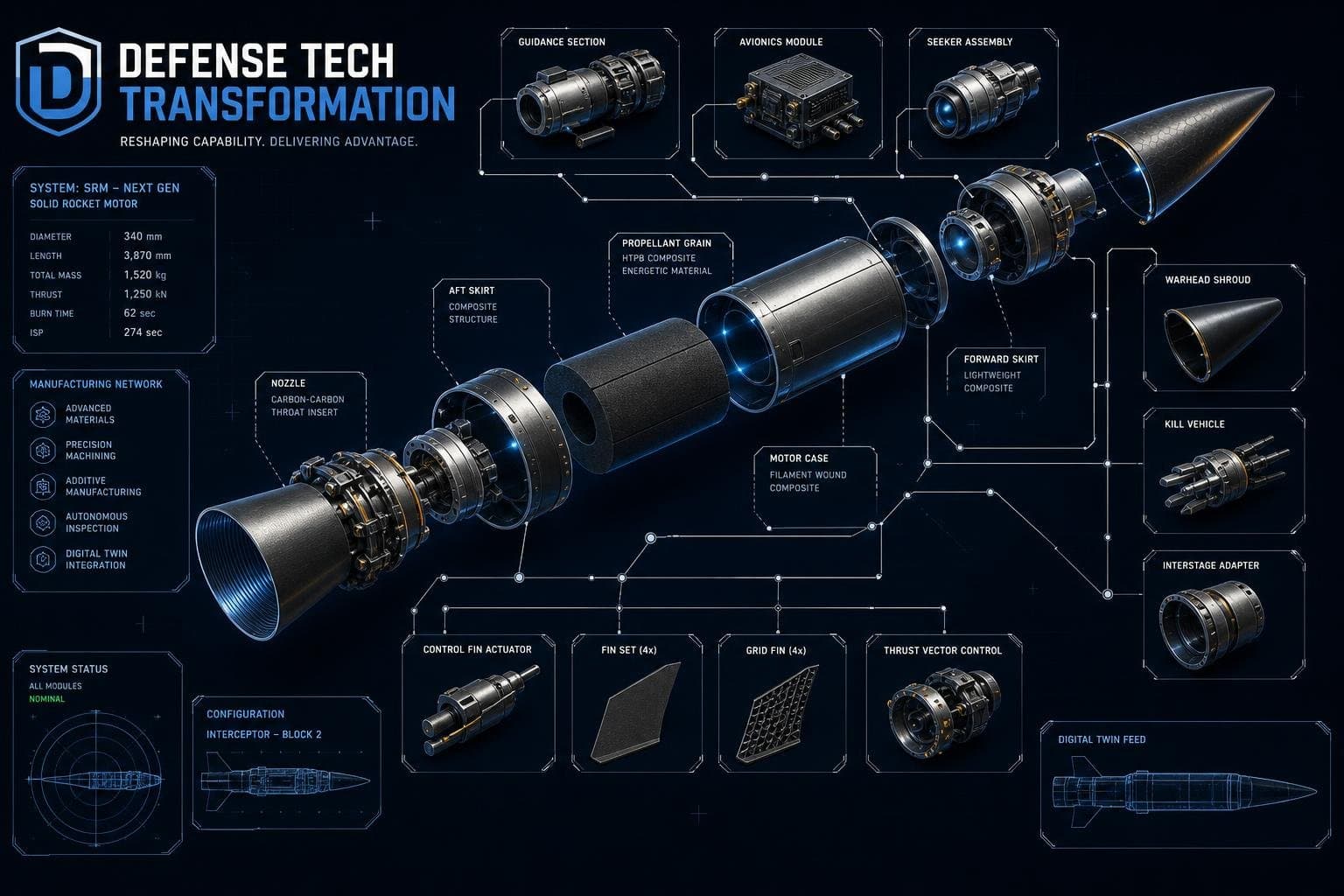

The math has been broken for years. A Patriot interceptor costs roughly $3.9 million and takes years to manufacture through a handful of licensed producers. The threats it's designed to defeat — ballistic missiles, hypersonic glide vehicles, cruise missiles flying at Mach 5-plus — are getting cheaper and faster on the adversary side while the U.S. inventory burns down. The war with Iran left the U.S. with fewer than 1,000 Patriot interceptors and roughly 250 THAAD rounds, according to Defense News. That's not a procurement gap. That's a strategic vulnerability.
What's changed in the past few weeks is that the Pentagon has started placing bets — real money, real contracts — on a fundamentally different approach. Rather than trying to out-produce legacy systems through legacy suppliers, the DoD is funding a new generation of manufacturers to redesign the economics of interceptors and hypersonic weapons from scratch. The signals are coming from multiple directions simultaneously: the Missile Defense Agency, the Air Force Research Laboratory, and the Defense Innovation Unit. That convergence is the story.
The Interceptor Shortage Forced a Rethink Nobody Wanted to Have
For decades, the solid rocket motor industrial base operated as a comfortable duopoly. Two companies — Northrop Grumman and L3Harris' Aerojet Rocketdyne — have long held the domestic market for the solid rocket motors inside interceptor weapons, while Lockheed Martin and Raytheon controlled Patriot production itself. Japan is the only country ever licensed to build the missiles abroad. The result was a supply chain with essentially no competitive pressure, no redundancy, and no ability to surge.
That structure held up fine when the threat environment was theoretical. It collapsed the moment the U.S. started burning through interceptors at operational tempo.
The Missile Defense Agency's response was a program called the Low-Cost Interceptor effort, which set a target that would have seemed absurd five years ago: an anti-ballistic weapon for less than $750,000 a shot — roughly a fifth the cost of a Patriot interceptor. The original solicitation, issued a year ago under MDA's Rapid Response Small Launcher Technology program, called for designs that could "rapidly demonstrate very low cost, modular interceptor designs to counter ballistic and hypersonic threats."
The first real contract under that effort just landed. The DoD awarded nearly $11 million to X-Bow Systems, a New Mexico-based rocket manufacturer, to fund further motor development and a first flight test. X-Bow's approach is structurally different from the incumbent model: the company prints its solid rocket motors and propellant in-house, using additive manufacturing to eliminate the supply chain dependencies that make legacy interceptors so expensive and slow to produce.
"America can't out-produce today's threats with yesterday's supplier base," X-Bow founder and CEO Jason Hundley said in a statement. "Our new manufacturing technology lets us bring affordable interceptors and rocket motors to the warfighter faster."
That's the pitch. The contract is the DoD saying it believes the pitch enough to pay for proof. What matters now is whether X-Bow can actually demonstrate the economics at scale — and whether the MDA's cost ceiling holds as the program matures. Phase 2 awards under programs like this have a history of drifting upward once the engineering realities set in. But the fact that MDA is running this competition at all, and that a venture-backed manufacturer using 3D-printed propellant just won a phase 2 award, represents a genuine structural shift in how the Pentagon thinks about interceptor production.
AFRL's New Hypersonic Missile Brief Is the Most Interesting Procurement Signal of the Week
While MDA is attacking the interceptor cost problem, the Air Force Research Laboratory just signaled it wants to attack the offensive hypersonic cost problem from the same direction.
In a one-page notice released September 1 and posted on SAM.gov, AFRL outlined a new project seeking an affordable hypersonic cruise missile with a range up to 500 nautical miles — falling under the broader Pioneering Aerospace Capabilities, Engineering & Research program. The notice explicitly encourages "modular open systems architectures, together with aggressive application of digital engineering advanced manufacturing techniques," which Air & Space Forces Magazine reads as an openness to 3D printing as a cost-reduction mechanism.
The design philosophy here is deliberately different from the Air Force's existing hypersonic programs. The Hypersonic Attack Cruise Missile (HACM) — an ongoing effort with RTX using a scramjet engine developed by Northrop Grumman — was built around a specific kinetic warhead for striking heavily defended targets. The Air-Launched Rapid Response Weapon (ARRW), built by Lockheed Martin, is a boost-glide weapon designed primarily for bombers. Both are expensive, payload-specific, and tied to legacy prime contractors.
The new AFRL project has no specific payload requirement. That agnostic approach means a single airframe could carry kinetic strike options, ISR payloads, or electronic warfare gear depending on mission requirements. Retired Air Force Col. Mark Gunzinger, director of future concepts and capability assessments at the Mitchell Institute for Aerospace Studies, told Air & Space Forces Magazine that such a weapon "could provide new 'middle ground' options for precision strikes against time-sensitive targets" — including moving maritime targets and potentially high-value airborne targets like AWACS aircraft.
That last capability is worth pausing on. A 500-nautical-mile hypersonic weapon that can target airborne command-and-control aircraft changes the calculus for adversaries who rely on those platforms to coordinate air defenses. It's the kind of capability that doesn't just add to the existing toolkit — it forces a rethinking of how adversaries structure their own air operations.
The Pacific context is explicit in the AFRL notice's framing. Gunzinger noted that hypersonic speed is "crucial for overcoming much of the Chinese military's capabilities," particularly the complex anti-access, area-denial systems the PLA uses to contest the Western Pacific. A cheaper, modular hypersonic cruise missile produced at volume would give Air Force planners options that current inventory levels simply don't support.
GE's DIU Contract Reveals Where the Test Infrastructure Gap Actually Lives
The offensive and defensive hypersonic programs both face the same upstream problem: you can't develop hypersonic weapons without hypersonic test infrastructure, and that infrastructure has been a bottleneck for years.
GE Aerospace just won a contract from the Defense Innovation Unit to provide a hypersonic test vehicle — the HyCAT program — alongside a separate performance-based logistics contract worth up to nearly $2.9 billion for F414 engine parts, according to Breaking Defense. The F414 powers the Navy's F/A-18 Super Hornet and EA-18G Growler, and the logistics contract runs to August 2031.
The HyCAT award is the more strategically interesting piece. GE is not a defense startup — it's one of the largest aerospace manufacturers in the world — but the DIU's decision to use it for hypersonic test infrastructure reflects a pragmatic reality: the test vehicle problem requires industrial-scale engineering capability that most startups don't have. The DIU, which has spent the past several years championing non-traditional vendors, is here choosing a legacy prime for a legacy-scale infrastructure problem.
That's not a contradiction of the new procurement philosophy — it's a clarification of it. The emerging model isn't "startups everywhere, legacy primes nowhere." It's "startups where manufacturing economics and speed matter most; established industrial capacity where the engineering complexity demands it." GE is also exploring additive manufacturing for its own engine production, which suggests the line between legacy and new-model manufacturing is blurring even within established companies.
The test infrastructure gap matters for the X-Bow and AFRL stories too. X-Bow's phase 2 award funds a first flight test — which means the company needs access to range time and test infrastructure that is itself constrained. As more startups enter the hypersonic and interceptor space, competition for test slots will become its own bottleneck. That's a problem the DIU's HyCAT investment is at least partially designed to address.
The Directed Energy Parallel Shows What "Production at Scale" Actually Requires
The hypersonic and interceptor stories are unfolding alongside a directed energy milestone that's worth reading as a parallel case study in what it takes to move from prototype to production.
The Army this week awarded AeroVironment a $464.8 million production contract for the Enduring-High Energy Laser program — the first production contract for a directed energy system in U.S. military history, according to Defense News. AV's LOCUST X3 is a 30kW laser weapon designed to defeat Group 1 through Group 3 drones, and it's platform-agnostic — it can mount on the Army's Joint Light Tactical Vehicle rather than requiring a dedicated platform.
The E-HEL award is relevant to the hypersonic defense story for a specific reason: it demonstrates what the transition from "promising prototype" to "production program of record" actually requires in terms of timeline, testing rigor, and institutional buy-in. The contract followed successful testing at White Sands Missile Range, led by Joint Interagency Task Force 401 and PAE Fires, and required a DOD-FAA safety agreement to validate the system for domestic use. That's years of groundwork before the production contract arrived.
X-Bow and the companies that will eventually respond to AFRL's hypersonic cruise missile solicitation are at the beginning of that same journey. The MDA's $11 million phase 2 award is a proof-of-concept investment, not a production commitment. The gap between those two things — in time, money, and institutional patience — is where most defense startups struggle. AV's E-HEL win is a reminder that the companies that navigate it successfully tend to be the ones that built real operational relationships with the services, not just impressive demos.
What to Watch in the Next 90 Days
Three specific milestones will tell us whether this week's signals represent a durable shift or a cluster of one-off awards.
First, watch for additional phase 2 awards under MDA's Low-Cost Interceptor program. X-Bow


