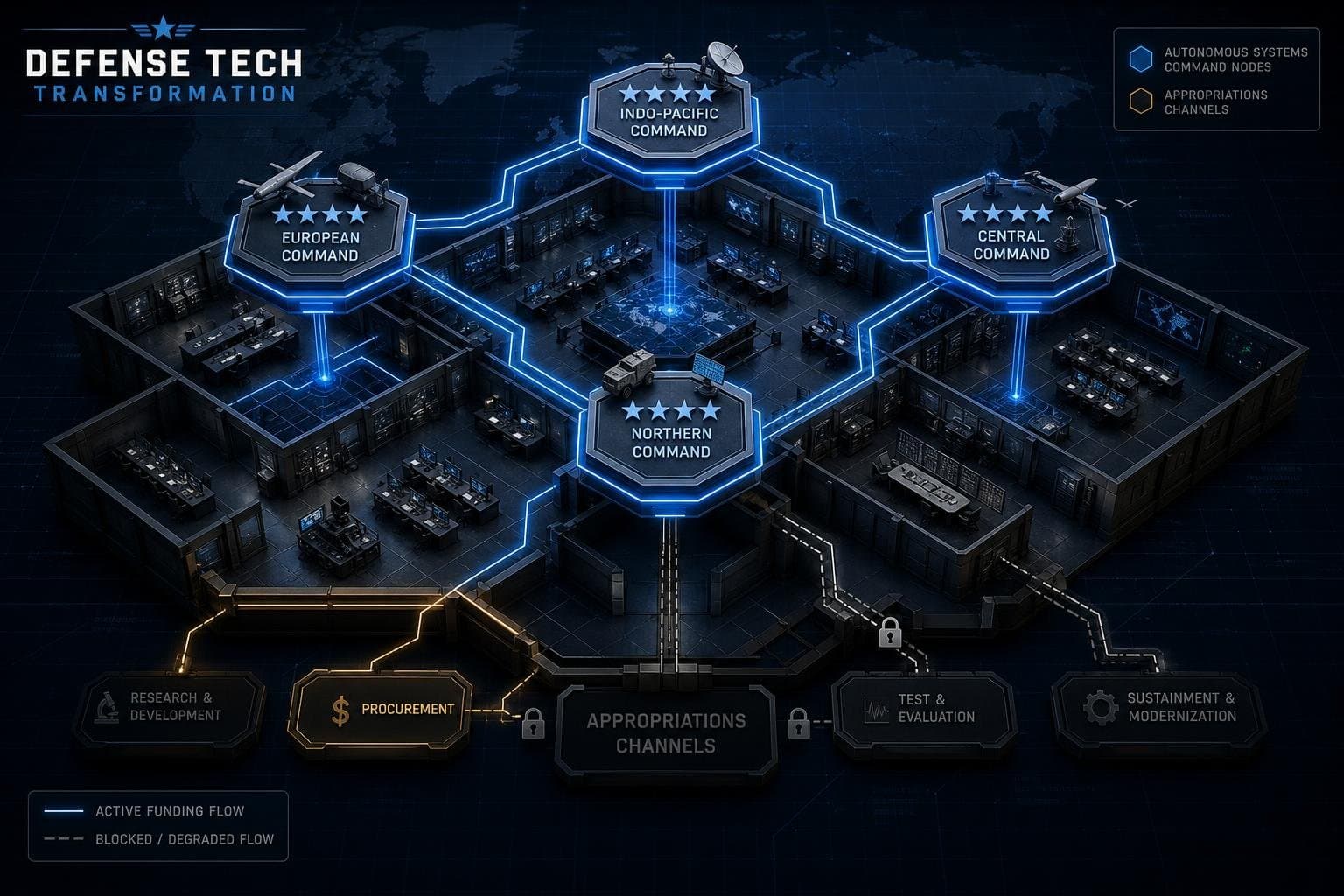

Here's the gap nobody's pricing in: the Pentagon is standing up new four-star commands for drones and robotics while the actual money to build them sits frozen behind a government funding mechanism that hasn't moved since October 1.
That's the real story in the FY2027 budget cycle right now, and it's a more useful signal than any top-line number. The Pentagon is telling you, through organizational moves rather than appropriated dollars, where it wants the next decade of capability to come from. Congress hasn't caught up yet.
The Org Chart Arrived Before the Money
Defense Secretary Pete Hegseth used his "State of the Force" speech at Quantico to announce a new four-star command built around drones and autonomy, which he's calling Autonomous Warfare Command, or AUTOWARCOM, describing it as built for "the fastest peacetime shift in modern military history" (Breaking Defense). As an interim step, he's converting the existing autonomy portfolio office into something called Project Agincourt, run by Defense Innovation Unit head Owen West and Max Strasiser, under a new "warfighting acquisition" model meant to push procurement decisions down to frontline units.
The Army moved within 24 hours. A memo from acting Army Secretary Adam Telle directs the creation of a new Futures and Autonomous Systems Command (FASCOM), with autonomous force development targeted across six formations — aviation, armor, sustainment, training and more — plus a new portfolio acquisition executive focused on autonomous fires, combat vehicles, resupply watercraft and breaching systems this fiscal year (Axios). Telle told Axios Hegseth "made it clear: We are done with the bureaucratic inertia holding back modernization." That's the kind of line that sounds great in a memo and means nothing without an appropriations bill behind it.
A Senate version of the fiscal 2027 defense authorization bill backs the same direction, calling for the Pentagon to establish a Robotic and Autonomous Systems Combatant Command (Breaking Defense). Standing up anything resembling SOCOM- or CYBERCOM-style acquisition authority for autonomy requires exactly that kind of legislative lift — Congress had to approve the same thing for special operations and cyber. So the institutional intent is real and bipartisan-adjacent. The funding mechanism underneath it is not yet real.
New Starts Can't Start
The Defense Department entered the new fiscal year on October 1 operating under a continuing resolution, which by definition blocks new program starts — and a search of FY2027 budget documents for programs flagged as "new starts" turned up more than 150 line items, spanning new drone programs, the Golden Fleet initiative and hypersonic weapons work (Breaking Defense). Space Force Chief of Space Operations Gen. Douglas Schiess put it plainly: "It's gonna slow us down, and the threat is not slowing down." Sen. Chris Coons, the top Senate Appropriations Democrat on defense, went further, warning that Pentagon leadership's hopes for $350 billion in reconciliation funding and another $100 billion-plus supplemental are unlikely to materialize while the war in Ukraine continues — leaving what he estimates as a $500 to $700 billion gap between Pentagon planning assumptions and what's actually likely to land.
This is the investor-relevant detail. Every startup that's spent the last two years positioning around a next-gen drone program, a hypersonic interceptor line, or an autonomy portfolio inside the services is now waiting on a CR that runs through December 11, with no guarantee the impasse resolves cleanly even then. It's also worth remembering that this spending pressure isn't happening in a vacuum — Russia has raised its own 2027 military budget by 27%, to roughly $202.6 billion, the highest figure since its invasion of Ukraine began, according to budget documents reviewed by Reuters (Defense News). That's the kind of comparison point that makes a frozen CR feel like a luxury the Pentagon can't actually afford.
Why the Signal Still Matters
None of this undercuts the thesis that autonomy and drones are where the institutional center of gravity is heading. If anything, the fact that Hegseth is willing to reorganize four-star commands and general-officer billets around robotics before the money exists tells you how much political capital is riding on this bet. NATO's own planning reflects the same instinct — Supreme Allied Commander Europe Gen. Alexus Grynkewich is set to present a "Theory of Victory" document in Poland on October 12 built around integrating drones and AI into a quick-reaction defense against a Russian attack on the alliance's eastern flank (Bloomberg). Ukraine's former defense minister, Mykhailo Fedorov, is making the same bet privately, launching what he's calling a "Manhattan Project" to pool engineers and capital toward humanoid and ground robots that could eventually replace infantry on the front line, telling Defense News he wants Ukraine to "seize the initiative in the war's next technological cycle before Russia" scales its own industrial base (Defense News).
For companies building toward Pentagon autonomy contracts, the next milestone isn't a budget topline — it's whether Congress clears a full-year FY2027 appropriations bill before December 11, and whether the authorization language creating a Robotic and Autonomous Systems Combatant Command survives conference (Axios). Watch that date more closely than any funding figure in the request itself.


