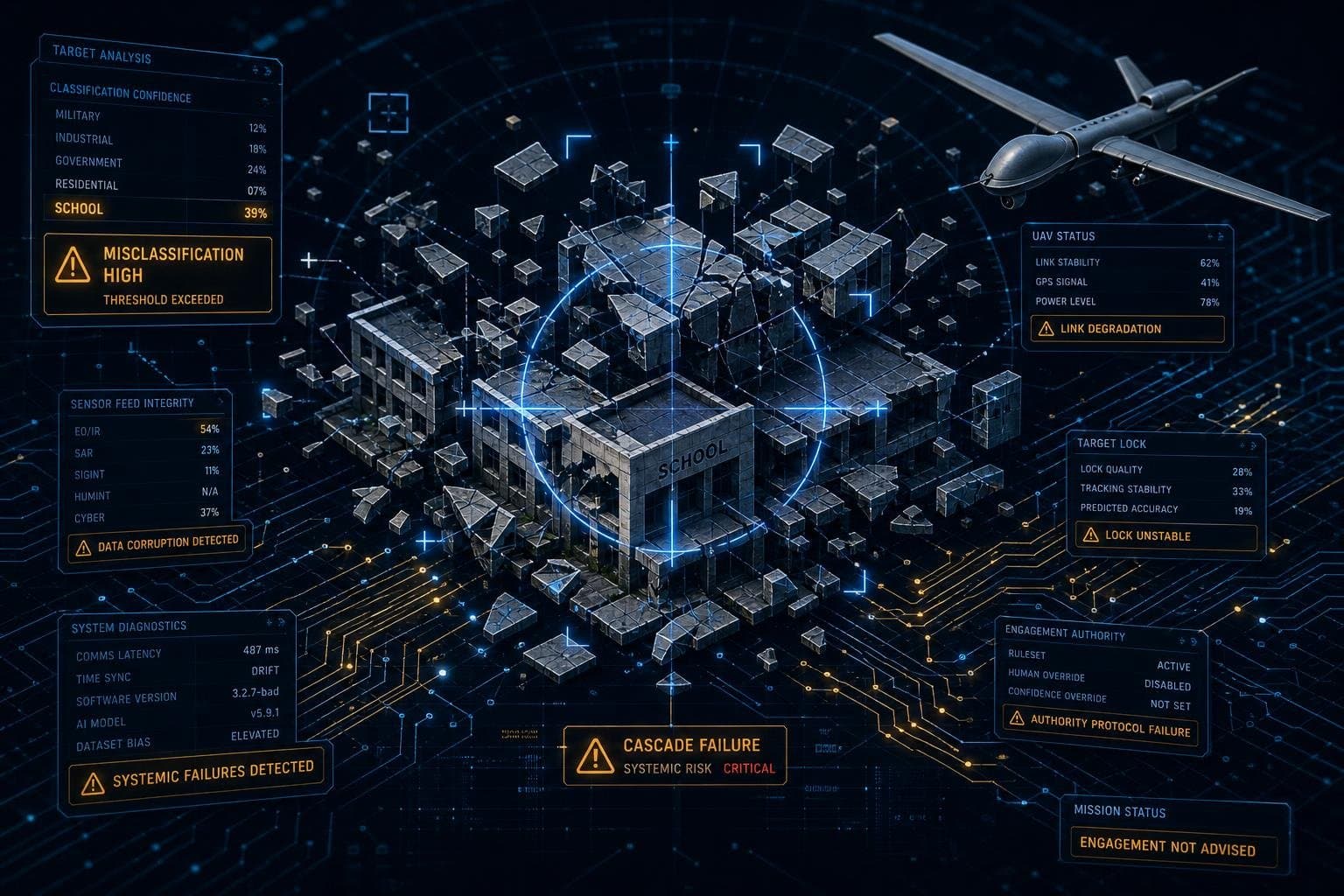

The U.S. military crossed a threshold this year that defense planners have been anticipating for a decade: autonomous systems went from experimental to operational at scale. More than 1,000 Iranian targets hit in 24 hours. Every Army squad outfitted with small attack drones. Collaborative Combat Aircraft landing at active Air Force bases. The mass-production autonomous systems bet — what observers have been calling the next phase of drone-era procurement reform — is no longer a concept paper. It's a deployed reality.
And on February 28, it killed 123 children in a school in Minab.
That's the tension that any honest accounting of autonomous weapons at scale has to sit with right now. The capability breakthrough is genuine. The procurement logic driving it is largely sound. And the operational consequences of deploying it faster than the doctrine, the safeguards, and the institutional knowledge can keep up are exactly as catastrophic as the critics warned they might be.
This isn't an argument for slowing down. The strategic pressure to field autonomous systems at volume is real, and the alternatives — legacy procurement timelines, shrinking pilot pipelines, peer competitors who aren't waiting — make standing still its own kind of risk. But the current moment demands a harder look at what "mass-produced autonomous systems" actually means in practice, who bears the cost when the integration fails, and whether the Pentagon's post-Minab reforms are sufficient or just the minimum visible response.
The Capability Architecture Is Maturing Faster Than Expected
Start with what's actually working, because the progress is genuine and worth understanding on its own terms.
General Atomics delivered an FQ-42 Vengeance aircraft to Creech Air Force Base last week, two months after Anduril's FQ-44 Fury was used in an Agile Combat Employment exercise at the same base. The Collaborative Combat Aircraft program now has two competing platforms in active test and evaluation — and General Atomics says it's already running a new low-observable paint facility aimed at production throughput, targeting six aircraft per month. The Air Force's fiscal 2027 budget request includes, per Defense News, $996.5 million in CCA procurement funding, plus $1.37 billion in continued research and development. Secretary of the Air Force Troy Meink said last week the service expects at least 500 autonomous aircraft in service by 2032.
On the ground, the Army's Drone Dominance program has accomplished something that would have seemed implausible three years ago: the service now has enough drones to equip every squad, per Col. Gregory Merkl, the Army's Drone Dominance director. The program, which Secretary Hegseth announced in 2025 with a mandate to outfit every Army squad with small one-way attack drones by end of fiscal 2026, met its hardware target. The remaining gap is training — specifically, operating in contested electromagnetic spectrum environments where adversaries actively jam drone comms and navigation. Merkl described the service as "running a whole series of working groups" on that problem, and noted that soldiers are getting practical experience working with Ukrainian and NATO counterparts during exercises like Saber Junction in Germany.
Meanwhile, Shield AI's Hivemind platform was selected as an autonomy provider for the Air Force's CCA program in February, followed by a $1.5 billion Series G at a $12.7 billion post-money valuation — the kind of capital that signals investor conviction that autonomous military systems are moving from R&D to production at scale.
The architecture that's emerging is coherent: purpose-built CCA platforms with low-observable features and internal weapons bays, flying in coordination with manned F-35s and F-15Es; ground units with organic one-way attack capability at the squad level; and AI battle-management systems like Maven Smart System tying targeting intelligence to lethal action. The pieces fit together. The question is what happens when you operate this system at the speed and scale that modern combat demands.
What Minab Actually Revealed About AI-Enabled Targeting at Scale
The Bloomberg investigation into the Minab strike is the most important defense technology document published this year, and it deserves more analysis than it's getting in procurement circles.
Pentagon investigators found that the February 28 strike that killed more than 150 people — including at least 123 children — at the Shajarah Tayyebeh Elementary School resulted from "an accumulation of smaller" failures, not a single catastrophic decision. The cascade included flawed intelligence, outdated imagery, cuts to civilian-protection personnel, and what investigators described as an overreliance on AI. The Trump administration had demanded an overwhelming assault; more than 1,000 Iranian targets were hit within the first 24 hours. That compression of the targeting timeline — instilling urgency across every node in the kill chain — set the conditions for errors that might have been caught in a slower, more deliberate process.
The head of the Pentagon's digital and artificial intelligence office, Cameron Stanley, confirmed to Bloomberg that the scale of that 1,000-target strike was enabled by Maven Smart System. Subsequent reporting confirms that U.S. Central Command has made multiple changes to its targeting process since: refining workflows for vetting planned targets, adding open-source data feeds to track civilian movement, and making dozens of upgrades to Maven itself — including new AI agents that re-review underlying intelligence and new capabilities to distinguish building function from building location.
These are meaningful reforms. But they also confirm something uncomfortable: the system that enabled a 1,000-target strike in 24 hours was operating with known gaps in civilian-protection staffing and intelligence-refresh protocols when it did so. The speed was a feature. The safeguards were assumed rather than validated. UN investigators have concluded there are reasonable grounds to consider the Minab strike a war crime.
For anyone evaluating the autonomous systems procurement thesis, this is not an abstraction. It's a data point about what happens when you field mass-production capability before the doctrine, the human oversight structures, and the institutional judgment required to use it responsibly are in place.
The Training Gap Is the Real Limiting Factor — Not the Hardware
Both the CCA program and the Army's Drone Dominance program point to the same structural gap: producing the systems at scale is the solved problem. Integrating them into a force that knows how to employ them effectively is not.
Col. Merkl's candor about the training deficit is worth taking seriously. The Army hit its hardware target — drones at every squad — but openly acknowledged that qualified pilots at the squad level remain a "work to do" item. The electromagnetic spectrum problem is particularly acute: in a contested EMS environment, the drone advantages that looked decisive in early conflict reporting from Ukraine become liabilities if operators don't understand how adversaries will try to defeat them. The Army's answer, as of now, is working groups and NATO exercises. That's a reasonable start. It's not a solved problem.
The CCA program faces a similar dynamic with a higher technological ceiling. Flying an autonomous aircraft in collaborative control with manned fighters requires trust — not just technically validated performance, but the kind of operational trust that develops through repeated, realistic exercises. Defense News reported that Creech conducted an Agile Combat Employment exercise with Fury two months ago, giving airmen experience building "foundational tactics and procedures." That's the right instinct. But the Air Force's target of 500 autonomous aircraft in service by 2032 implies an integration timeline that compresses rapidly.
The French Army, watching the Ukrainian stalemate closely, has arrived at a complementary conclusion from the other side of the problem. Gen. Bruno Baratz, commanding the French Army's Future Combat Command, described a "zone of death" along modern frontlines where drone observation makes mass and maneuver nearly impossible — and identified the resulting need for opacity, deception, and electromagnetic complexity as the next tactical challenge. His insight is that autonomous systems at scale don't automatically translate into offensive advantage. They create a more transparent, lethal environment that can calcify into stalemate as readily as it can enable decisive action. Winning that environment requires doctrine and operational creativity, not just hardware volume.
The Palantir Data Point and the Platform-Software Convergence
There's a through-line connecting the CCA program, Maven Smart System, and a quieter contract announced this week that ties the whole architecture together.
The Army awarded Palantir $48.1 million to develop software consolidating nine separate legacy ammunition management platforms into a single system using commercial low-code, no-code technology. The contract is unglamorous by defense tech standards — this is inventory software, not strike autonomy. But it illustrates something important about where the real value in the autonomous systems bet is being captured.
The Army's existing ammunition management systems operated independently, meaning training schedule changes weren't reflected across the procurement and distribution chain in real time. Forecasts relied on historical trends rather than actual demand. The "accountability model," per the Army's own journal, was "failing to meet the operational tempo or digital expectations of the modern force."
That's the same problem that produced Minab at the targeting layer: disconnected systems, stale data, and human decisions made on the basis of incomplete information under time pressure. The fix in both cases is the same — better integration, real-time data, AI that surfaces anomalies rather than concealing them. Palantir is now under contract to solve this problem in logistics. It's already deployed to solve it in targeting, with the post-Minab Maven upgrades. The company's position at the intersection of both domains is worth watching.
The investment thesis I'd make here isn't about any single program. It's about the companies building the connective tissue — the data infrastructure that makes autonomous systems at scale actually function as a coherent force rather than a collection of capable but disconnected platforms. Hardware production is getting solved. The software integration layer is where the durable competitive moat is being built.
What to Watch Before the Year Ends
The FY2027 budget request puts $2.37 billion total behind the CCA program. That number will tell you a lot about congressional appetite for autonomous systems procurement in a post-Minab political environment — watch for markup sessions in the next 60 days to see whether the civilian-protection failures produce funding conditions or simply generate floor speeches.
The more immediate signal will come from Central Command's operational tempo. The Bloomberg reporting confirms that CENTCOM's Maven upgrades are live, but also that defense officials and experts privately consider the risk of another Minab "still too high." Whether those private assessments produce formal doctrinal constraints — or whether operational pressure overrides them — is the question that will define autonomous systems procurement for the next decade.
Anduril still hasn't announced which Air Force base will house Fury. That announcement, when it comes, will tell you something about how the service is thinking about CCA basing strategy and whether the two competing platforms end up at operationally distinct locations or direct neighbors. Either choice has implications for how tactics and integration doctrine


