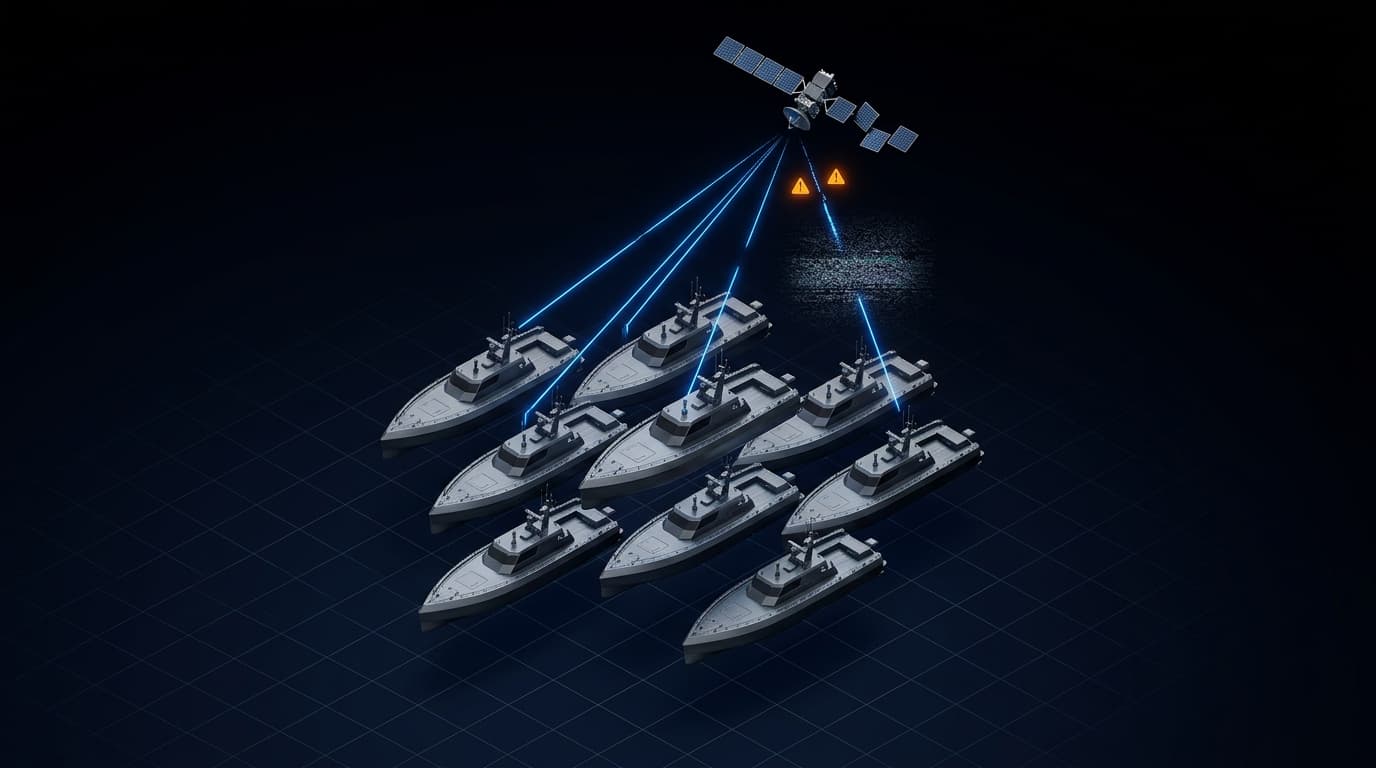

Last August, two dozen unmanned surface vessels sat bobbing off the California coast, unable to receive commands, their operators staring at dead screens. The culprit wasn't enemy jamming or a cyberattack — it was a Starlink outage. C4ISRNET reported that the disruption halted Navy autonomous drone operations for nearly an hour, affecting vessels specifically designed to expand U.S. military options in a potential conflict with China.
That incident is a useful lens for everything happening in defense tech right now. The Pentagon is betting heavily on autonomous systems to transform force projection — more reach, less risk to personnel, faster decision cycles. But the Starlink episode reveals a structural tension that doesn't get enough attention: the more capable your autonomous systems become, the more catastrophically fragile your dependencies become with them.
This isn't an argument against autonomous systems. It's an argument that the real competition in defense tech isn't about which drone flies fastest or which AI makes the sharpest targeting call. It's about who builds the infrastructure stack that makes autonomous operations actually reliable at scale — and what happens when that stack has a single owner.
The Dependency Problem Is Already Operational, Not Theoretical
The Navy's Starlink problem isn't a cautionary tale about future risk. It's a description of current reality. According to the C4ISRNET reporting, the disruptions affected multiple test events, not a one-off anomaly. The vessels involved were part of programs intended to give the U.S. Navy unmanned surface capability in contested Pacific scenarios — exactly the operational context where communications resilience matters most.
SpaceX's position here is genuinely extraordinary. Its low-earth orbit constellation of close to 10,000 satellites gives the military a communications network with a scale no competitor currently matches. Amazon's recently announced $11.6 billion acquisition of Globalstar signals that competition is coming, but it's not here yet. In the interim, the Pentagon has built autonomous programs that functionally require Starlink to operate — which means a commercial company's service reliability is now a variable in U.S. military readiness.
Clayton Swope of the Center for Strategic and International Studies put it plainly: "If there was no Starlink, the U.S. government wouldn't have access to a global constellation of low earth orbit communications." That's not a criticism of SpaceX — it's a description of how thoroughly the military's autonomous ambitions have outpaced its communications infrastructure planning.
The pattern here matters beyond satellites. Every autonomous system — drone swarms, unmanned surface vessels, AI-driven logistics — requires a communications and data layer to function. When that layer is resilient and distributed, autonomous systems multiply force. When it's fragile or concentrated, they become expensive liabilities that go dark at the worst moments.
Operation Epic Fury Shows What's Actually Getting Deployed
While the infrastructure debate plays out in test ranges off California, a more immediate data point has emerged from actual operations. Defense Tech and Acquisition reported that in Operation Epic Fury, nearly every U.S. weapons system deployed was developed during the Reagan administration or earlier — some 40, 60, or even 80 years old. Only one system developed in the last 15 years saw operational use: the Low-cost Unmanned Combat Attack System (LUCAS), a cheaper, rapidly produced autonomous drone.
One system. In an operation that was supposed to demonstrate American military capability.
That single data point does more to explain the current urgency in defense tech investment than any procurement reform white paper. The gap between what the Pentagon is funding in labs and what it can actually field in operations is enormous — and it's not closing fast enough. The same report notes that despite VC investment in defense tech reaching $56 billion in 2025 (up 83% from the prior year), less than 1% of Pentagon contract spending goes to top defense technology companies.
The money is flowing into the sector. The procurement pathways to get that technology into operational use are not keeping pace. LUCAS being the lone modern system in Epic Fury isn't a success story — it's a warning about what happens when innovation stays in prototype phase while legacy systems absorb the actual contract dollars.
The Capital Stack Is Shifting, But Toward Whom?
Lockheed Martin's decision to expand its venture fund from $400 million to $1 billion — a 250% increase and the largest boost since the fund launched in 2007 — is the most telling institutional signal of the week. GovConWire reported that the fund has already invested more than $500 million across 120-plus companies, with more than 60 becoming Lockheed suppliers.
Read that last number carefully. Sixty companies became suppliers. That's not a portfolio of independent disruptors — that's an acquisition pipeline dressed up as a venture fund. Lockheed is essentially paying to see the innovation market early, then absorbing the winners into its supply chain. The companies that don't get absorbed either find other primes to partner with or navigate the direct Pentagon procurement path on their own.
This matters for autonomous systems specifically because the most interesting autonomous capabilities — Saronic's unmanned surface vessels, the drone swarm programs, AI-driven ISR — require integration across hardware, software, and communications layers that no single startup controls. The prime contractors understand this integration problem better than anyone. Their venture arms are a bet that they can stay at the center of that integration even as the underlying technology components come from outside.
I'd argue this creates a two-tier innovation dynamic: startups that get absorbed into prime supply chains move faster to operational deployment but lose pricing leverage and independence. Startups that stay independent get better valuations but face the procurement timeline problem that's kept defense tech at less than 1% of Pentagon contract spending.
The reauthorization of federal aid to defense startups — signed into law earlier this month — helps the independent path, but it doesn't solve the integration problem or the procurement speed problem. It keeps more companies alive long enough to compete. Whether they can actually scale to operational deployment is a separate question.
The Real Force Projection Calculus
Here's what the Starlink incident, Epic Fury, and Lockheed's fund expansion are collectively pointing at: autonomous systems have already changed what force projection is theoretically possible. The Navy can design unmanned surface vessel programs for Pacific contingencies. The Air Force can fund Collaborative Combat Aircraft. The Army can field LUCAS. The capability concepts are real.
But force projection isn't about what's theoretically possible — it's about what's reliably deployable when it matters. And right now, the infrastructure layer (communications resilience, procurement pathways, integration architecture) is the binding constraint, not the autonomous systems themselves.
The Starlink dependency problem will get some relief as Amazon's Globalstar acquisition matures and as the Pentagon's own Starshield constellation expands. Watch for Space Force's commercial-first budget posture — flagged in the Defense Tech and Acquisition reporting — to accelerate that diversification. The more interesting near-term signal will be whether the Navy's autonomous surface vessel programs get redesigned for multi-constellation communications or simply wait for Starlink's reliability to improve.
On the procurement side, the FY27 defense budget request — reportedly the largest in U.S. history — is the next forcing function. If the budget lands with autonomous systems and defense tech still receiving less than 1% of contract spending, the VC momentum currently driving the sector will face a serious credibility test. Investors can absorb a few more years of prototype contracts. They cannot absorb indefinite exclusion from scaled procurement.
The autonomous force multiplier is real. The Pentagon has seen enough — in Ukraine, in Epic Fury, in its own test ranges — to know that unmanned systems operated at scale change what small forces can accomplish. The question now is whether the infrastructure, procurement, and integration architecture can catch up to the capability before the next real test isn't a disrupted exercise off California, but something that actually counts.


