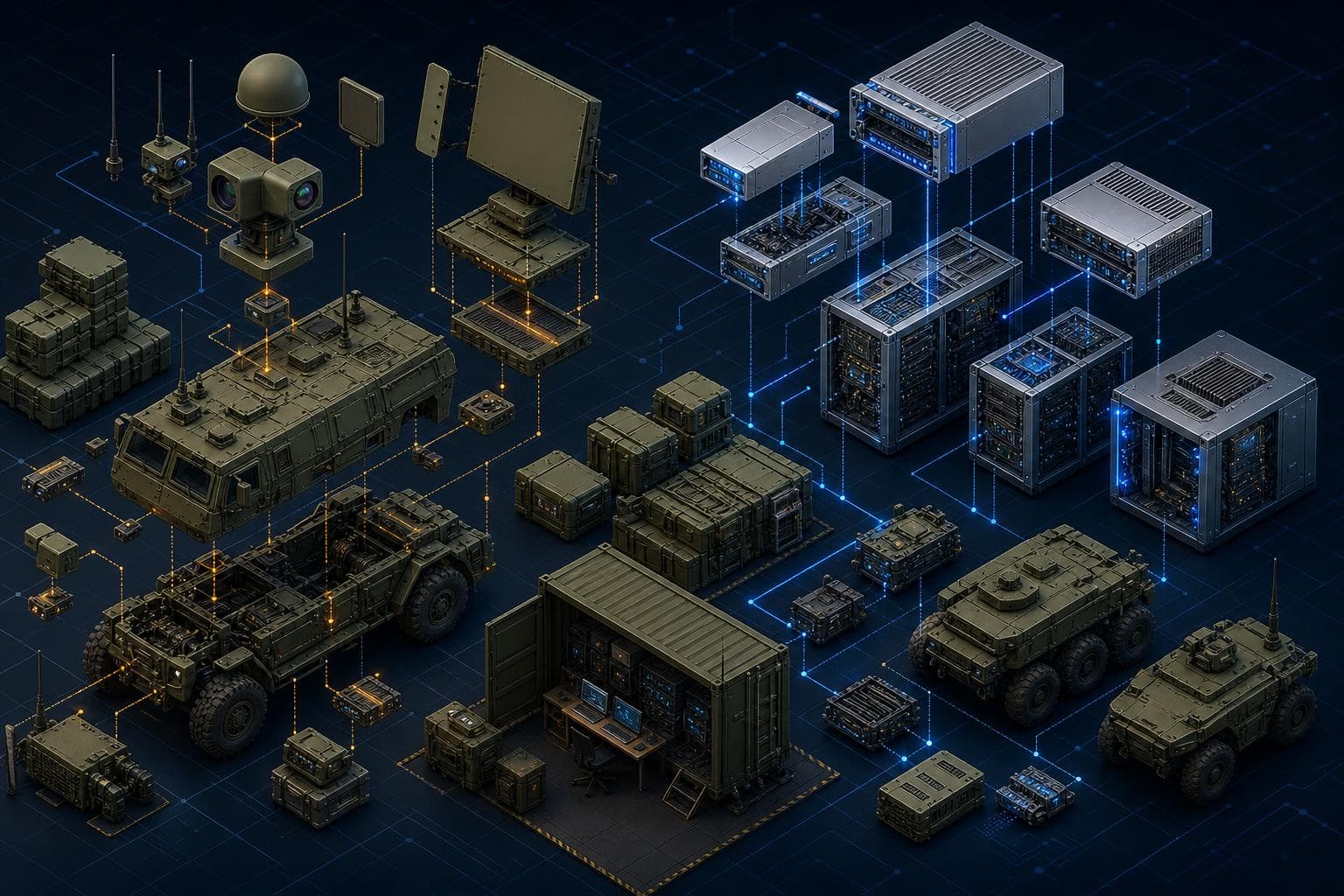

The Pentagon wants to spend $29.5 billion on AI infrastructure in fiscal 2027, explicitly naming supply chain logistics as one of the target applications. That's a serious signal. But if you're looking for a wave of AI logistics startups cashing Army supply chain contracts right now, the evidence isn't there — and understanding why tells you something important about where the real opportunity sits.
The Infrastructure Has to Come First
The DoD's new AI Arsenal initiative isn't a procurement program for logistics software. It's a foundational bet: build the hardened, SCIF-accredited data centers and GPU clusters that make any serious AI application — including supply chain — possible at military scale. DefenseScoop's reporting on the budget request describes the Pentagon explicitly trying to "transition from funding scattered clusters" of compute to an integrated infrastructure portfolio. That's not a logistics startup problem. That's a plumbing problem, and the plumbing isn't finished.
This matters for how you think about the investment thesis. The Army's supply chain modernization opportunity is real — but it's downstream of infrastructure decisions being made right now. Startups pitching AI-powered demand forecasting or autonomous inventory management are selling into a system that, by the Pentagon's own admission, doesn't yet have the compute backbone to run them at scale.
The Integration Problem Is Worse Than the Software Problem
The more revealing signal this week came from SOCOM's top acquisition official at SOF Week, who said the development of cross-platform autonomous systems "is not moving fast enough." Deputy Director of Acquisition David Breede was talking about collaborative autonomy for combat systems — but the underlying problem is identical to what plagues logistics: decades-old equipment that can't talk to new software without expensive, bespoke integrations that "not only failed, but were costly to implement," in the Army's own words.
Army Secretary Dan Driscoll's "Right to Integrate" effort — pushing industry to share interfaces and develop common communication networks — is essentially an acknowledgment that the Army has been building software islands for years. Any AI logistics startup that walks in with a proprietary platform is going to hit the same wall. The companies that win here won't just have better algorithms; they'll have figured out how to plug into legacy systems without requiring a multi-year integration project.
That's a harder problem than most pitch decks admit.
Where the Money Is Actually Going
The contracts getting signed this week are instructive by contrast. Perennial Autonomy's $500 million award from JIATF-401 and Shield AI's selection for the LUCAS kamikaze drone program share a common thread: both companies solved a specific, measurable operational problem — counter-drone interception, autonomous swarming — with hardware and software that had already been tested in active combat environments. Perennial's Merops interceptor was developed for Ukraine against Russian Shaheds. Shield AI's Hivemind has flight hours. Neither company was selling a vision of what AI could do for the Pentagon someday.
The Army's supply chain modernization will eventually follow the same logic. The contracts will go to companies that can demonstrate — not just model — measurable improvements in specific, painful logistics bottlenecks: parts availability at forward operating bases, predictive maintenance for vehicle fleets, automated requisition processing that doesn't require a human to manually reconcile three different legacy databases. The pitch has to be operational, not architectural.
Pentagon Pulse
The FY27 budget request's $54.6 billion for the Defense Autonomous Warfare Group — a near 24,000 percent increase over FY26 allocations — signals that autonomous systems are now a permanent budget line, not a pilot program. For logistics-adjacent startups, the more relevant number is the $29.5 billion AI Arsenal request: that's the infrastructure spend that determines whether any AI application, supply chain or otherwise, can actually run inside classified military networks. Watch for congressional markup of both line items this summer — that's where you'll learn which applications the Hill actually believes in versus which ones are still aspirational.
The logistics opportunity is coming. The startups that position now around interoperability and legacy integration — not just algorithmic sophistication — are the ones who will be ready when the infrastructure catches up.


