
The U.S. Army has been trying to field autonomous ground vehicles for decades. What it mostly got was expensive prototypes, failed programs, and a procurement system that moved slower than the technology it was trying to buy. What's different now isn't the technology — it's where the pressure is coming from.
Three separate developments in the past two weeks tell a coherent story: a Seattle startup demonstrating combat-capable autonomous vehicles in the Sahara Desert alongside actual infantry units, a legacy manufacturer partnering with a commercial EV company to build expendable robotic cargo trucks, and the Army standing up a new innovation program explicitly designed to put technology in soldiers' hands within 90 days. The through-line isn't any single contract or company. It's a structural shift in how the Army is approaching the problem — and who it's willing to trust to solve it.
The Demo That Actually Mattered
Most autonomous ground vehicle demonstrations happen on test ranges, in controlled conditions, with program managers watching from a safe distance. Overland AI's deployment at African Lion 2026 was something else.
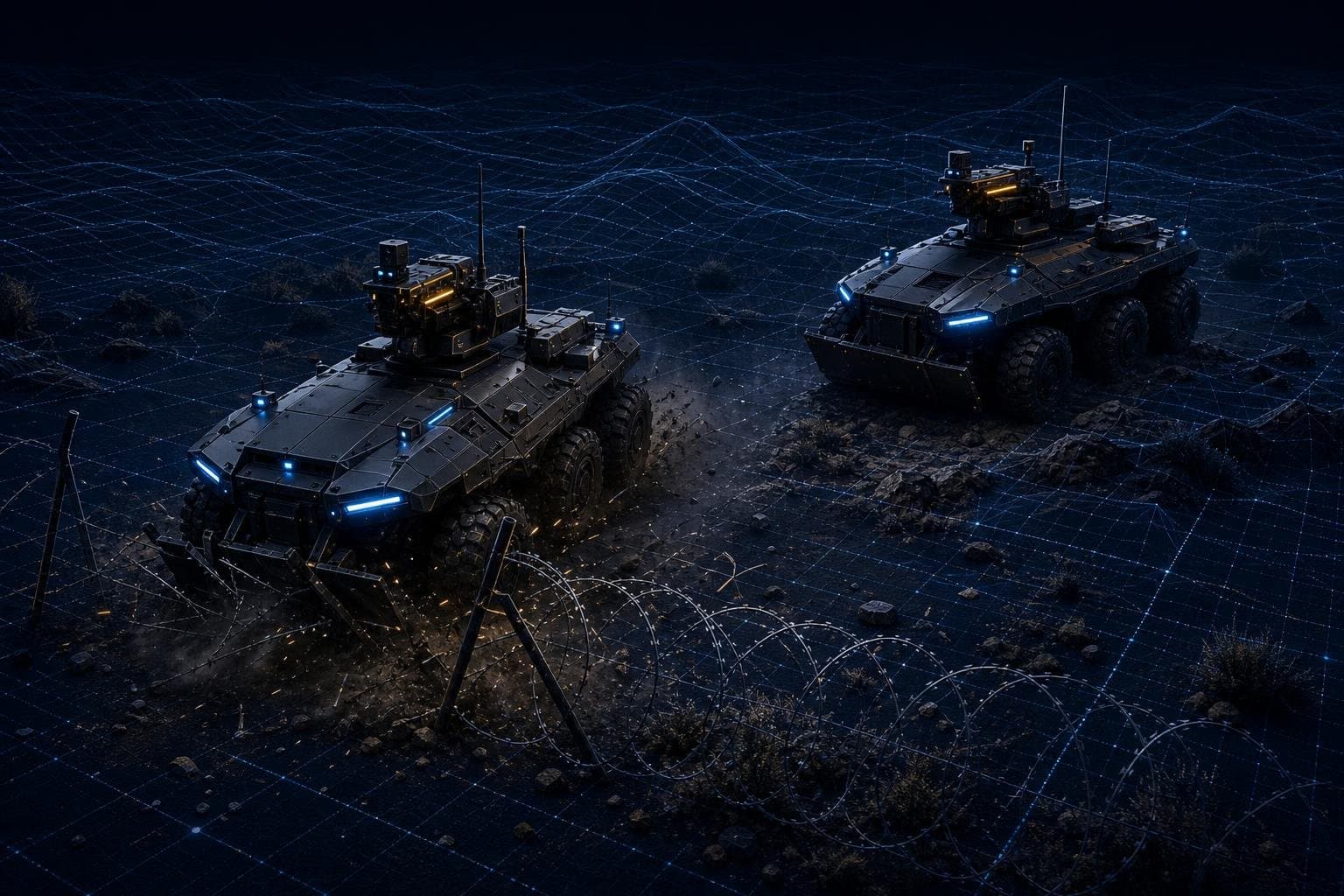
The Seattle-based company, founded in 2022, deployed two ULTRA autonomous ground vehicles into U.S. Africa Command's largest annual joint exercise in Morocco. The vehicles didn't just drive around. They executed breaching operations using an APOBS system while a second vehicle provided direct fire support via a CROWS weapon station — coordinated combined-arms tasks that require multi-agent behavior, real-time obstacle detection, and reliable execution across berms, anti-vehicle ditches, and minefields. Soldiers from the 173rd Airborne Brigade, 7th Engineer Brigade, and 2nd Combat Engineer Battalion operated the platforms. Senior leaders from USAEUR-AF and AFRICOM observed live.
The detail that deserves more attention: the vehicles were air-transported from the United States and reached mission-ready status within 24 hours of arriving in Morocco. Rapid deployability has historically been one of the hardest engineering problems in military robotics — a vehicle that takes a week to set up and calibrate in-country is a vehicle that won't get fielded. Overland AI didn't just demonstrate a capable platform; it demonstrated a deployable one. That distinction matters enormously to program managers who have watched promising systems collapse under the weight of their own integration complexity.
Soldiers achieved independent multi-vehicle mission planning within hours of training. That's the other number worth sitting with. The Army's institutional fear about autonomous systems has always been the training burden — that you'd need a specialized operator cadre, months of certification, and a support tail that negates the force multiplication benefit. A system that infantry soldiers can operate meaningfully within hours of first contact changes that calculus.
The Expendable Truck Is a Strategic Concept, Not Just a Vehicle
While Overland AI was demonstrating combat autonomy in Morocco, a different kind of autonomous ground vehicle was taking shape through a partnership between American Rheinmetall and Harbinger: robotic cargo trucks designed to be stealthy, affordable, and explicitly expendable.
The concept is worth unpacking because it represents a genuinely different theory of value. Traditional military vehicles are optimized for survivability and longevity — they're expensive, they're crewed, and losing one is a significant event. The American Rheinmetall/Harbinger vehicle inverts that logic. Harbinger provides a commercially derived drive-by-wire hybrid-electric chassis; American Rheinmetall handles combat vehicle integration and modular mission-kit interfaces. The result is a platform with no cab, no manual steering, hybrid propulsion that enables electric-only operation for reduced acoustic and thermal signatures, and a cost structure designed to make the vehicle risible in contested logistics scenarios.
The tactical application is direct: delivering ammunition, fuel, and rations under fire without putting soldiers in the kill zone. Every infantry officer who has planned a resupply mission under contact knows the math — the moment you need to move supplies forward, you're either accepting risk to your soldiers or accepting risk to your mission. An expendable autonomous truck changes that equation. You can push supplies forward into situations where you'd never send a crewed vehicle, accept the possibility of losing the platform, and keep your people back.
This is the force multiplication argument in its clearest form. It's not about replacing soldiers; it's about removing soldiers from tasks that don't require human judgment and exposing them to risk that doesn't require human presence.
The Procurement Architecture Is Finally Catching Up
Hardware demonstrations are only half the story. The other half is whether the Army can actually buy what it's seeing demonstrated — and historically, that's where the process has broken down.
Two recent developments suggest the procurement side is genuinely changing. The first is Army FUZE, a new innovation program described by its director Matt Willis as combining multiple existing programs into a more streamlined system with an explicit venture capital mindset. According to Willis, the program's goal is to identify promising technologies and place them in soldiers' hands within 75 to 90 days — a timeline that would have been considered fantasy under traditional acquisition frameworks. The program emphasizes soldier involvement from the beginning, not as end-users who receive a finished product, but as co-developers who shape requirements and assess performance in operational conditions.
The 90-day target is aggressive enough to be meaningful. Traditional acquisition timelines for ground vehicle systems have stretched across years and sometimes decades. The gap between what a startup can demonstrate and what the Army can actually procure has been the graveyard of dozens of promising companies. FUZE is explicitly designed to close that gap by making better use of existing acquisition authorities and creating more agile pathways for commercial companies to engage.
The second development is the Gallatin AI contract with III Armored Corps — which, while focused on logistics software rather than ground vehicles, illustrates the same structural shift. Gallatin AI, a defense software company founded in 2024 and headquartered in El Segundo, California, was awarded a contract through an Other Transaction Agreement to deploy its Navigator AI logistics platform in direct support of III Corps exercises over the next 18 months. OTAs are the procurement mechanism that lets the Army move faster with commercial technology than traditional contracts allow — and the fact that a two-year-old company is now working directly with one of the Army's primary warfighting headquarters signals that the OTA pathway is maturing into something more than a workaround.
The Gallatin contract also points to an underappreciated dependency: autonomous ground vehicles are only as useful as the logistics system that sustains them. A corps commander managing tens of thousands of soldiers across months of sustained conflict, with supply lines potentially stretching a continent away, needs predictive consumption algorithms and a unified logistics common operating picture — not spreadsheets. As Gallatin CEO Woody Glier put it, the operational level of war requires "a decision support capability built for operational timescales and operational complexity." Autonomous vehicles operating at the tactical edge need that operational-level software backbone to function as part of a coherent system rather than as isolated platforms.
The Legacy Manufacturers Are Reading the Same Signal
The venture-backed startups aren't operating in a vacuum. AM General — the company that built the Humvee — is pitching its own Unmanned Ground Vehicle at Eurosatory in Paris, developed in cooperation with Textron Systems and Carnegie Robotics, powered by a 250 hp engine with a payload capacity of up to 6,000 lb. The platform is designed for logistics support, reconnaissance, casualty evacuation, and armed overwatch. AM General is also integrating counter-drone systems directly into the UGV — a recognition that any ground platform operating in contested airspace needs organic C-UAS capability.
The Ukrainian battlefield context is explicit in AM General's pitch. With unmanned vehicles playing a significant role in Ukraine's defense against Russia, NATO member states are actively rethinking their ground equipment inventories. The Ukrainian military's stated goal of contracting 25,000 unmanned ground platforms in the first half of this year — more than double its 2025 total, per Defense News — has concentrated European minds considerably. Milrem Robotics is presenting an entire robotized Eastern Flank defense architecture ahead of Eurosatory, built around the concept of unmanned systems making first contact, absorbing losses, and buying time for human decision-making — without immediately putting soldiers at risk.
The competitive pressure this creates for U.S. Army procurement is real. If NATO allies are fielding robotic ground systems at scale along the eastern flank, and the Army is still running multi-year acquisition programs for platforms that startups are demonstrating in live exercises, the capability gap argument writes itself. The Army knows this. The question is whether FUZE, OTAs, and programs like the Gallatin contract represent a genuine structural change or another layer of workaround on top of a procurement system that still defaults to its old rhythms when the pressure is off.
What the Next 18 Months Will Actually Reveal
The honest answer is that the current moment is a stress test, not a verdict. Overland AI demonstrated combat-capable autonomy in Morocco; it hasn't won a program of record. American Rheinmetall and Harbinger are developing expendable robotic trucks under a modernization contract; they haven't delivered them at scale. Army FUZE has a 90-day target; it hasn't proven it can sustain that pace across a portfolio of programs rather than a handful of showcase efforts.
The signals to watch are specific. Does Overland AI's African Lion demonstration translate into a follow-on contract with USAEUR-AF or AFRICOM, or does it end as a successful demo with no procurement pathway? Does the American Rheinmetall/Harbinger program progress from initial development to production vehicles on a timeline that keeps pace with the threat? Does Army FUZE's 90-day clock hold up when it's applied to more complex systems with harder integration requirements — or does it revert to the mean once the institutional novelty wears off?
The deeper question is whether the Army is building a procurement architecture that can absorb the pace of commercial innovation, or whether it's creating a set of faster on-ramps that still lead to the same slow highway. The Gallatin contract, the Overland AI demo, and the FUZE program all point in the right direction. The direction is correct. The speed is the variable that remains unproven.
For investors and defense industry professionals, the bet worth making isn't on any single platform — it's on the companies that have demonstrated they can operate within the Army's new acquisition frameworks while maintaining the technical velocity that makes them worth buying in the first place. That combination is rarer than either capability alone.


