


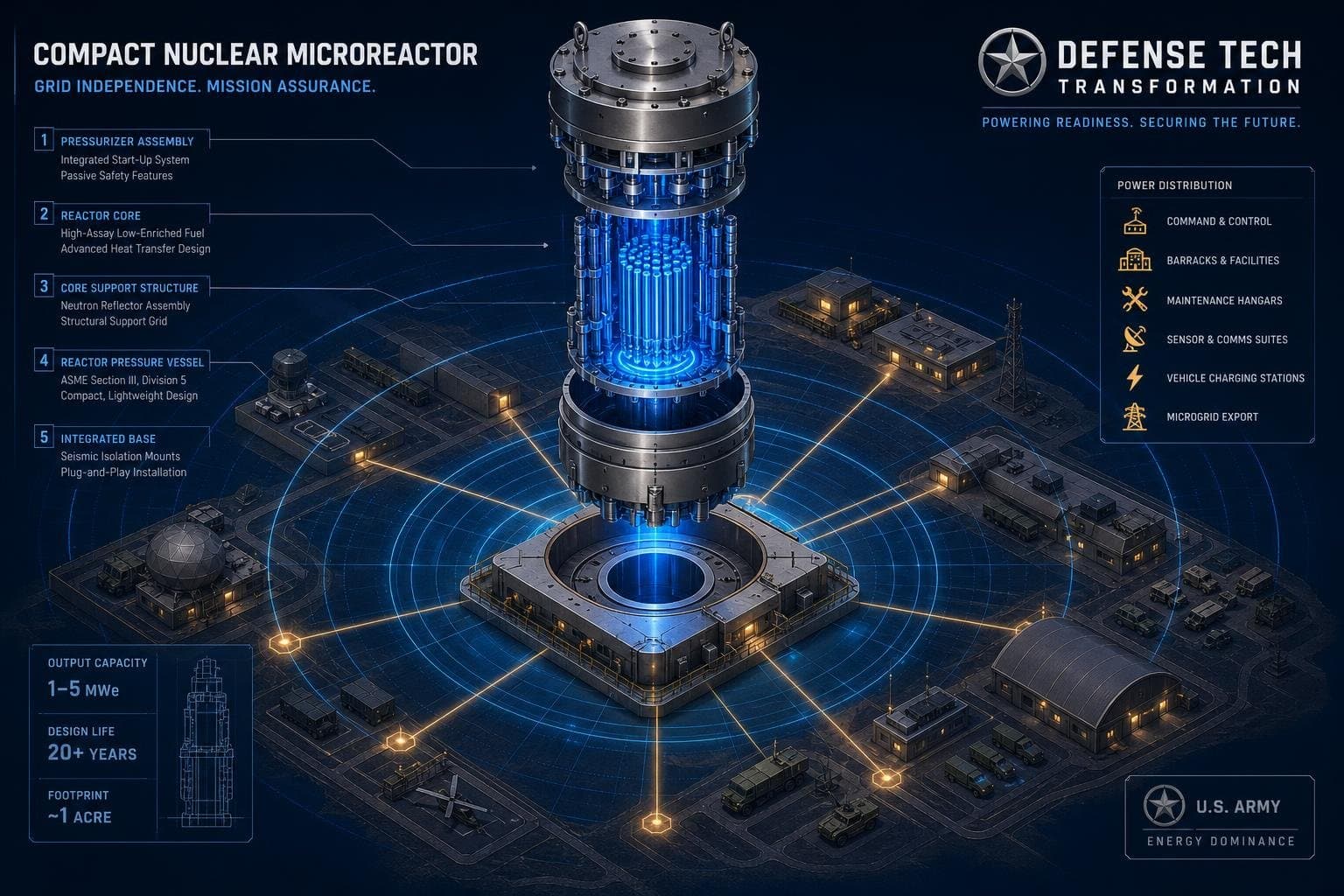

The Pentagon has spent years talking about energy resilience. The Army just started paying for it.
Five companies — Antares Nuclear, BWXT Advanced Technologies, General Atomics Electromagnetic Systems, Radiant Industries, and Westinghouse Government Services — have been selected under the Army's Janus program to build nuclear microreactors at installations across the U.S., with agreements worth up to $2.2 billion combined. The target: more than 20 reactors fielded across DoD installations, with at least one operational by September 2028.
The strategic logic here is harder to argue with than most Pentagon energy initiatives. As Army officials noted at Wednesday's briefing, every piece of critical Army infrastructure currently runs on diesel backup. That's a supply chain vulnerability that peer adversaries have already war-gamed. Antares CEO Jordan Bramble put it plainly to Axios: the military needs to sustain critical operations "without the grid, without a civilian supply chain" — and nuclear is the only technology with the capacity factor to actually do that.
What makes Janus structurally interesting beyond the dollar figure is the contracting model. Reactors are contractor-owned and operated; vendors only get paid on technical milestones. That's the Pentagon applying the same performance-based logic it's been pushing in drone and software procurement to a domain — nuclear — where cost overruns have historically been the default outcome.
The mix of companies selected is worth watching. Radiant Industries and Antares are startups. BWXT, General Atomics, and Westinghouse are established players. Janus isn't a winner-take-all bet on any single technology approach — it's a portfolio play, which is the right call when the operational deadline is 2028 and the technology is still maturing.
The