
The Pentagon has spent years warning that logistics is the hidden vulnerability in any major theater conflict. Now a small AI startup is getting a chance to prove that warning was actually solvable.
Gallatin AI announced on July 15 that it has won a Defense Innovation Unit contract under the Joint Sustainment Decision Tool program, deploying its Navigator platform into the logistics workflow of U.S. Army Europe-Africa. The mission: give commanders a real-time picture of supply chain pressures across theater-level operations, before shortfalls become crises.
That's a meaningful test environment. USAREUR-AF isn't a sandbox — it's the command responsible for the Eastern Flank Deterrence Initiative, where sustainment complexity is real and the margin for error is thin.
What Navigator Actually Does — and Why the Approach Is Different
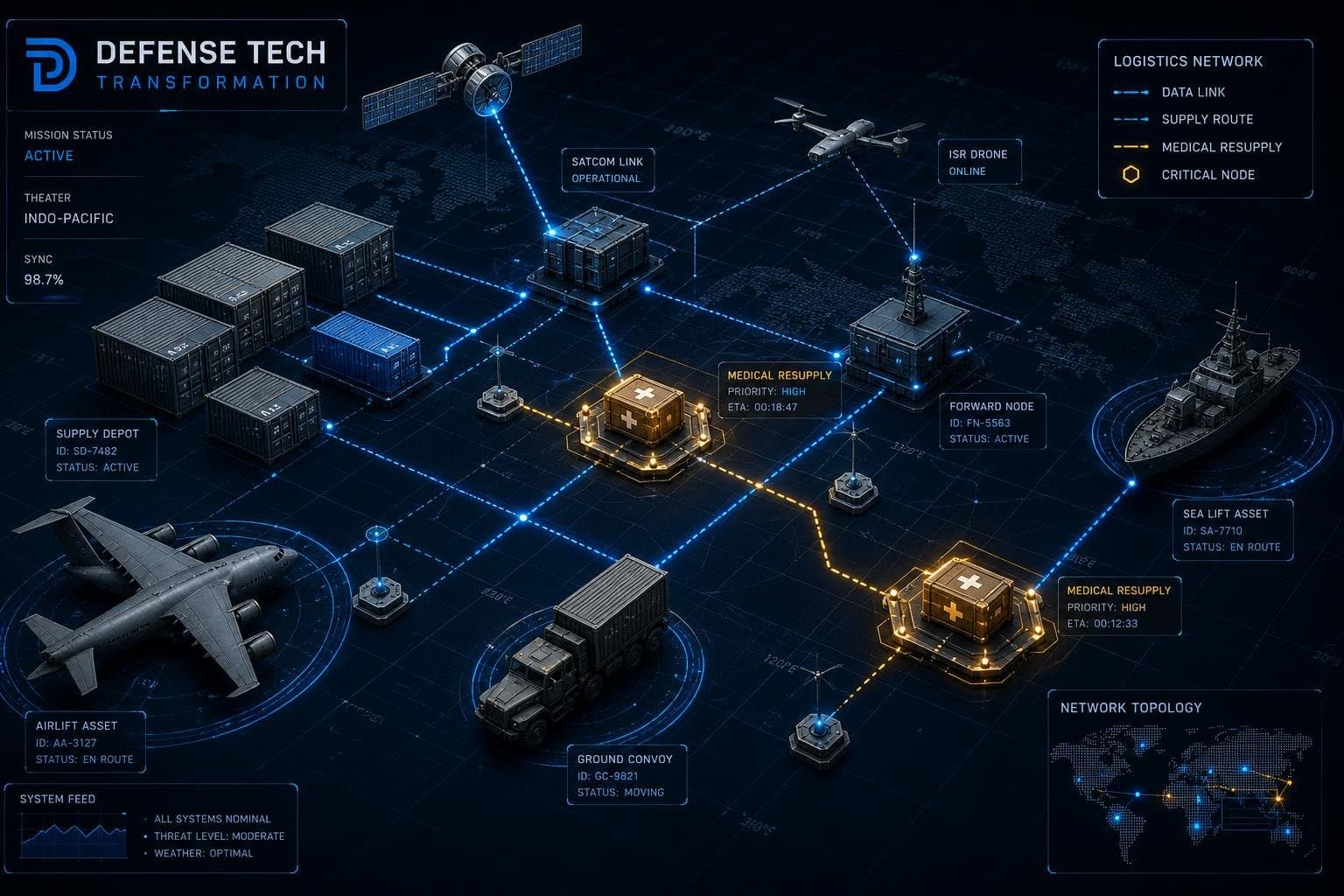
Navigator combines machine-learning demand forecasting with a generative AI engine that produces supply-chain courses of action on the fly. According to the announcement, the system ingests data from inventory systems, transportation assets, and mission-level intelligence, then flags potential shortfalls and proposes optimal resupply routes — including prioritization of medical kits and casualty-evacuation pathways.
The claimed capability improvement is significant: what used to be a multi-day planning process compressed into minutes.
That's the pitch most AI logistics startups make, so the differentiator worth examining is the generative component. Legacy defense logistics platforms are largely rule-based — they tell you what the rules say, not what you should do when the rules don't fit the situation. Navigator's generative layer is designed to produce "what-if" scenarios dynamically, which is closer to how experienced logistics officers actually think under pressure. The platform also brings Scale AI as a named teammate, with Scale's generative AI cross-checking Navigator's course-of-action recommendations against mission context.
The "AI stack" model — best-of-breed components integrated rather than a single monolithic platform — mirrors what's worked in commercial cloud deployments. Whether it survives contact with Army data infrastructure is a different question, and one the USAREUR-AF deployment will answer.
The DIU Contract as Market Signal
I've written before about how DIU contracts function as proof-of-concept validation rather than just revenue — they're the mechanism by which the Pentagon signals which technology bets it's willing to scale. The Gallatin AI award fits that pattern exactly.
The Joint Sustainment Decision Tool program isn't a one-off experiment. It's a named program with a specific operational mandate, which means a successful deployment creates a replicable template. If Navigator works in USAREUR-AF, the path to other theater commands is shorter than it would be for a company that won a one-time pilot.
The competitive context matters too. Gallatin AI's announcement positions Navigator against established defense AI vendors including Palantir, BAE Systems, and IBM's Watson for Defense. That's a crowded field, but the incumbents have a known weakness: their platforms were built for the data environments that existed when they were designed, not for the generative AI capabilities that have emerged since. A startup building natively on current-generation AI has an architectural advantage that's genuinely hard for legacy vendors to replicate without rebuilding from scratch.
The broader venture signal is also worth noting. Andreessen Horowitz just added Connor Love — a military veteran and former Lightspeed investor who backed Anduril and Saronic — to its American Dynamism team as a general partner. A16z isn't hiring defense-credentialed GPs because the opportunity is shrinking. The firm is positioning for a sustained wave of defense tech investment, and logistics AI sits squarely in the category of "Pentagon pain point with a clear demand signal."
The Real Test Is Integration, Not the Algorithm
Here's the honest caveat: the hardest part of what Gallatin AI is attempting has nothing to do with the AI. Army logistics data is notoriously fragmented across legacy systems that weren't designed to talk to each other, let alone feed a real-time machine-learning platform. The companies that have struggled in this space — and there have been several — didn't fail because their algorithms were wrong. They failed because the data pipeline never got clean enough to make the algorithm useful.
The USAREUR-AF deployment is where that problem either gets solved or exposed. A theater-level command with active deterrence responsibilities is exactly the environment where data quality issues surface fast. If Navigator can demonstrate reliable demand forecasting under those conditions, the Army has a replicable model. If the integration breaks down, it's a useful data point about what the next generation of platforms needs to solve first.
Watch for whether the JSDT program expands to additional commands in the next budget cycle — that's the clearest indicator of whether the deployment produced results the Army actually trusts.


