
The assigned topic — cyber defense startups winning Air Force zero-trust architecture modernization contracts — is a real and active area of Pentagon investment. The sources available this week don't confirm specific Air Force zero-trust contract awards to startups, so this post covers the verified reality of where zero-trust modernization is actually moving right now, and what it means for the companies positioned to compete.
Zero trust was supposed to be the Pentagon's cybersecurity answer to everything. Mandate it, fund it, watch the old perimeter-defense model collapse under its own obsolescence. The reality, as usual, is messier — and more interesting.
What's actually happening across the DoD right now is a convergence of three separate pressures: a new coalition data-sharing architecture built explicitly on zero-trust principles, a commercial zero-trust market undergoing rapid consolidation, and a workforce incentive problem that threatens to undermine all of it. Together, they sketch a clearer picture of where the real procurement opportunities are — and where the hype is running ahead of the contracts.
DISA Is Building the Architecture That Startups Will Have to Plug Into
The most concrete zero-trust development in the past two weeks came not from the Air Force specifically, but from DISA, which unveiled its new Mission Partner Environment strategy at AFCEA's TechNet Cyber 2026 conference. At the center of the strategy is the Coalition Information Environment — a shared digital architecture designed to let U.S. forces and allied nations operate through a common information framework rather than spinning up separate mission-specific networks for every operation.
The security model underpinning CIE is explicitly zero-trust. Army Lt. Col. David Courter, DISA's chief of combatant command integration and plans, described the objective as connecting and federating existing environments rather than building new infrastructure from scratch — a meaningful distinction that tells you something about what kinds of vendors will win here. This isn't a greenfield build. It's an integration challenge, and the initial deployment is slated for the Indo-Pacific Command region.
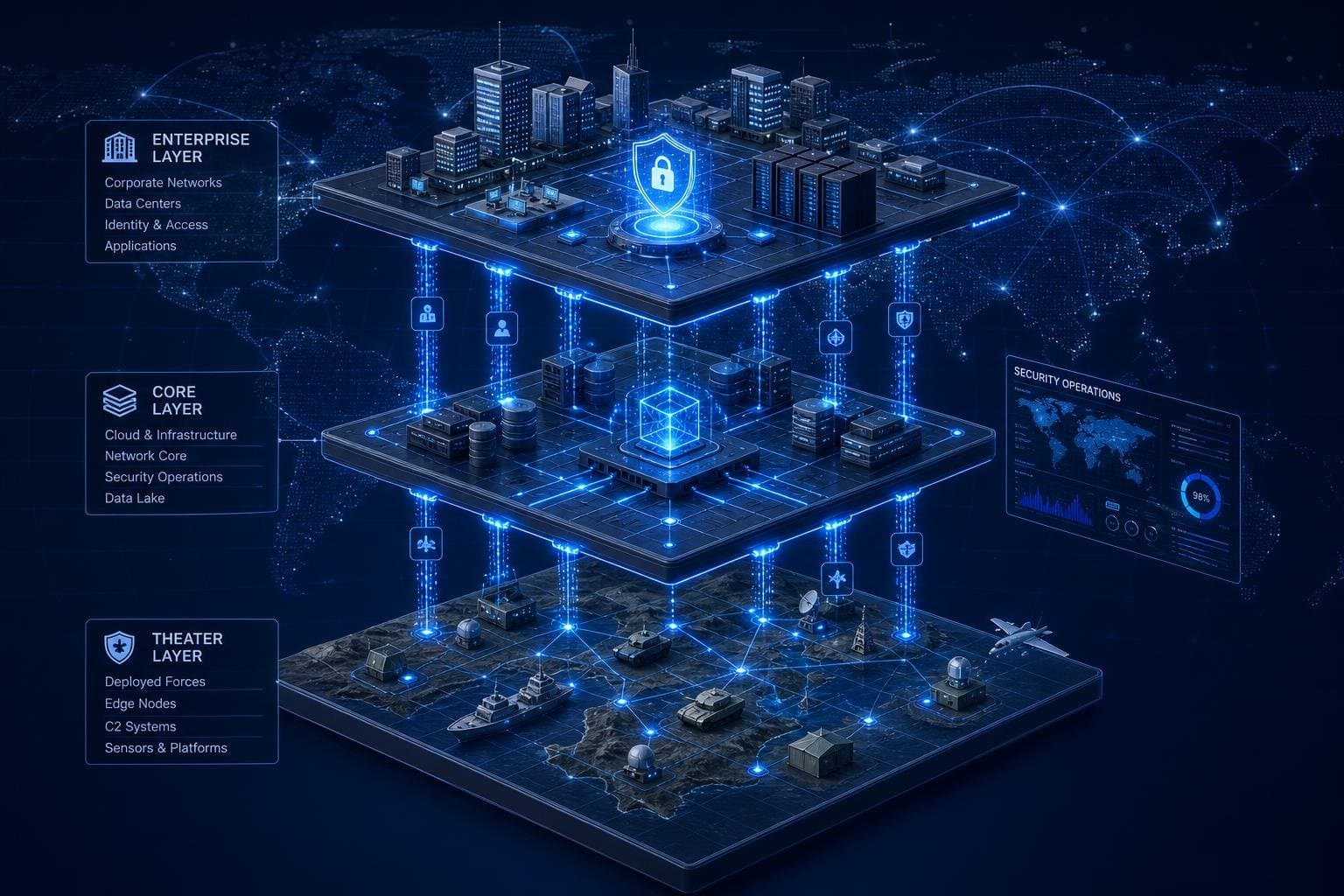
For startups, the implication is direct: the DoD's zero-trust architecture is increasingly a platform that new entrants must integrate with, not a blank canvas they get to design. That's a harder sales motion than it sounds. The companies that win won't just have good zero-trust technology — they'll have the integration track record and the clearances to plug into DISA's three-layer architecture (enterprise, core, and theater) without creating new security gaps in the process.
The Commercial Market Is Consolidating Faster Than the Pentagon Can Keep Up
While DISA is building the government-side architecture, the commercial zero-trust market is moving at a pace that makes Pentagon procurement timelines look geological. Zscaler launched what it's calling the first complete zero-trust platform for agentic AI at its Zenith Live 2026 conference, extending its Zero Trust Exchange to cover AI agent communications, endpoint AI threats, and data lineage tracking across enterprise environments. The new AI Broker secures Model Context Protocol and Agent-to-Agent communications — the emerging standards for how AI agents talk to each other and access data.
That matters for defense procurement because the Pentagon's own AI ambitions are scaling fast. The DoD is requesting close to $30 billion in fiscal 2027 to build out AI supercomputing infrastructure through its new "AI Arsenal initiative" — SCIF-accredited data centers, next-generation GPUs, integrated compute across the joint force. Every one of those systems will need zero-trust security architecture. The question is whether the commercial platforms being built for enterprise AI environments can meet the DoD's classification and operational requirements, or whether defense-specific vendors will carve out that space.
The M&A data suggests the commercial players aren't waiting to find out. Twenty-six cybersecurity deals closed in May 2026 alone, including Cisco's roughly $400 million acquisition of Astrix Security to extend its zero-trust architecture to AI agents, and Akamai's roughly $205 million acquisition of LayerX for AI and browser security. The consolidation logic is straightforward: zero-trust for agentic AI is a new enough problem that acqui-hiring the right team is faster than building. Defense-focused startups operating in this space should be watching these deals carefully — both as competitive signals and as potential acquirers.
The Workforce Problem Could Undermine the Architecture
None of this infrastructure matters if the Pentagon can't staff the people to run it. The DoD's announcement of "Cyber Mastery Incentive Pay" — C-MIP, set to go into effect October 1 as part of the Cybercom 2.0 initiative — is an acknowledgment that the military's cyber workforce problem is structural, not incidental. Gen. Joshua Rudd, head of U.S. Cyber Command, framed it as recognizing commitment in the most demanding roles. Former House Armed Services Committee staffer Joshua Stiefel called it "long overdue."
The program's two-layer structure — Skill Incentive Pay for technical growth, and a separate Special Duty Pay component — is directionally right. But the announcement notably omits the actual dollar amounts and qualification criteria, which limits its immediate credibility as a retention tool. For defense tech companies, this is actually a useful signal: the government is competing harder for cyber talent, which means the pipeline of cleared operators who might eventually move to the private sector is getting more expensive to access. Startups that have already built their clearance infrastructure and technical teams have a wider moat than they might realize.
The zero-trust modernization story isn't one contract or one company. It's a three-front competition — architecture, technology, and talent — playing out simultaneously. The startups that understand all three fronts are the ones worth watching.


