
The Air Force didn't announce a competition. It announced an architecture. That distinction is doing a lot of work right now.
When Trust Automation won a $490 million IDIQ contract in August 2025 to deliver its Small-Unmanned Air Defense System (SUADS) — covering rapid-deployable, fixed-site, and expeditionary variants — it didn't just win a contract. It became a platform. And platforms attract subcontractors the way gravity attracts mass.
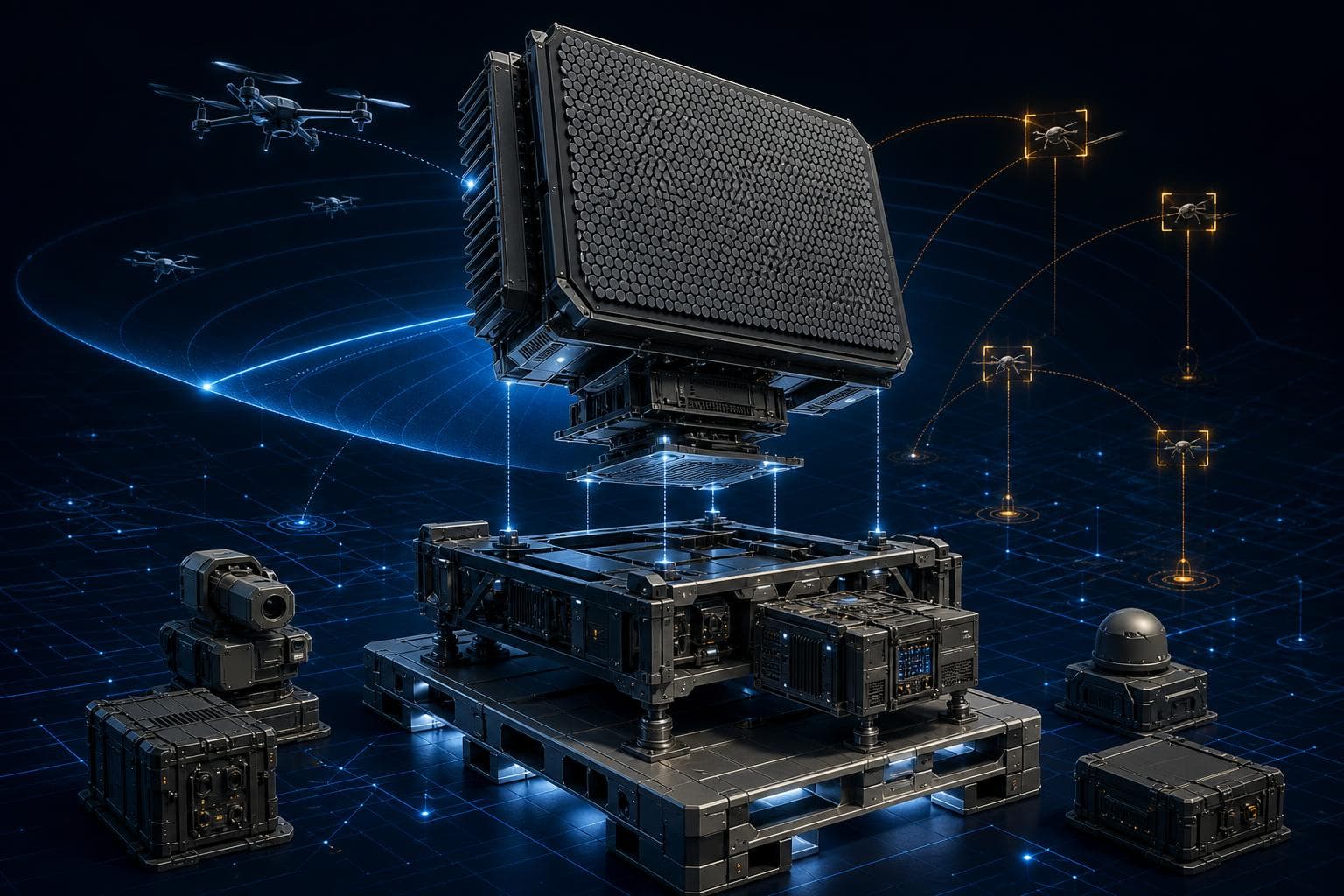
That's how Echodyne, a Kirkland, Washington radar startup, just landed a primary sensor role inside the SUADS architecture. Its EchoShield radar is now the backbone detection layer for Trust Automation's counter-UAS platforms being delivered to the Air Force. The contract runs through August 2030. Echodyne didn't have to beat Raytheon in a head-to-head procurement fight. It had to be the best radar that fit the architecture — SOSA-compliant, commercially available, and machine-learning-capable. It was.
The Architecture Play Is the New Moat
This is the pattern worth watching, and it's different from how defense procurement worked even five years ago.
The old model: a prime contractor wins a massive development contract, builds everything in-house or through a small circle of approved suppliers, and the government gets whatever the prime delivers. Startups could spend years trying to crack that circle.
The new model: the government defines an open architecture standard — in this case, the Sensor Open Systems Architecture (SOSA) — and awards an IDIQ to a systems integrator. The integrator then selects best-of-breed components. Echodyne's EchoShield is, per the company, the first fully integrated SOSA-compliant radar solution within the SUADS platform. That's not a marketing claim — it's a technical certification that makes the radar interoperable across the entire platform family.
For startups, this changes the calculus entirely. The question isn't "can we win a Pentagon contract?" It's "can we become the default sensor, software layer, or effector inside an architecture that the Pentagon has already committed to scaling?" The latter is a much more tractable problem — and a much stickier business once you're in.
The Army Is About to Write Bigger Checks for the Same Problem
The Air Force's SUADS contract is notable, but it's a preview of a larger procurement wave. The Army's FY27 budget request sets aside $994 million for small counter-UAS capabilities — nearly double the $596 million in the FY26 enacted budget. The Army is explicitly building a "systems of systems" architecture: expeditionary platforms, sensors, effectors, and electronic warfare components designed to interoperate as a unified fire control system.
The largest single line item is $414 million for "operational" capabilities. Another $132 million goes toward effectors, including 800 kinetic systems and 24 units of the Next Generation cUAS Missile. The Army is also spending $165 million on fixed-site capabilities, partly driven by the ongoing regulatory friction between DoD and the FAA over what's permissible for base defense.
That last detail matters. The installation defense problem — protecting bases from drone threats without triggering FAA airspace conflicts — is one of the genuinely unsolved operational challenges in domestic military posture right now. Startups that can thread that needle, delivering defeat capabilities that work within FAA constraints, are solving a problem that money alone hasn't fixed.
What Echodyne's Win Actually Signals
I'd argue the Echodyne selection is less about one radar company and more about what the Air Force is optimizing for at the component level. EchoShield uses machine learning for target classification — the system improves operator response times by reducing the cognitive load of distinguishing a commercial DJI quadcopter from a weaponized Group 2 UAS. That's not a nice-to-have. In a dense drone environment, operator decision speed is the bottleneck, and ML-assisted classification directly addresses it.
The SUADS platform is also designed for transport aboard military aircraft on standard pallet dimensions. The expeditionary variant fits in checked-baggage-sized packaging and deploys from SUV-class vehicles. These aren't specs that emerged from a requirements document written in 2015. They reflect hard lessons from Ukraine and the Middle East about how counter-drone systems actually need to move and operate in contested environments.
The companies winning inside these architectures aren't winning on price. They're winning because their technical specifications map precisely onto operational realities that the legacy contractors were too slow — or too structurally incentivized — to address.
Watch for how the Army structures its FY27 IDIQ awards over the next 12 months. If it follows the Air Force's open-architecture model, the subcontractor selection process will tell you more about which defense startups have real staying power than any funding round announcement.
Pentagon Pulse: Defense tech venture funding has already reached $13.6 billion through mid-May — on pace to more than double 2025's record $8.8 billion total, per Crunchbase. Anduril's $5 billion Series H at a $61 billion valuation is the headline number, but the more interesting signal is the breadth: capital is flowing into the sector broadly, not just to one marquee name. The architecture-layer startups — the ones building the sensors, software, and effectors that slot into DoD's open-standard platforms — are the ones worth tracking as that capital deploys.


