
The Air Force just handed an AI-powered electronic warfare contract to Pacific Defense Solutions. That's the headline. The more interesting story is what it reveals about where spectrum dominance modernization actually stands — and why the Army's parallel EW program tells you more about the real trajectory than any single contract award.
Source [5] (AirPro News) confirms the USAF award to Pacific Defense, but the excerpt provides limited contract details — no dollar figure, no specific capability specifications, no program office named. So rather than overstate what that single data point shows, it's worth setting it alongside the richer picture emerging from the Army's EW modernization, where the procurement logic is now fully visible.
The Army Just Admitted Its Original EW Vision Was Wrong — and That's Progress
The most revealing EW story of the past two weeks comes from Augusta, Georgia, not from an Air Force contract announcement. At the TechNet Augusta conference, Mark Saxon, deputy project manager for Electromagnetic Warfare & Collection, told Breaking Defense something you rarely hear from a Pentagon program manager: "We shifted our whole mentality."
The program in question is the Terrestrial Layer System-Echelons Above Brigade (TLS-EAB), the Army's long-range ground jammer. Originally conceived around 2020 as a large, bespoke signals intelligence and electronic warfare capability for division and corps-level operations, it ran into the same wall that kills most Pentagon megaprograms — the operational environment changed faster than the requirements document could track.
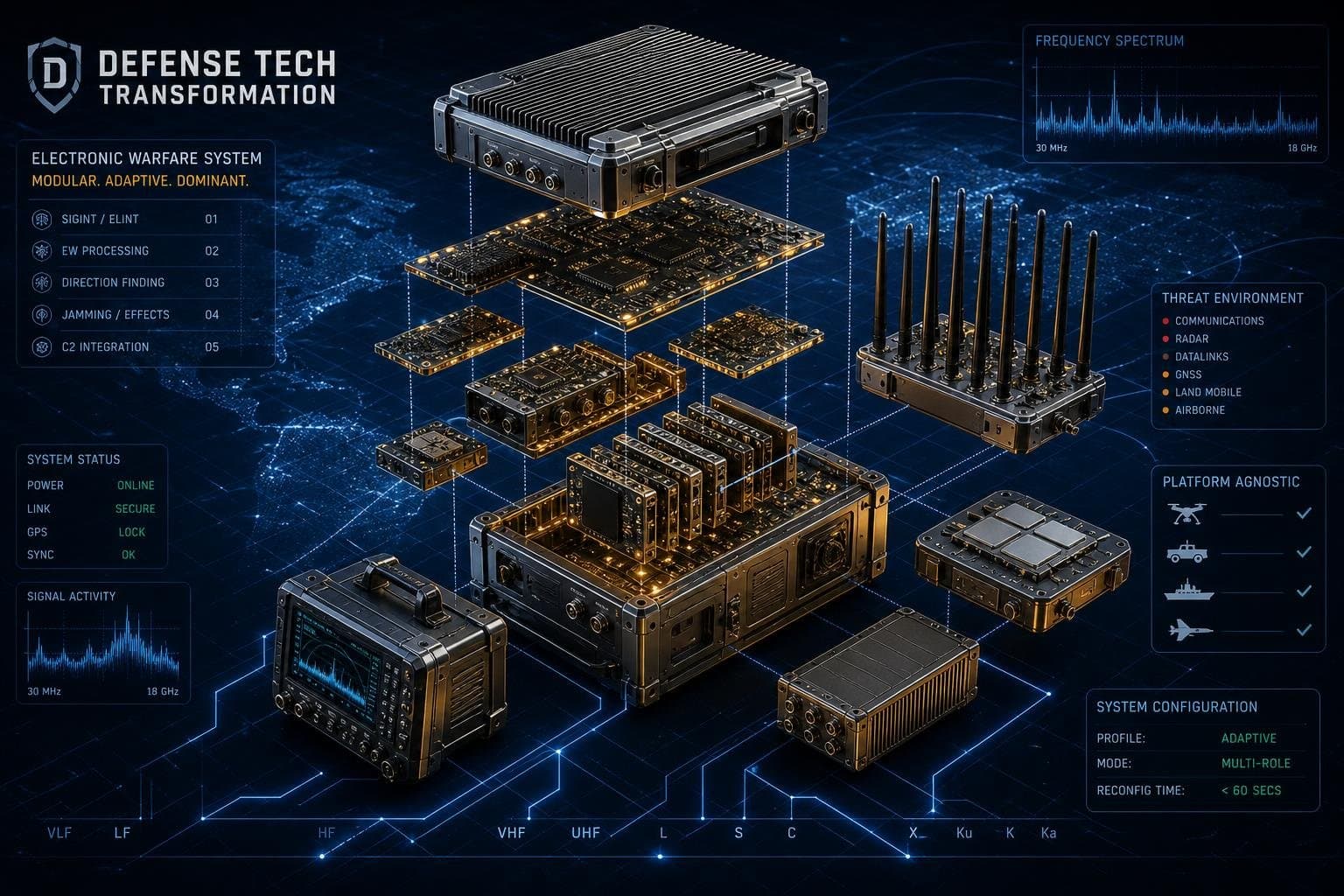
The Army's response was to go commercial-first and modular. TLS-EW now fits in a portable box that can be loaded onto different platforms rather than built into specific vehicles. Both the signals intelligence variant and the EW variant are slated for production in fiscal 2027, validated by prototype performance at Project Convergence and with the 25th Infantry Division in the Pacific.
Think about what that pivot actually means from a capability standpoint. A system that was once platform-dependent — tied to specific vehicles, specific echelons, specific threat assumptions — is now a portable module that can ride whatever platform the mission demands. That's not just a procurement reform story. That's a fundamentally different theory of how electronic warfare should work in a fast-moving, drone-saturated battlespace.
The Commercial-First Pivot Is the Real Procurement Signal
The TLS-EAB evolution matters for the Air Force AI-EW story because it illustrates the logic that's now driving spectrum modernization across the services. The old model — write detailed requirements, award a development contract, wait years for a bespoke system — keeps producing programs that are obsolete by the time they field. The new model starts with what commercial technology can do today and builds military-grade requirements around that baseline.
That's the environment Pacific Defense is operating in when it wins an AI-EW contract from the Air Force. The question worth asking — the one an early-stage investor would ask — is whether Pacific Defense's AI capability is genuinely modular and upgradeable, or whether it's another point solution that will need to be replaced when the threat environment shifts again in 18 months. The source pool doesn't answer that question definitively, but the Army's experience with TLS-EAB suggests it's the right one to press.
The broader pattern is also worth tracking through the lens of allied defense investment. Reuters reported that In-Q-Tel, the CIA-linked venture firm, has been actively helping European defense startups like German drone maker Quantum Systems break into U.S. markets — and is expanding its European investment focus as the continent ramps up military spending. IQT's involvement signals where the intelligence community sees technology gaps worth filling. Electronic warfare and spectrum management are consistently on that list.
What the NSA Bahrain Damage Tells EW Investors
There's a harder context underneath all of this. Defense News reported that NSA Bahrain sustained roughly $400 million in damage during the opening days of Operation Epic Fury — including communications towers — from Iranian strikes. A regional adversary degraded one of America's most significant forward bases in days.
That's the threat environment that makes spectrum dominance modernization urgent rather than aspirational. Communications towers are EW targets. The ability to jam, spoof, or blind adversary sensors while protecting your own communications infrastructure is exactly what programs like TLS-EAB and the Air Force's AI-EW contracts are designed to address. The Bahrain damage is a proof point that the investment thesis is real — and that the gap between current capability and what's needed remains uncomfortably wide.
Watch for two things in the next 90 days: whether the Air Force's Pacific Defense contract surfaces more detail on capability specifications (range, frequency bands, autonomy level), and whether the Army's TLS-EW production ramp in FY2027 attracts commercial AI partners who can upgrade the system's cognitive jamming capabilities without requiring a new program of record. The latter would be the clearest signal yet that the commercial-first EW model has actually taken hold.


