


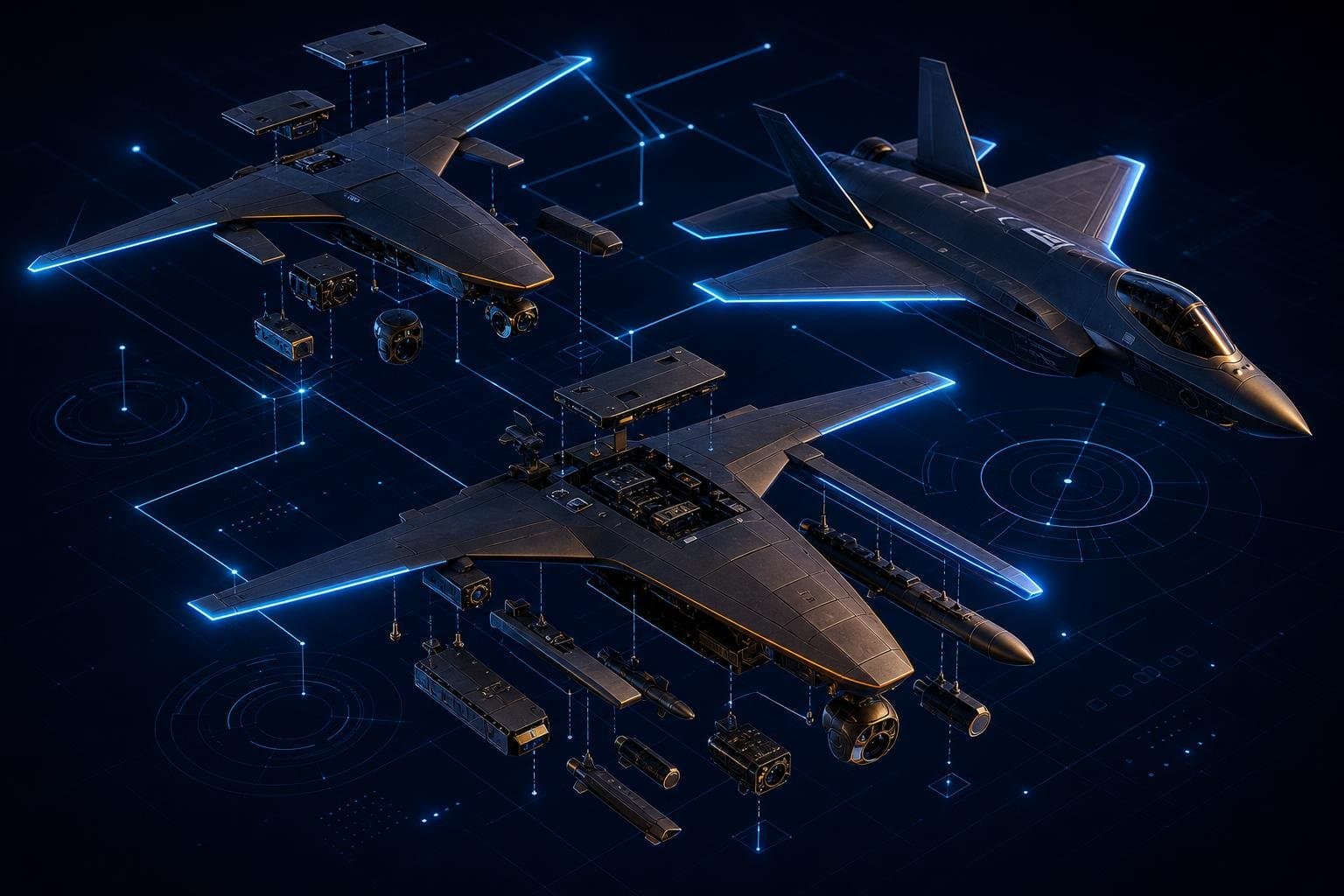

The contracts landed months ahead of schedule. That detail matters more than the dollar figures the Air Force declined to disclose.
Last week, the Air Force awarded full-scale manufacturing contracts to General Atomics (FQ-42) and Anduril (FQ-44) under its Collaborative Combat Aircraft program — moving from prototype to production in just over two years. Secretary of the Air Force Troy Meink framed it plainly: "By moving fast from competitive selection into full-scale manufacturing, we position ourselves to field highly credible and combat-ready semi-autonomous systems to stay ahead of the pacing challenge." The Air Force's stated end goal is roughly 1,000 combat-capable CCA, with continuous vendor competition built in to drive costs down as the fleet scales.
Early Production Is the Signal — Not the Milestone
The CCA program has always been about human-machine teaming: semi-autonomous wingmen that extend a crewed fighter's reach, awareness, and survivability in contested airspace. What the ahead-of-schedule production award confirms is that both aircraft actually meet mission requirements — this isn't a contract to keep a promising program alive, it's a contract because the hardware works well enough to manufacture at scale.
That framing connects directly to a broader pattern in Pentagon autonomous systems spending. The FY27 NDAA drafts advancing through both chambers include new requirements for risk-informed rules on autonomous and AI-enabled systems that influence use-of-force decisions — which means the regulatory architecture for deploying these aircraft operationally is being built in parallel with the aircraft themselves. The Pentagon isn't waiting for doctrine to catch up to hardware anymore.
The dual-vendor structure is worth watching closely. Keeping General Atomics and Anduril in continuous competition isn't just procurement hedging — it's a deliberate cost-control mechanism for a program aiming at four-digit fleet numbers. The FT reported that wars have triggered a $12 billion venture capital rush into defense tech broadly, and the CCA award is exactly the kind of production-scale validation that downstream investors in autonomous systems suppliers will be tracking.
The question for the next 18 months: which of the two platforms earns the larger production share, and whether the Air Force's continuous-competition model actually holds when manufacturing pressure builds. Early production is where the cost curves diverge. Watch the per-unit economics, not the headline contract values.