
The assigned topic — venture-backed AI counter-drone startups winning Air Force base air defense contracts — is directionally right but slightly ahead of where the sources land. What the sources actually show is more interesting: the Air Force just published a solicitation that makes the startup thesis explicit, and at least one venture-backed company is already scaling production to meet demand from adjacent services. The picture is real; the contracts are still forming.
The Air Force Skipped Phase I — That's the Tell
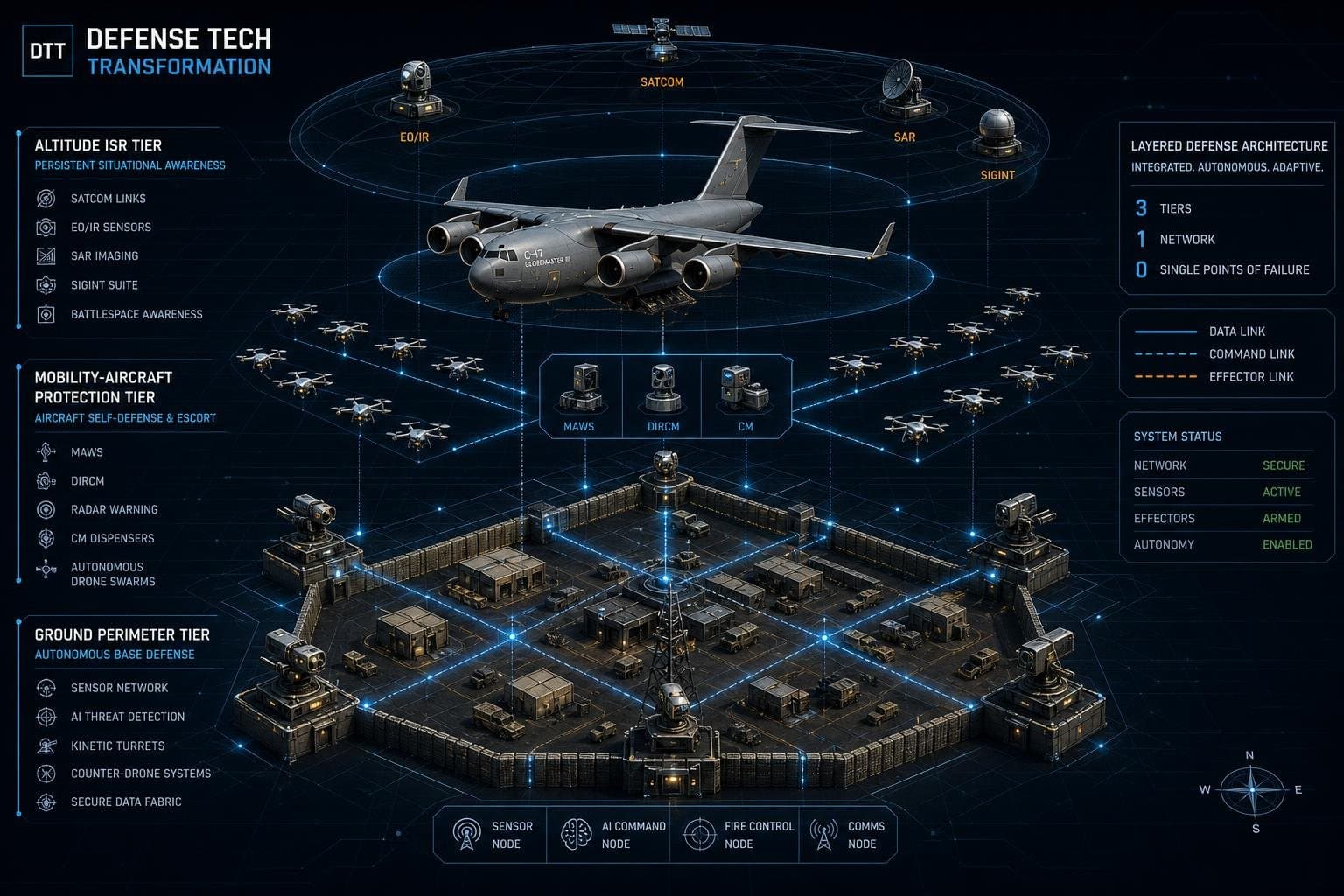
Defense News reported this week that the Air Force issued a Small Business Innovation Research solicitation seeking AI-controlled drone swarms capable of autonomously defending forward operating bases — and any aircraft parked there — from attack. The deadline is October 21. The concept: cargo planes become mobile launch platforms that deploy swarms on arrival, turning a C-17 or KC-135 into a self-deploying perimeter defense system.
The procurement signal buried in the fine print is the one worth watching. The Air Force is skipping Phase I of the SBIR process entirely and going straight to Phase II. The justification, quoted directly in the solicitation: "The fundamental scientific and technical merit of coordinating multiple uncrewed aerial systems via artificial intelligence has already been established by the private sector."
Read that again. The Pentagon is formally acknowledging that the commercial sector has already solved the underlying science. The government's job now is integration and deployment, not basic research. That's a meaningful shift in how the Air Force frames its relationship with the startup ecosystem — and it's exactly the kind of procurement signal that should move capital.
The solicitation describes a three-mission architecture: ISR from altitude, self-protection for mobility aircraft operating in contested airspace (a capability that would have mattered during Iranian strikes on American tankers and AWACS aircraft at Persian Gulf bases), and autonomous perimeter defense for forward operating locations. One SBIR, three operational problems. The Air Force is essentially publishing a requirements document and asking the private sector to fill it.
Allen Control Systems Is Already Running the Playbook
While the Air Force solicitation is forward-looking, Axios reported this week that Allen Control Systems is cutting the ribbon on a 191,000-square-foot manufacturing facility in Austin to scale production of its Bullfrog counter-drone turret. ACS raised $200 million this summer and was valued above $2 billion. Eighty turrets have been committed this year.
Bullfrog combines precision robotics, computer vision, and autonomous control to enable standard infantry weapons — the M240, M2, M230, and M134 — to engage small, fast-moving drones. The pitch is elegant: instead of burning expensive interceptors on cheap drones, you use the ammunition stockpiles that already exist everywhere. CEO Mike Wior framed it directly: "Getting this into the fight, leveraging the unlimited arsenal of 7.62 bullets that we have all over the world, is just a critical layer to being able to free up" higher-end resources.
ACS has signed contracts with the Army, Marine Corps, and Special Operations Command, and has buyers in South Korea and the UAE. The Air Force base security mission is a natural adjacency — the same threat profile, the same cost-per-kill logic, the same need for autonomous engagement at machine speed. Whether ACS competes directly for the new SBIR or positions Bullfrog as a complementary layer to whatever swarm system emerges, the company is building toward exactly the operational gap the Air Force just described.
The Directed Energy Layer Completes the Picture
The Army's parallel move adds context. Breaking Defense reported that AeroVironment received a $464.8 million contract for the Enduring-High Energy Laser program — the first production contract for a directed energy weapon in U.S. military history. AV's LOCUST X3 fires a 30kW laser capable of defeating Group 1 through Group 3 drones, and it's platform-agnostic: it fits on a Joint Light Tactical Vehicle rather than requiring a dedicated platform.
AV's VP of directed energy systems told reporters the company is currently scaling into the 20s of systems per year and expects to push well beyond that within 12 to 24 months. The cost logic mirrors ACS's: lasers reload from the power supply, not from a finite missile magazine. Against drone swarms, that matters enormously.
The emerging architecture looks like this: AI-coordinated swarms for ISR and perimeter detection, kinetic systems like Bullfrog for high-volume small-drone engagement, and directed energy for sustained operations without resupply constraints. No single company wins the whole stack. The Air Force SBIR is specifically targeting the swarm coordination layer — the piece that ties the others together.
What to Watch Before October 21
The SBIR deadline is the near-term forcing function. Watch which companies respond — particularly any that have already demonstrated autonomous multi-UAS coordination in contested environments, which the solicitation explicitly requires. The Phase II jump means the Air Force wants working systems, not research proposals.
The deeper question is whether the Air Force base security mission becomes a standalone procurement pathway or gets folded into the broader counter-UAS marketplace the Pentagon has been building. Either way, the solicitation makes one thing clear: the Air Force has decided the private sector already knows how to do this. The contracts are the next step.


