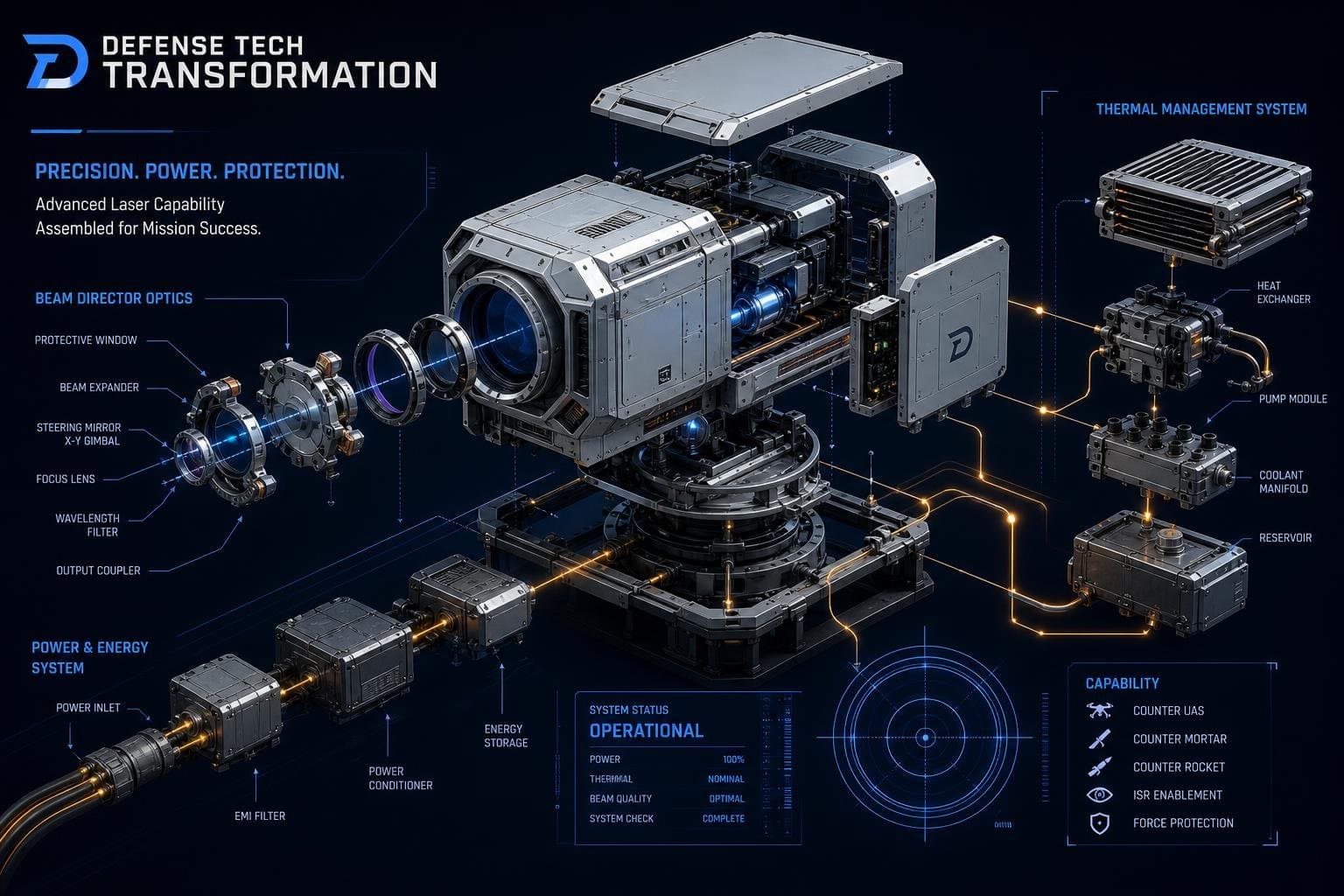

The Boeing Compact Laser Weapon System is now operating in "locations across the theater" across Europe and Africa — not in a test range, not in a demo for a defense secretary, but in actual deployment against real drone threats. U.S. Air Forces in Europe and Air Forces Africa confirmed the deployment on July 22, declining to specify exact locations for operational security reasons.
That's the signal the directed energy sector has been waiting years to receive. And the timing matters: a venture-backed startup called Aurelius Systems announced a $40 million Series A the same week, with plans to put its own laser counter-UAS platform into customer hands as fast as it can manufacture them.
The gap between those two stories — a Boeing system already deployed, a startup racing to compete — is where the interesting procurement question lives.
Boeing Proved the Concept; Startups Are Betting They Can Own the Next Generation
The CLWS is a Boeing product, which means it carries Boeing's cost structure, Boeing's supply chain, and Boeing's institutional relationship with the Air Force. A 5-kilowatt version of the system demonstrated its effectiveness against Group 3 drones in Saudi Arabia in 2024. That's a real capability milestone. But "it works" and "it scales affordably" are two different problems, and the drone threat the Air Force is now confronting — cheap, proliferating, asymmetric — demands the second answer as urgently as the first.
"The modern threat has erased the idea of a safe haven; inexpensive and highly adaptable UAS technology can hold any installation or operating location at risk," Air Force Col. Victoria Habas said in a statement. That framing — cheap drones threatening expensive installations — is precisely the cost asymmetry that makes the directed energy thesis compelling. An infinite magazine, powered by electricity rather than interceptors, is the right answer to a threat that costs $500 per unit to manufacture.
Aurelius is building directly at that problem. Its Archimedes system targets Group 1-2 drones — the cheap quadcopters and small UAVs that are flooding conflict zones — using electro-optical sensors, machine-learning-based autonomous tracking, and a laser that requires no human in the loop to engage. The system is designed to be platform-agnostic and field-portable: mountable on a truck, a UGV, or set up standalone in a field. Critically, it's built from mostly commercially available components, which is the startup's primary cost-control lever.
The Vertical Integration Bet Is the Real Strategic Move
The $40 million round — co-led by Draper Associates and KAS Venture Partners, with General Catalyst, Hanwha Defense USA, and several others participating — is notable not just for its size but for what Aurelius says it will fund. Beyond scaling production and expanding the team, the company is building out a directed energy component manufacturing line it announced in April.
CEO Michael LaFramboise told Tectonic that this will make Aurelius "one of two directed energy companies that's vertically integrated in the United States." That's a significant strategic claim. Vertical integration in directed energy means controlling the supply chain for the components that matter most — the laser sources, beam directors, and power electronics that currently create bottlenecks for the entire sector. If Aurelius can manufacture those components internally and sell them to competitors, it becomes infrastructure for the industry, not just a product company.
That's the kind of moat that justifies a Series A at this stage. Draper and General Catalyst, who also led the company's seed round last fall, are clearly betting on the platform play, not just the product.
The FY27 Budget Signal Is Real — But the Deployment Gap Remains
The Pentagon's FY27 budget request includes $2 billion for directed energy systems, and the Air Force's overseas deployment confirms the demand signal is operational, not theoretical. The question for startups like Aurelius is whether the procurement pathway from "impressive demo" to "deployed at scale" can be compressed. That's been the directed energy sector's persistent failure mode — I covered the deployment problem in depth back in July, and the Boeing deployment doesn't solve it so much as raise the stakes.
What's changed is the urgency. The Pentagon is simultaneously accelerating production of Patriot and THAAD interceptors — tripling PAC-3 capacity, quadrupling THAAD — because missile inventories have been depleted by conflicts in Iran and Ukraine. That's an enormous ongoing investment in kinetic interceptors. The Pentagon has been awarding mega contracts to firms as those war-driven demands intensify, which makes directed energy's pitch — that it eventually makes interceptor expenditure unnecessary for the drone tier of the threat — land with new urgency. The Air Force deployment suggests the argument is getting through.
Watch for whether Aurelius's manufacturing buildout produces a component supply agreement with a larger prime before the end of the year. That would be the clearest signal that the vertical integration strategy is real — and that the startup tier of directed energy is graduating from demo to supply chain.


