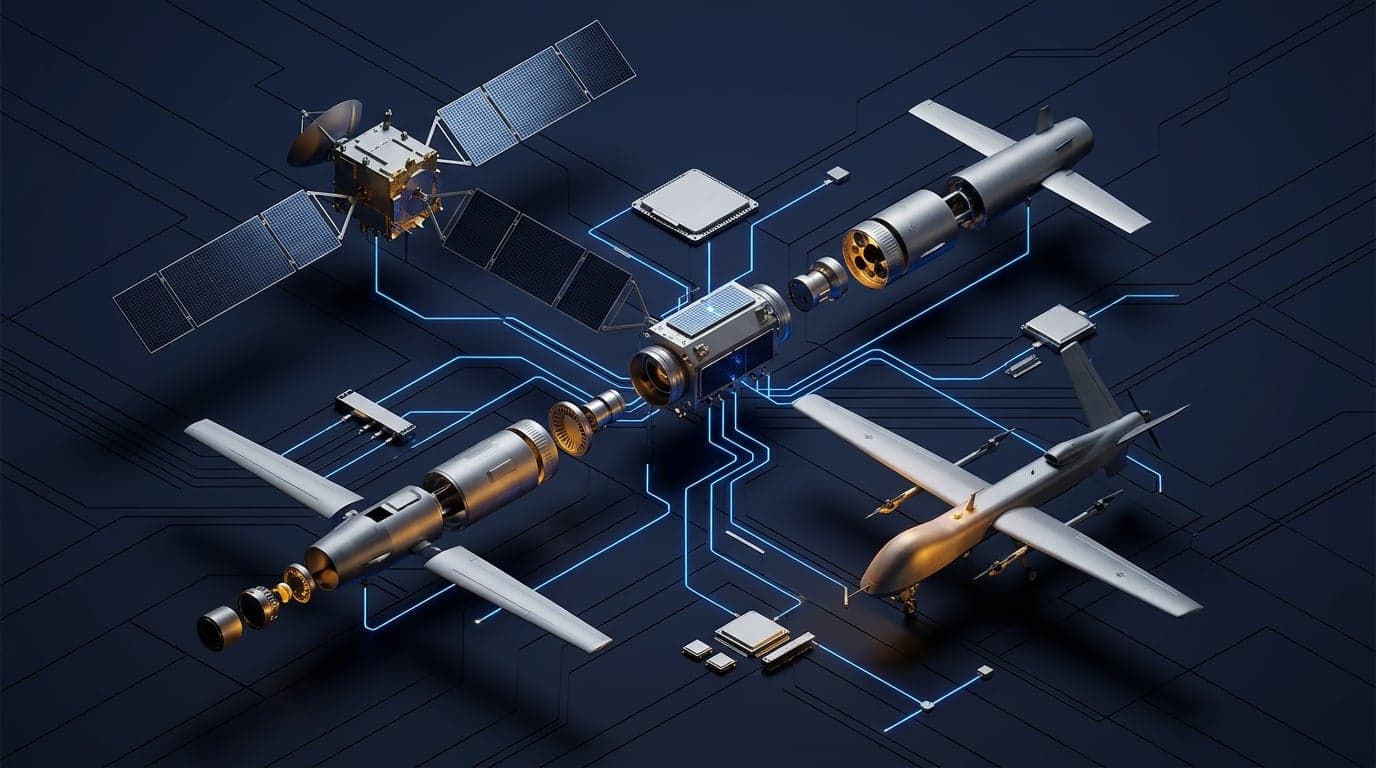

The assigned topic asks why traditional defense primes are acquiring venture-backed startups to stay competitive in AI-driven modernization. It's a reasonable directional question. The problem: this week's source pool doesn't confirm a wave of prime acquisitions. What it does confirm — with considerable force — is something more interesting: the startups are getting so large, so fast, and so institutionally credible that the acquisition model is being bypassed entirely. The primes aren't buying the future. The future is raising $1.8 billion at an $18 billion valuation and partnering with the primes on its own terms.
That's the story worth telling.
When the Startup Outgrows the Acquirer's Logic
The traditional acquisition playbook made sense in a specific era. A prime like Lockheed or Raytheon would spot a promising startup, acquire it before it scaled, absorb the technology, and fold the team into a program office where the institutional machinery could take over. The startup got an exit; the prime got a capability. Everyone understood the transaction.
That model assumed the startup needed the prime more than the prime needed the startup. The funding rounds happening right now suggest that assumption is breaking down.
Helsing's $1.8 billion Series E — Europe's largest-ever defense startup funding round — values the Munich-based AI company at $18 billion. Founded in 2021, Helsing is now worth more than many legacy defense firms that have been building weapons systems for decades. The round drew institutional capital from Goldman Sachs Alternatives' growth equity arm, JPMorgan Chase, the Canada Pension Plan Investment Board, Lightspeed Venture Partners, and General Catalyst, according to Bloomberg. Investor demand "significantly" exceeded the available allocation.
A company that can attract that kind of institutional capital — pension funds, major banks, top-tier venture firms — doesn't need to sell itself to a Lockheed Martin. It can dictate partnership terms instead. And that's exactly what Helsing is doing: its AI platforms integrate with Rheinmetall, Kongsberg, and Saab, but Helsing controls the software layer. The primes become hardware vendors in that arrangement. The startup becomes the system integrator.
This is a structural inversion, not just a funding milestone.
The Partnership Model Is Replacing the Acquisition Model — For Now
Helsing's product portfolio illustrates why the partnership dynamic works differently at this scale. The company offers the HX-2 strike drone, the Altra AI-enabled battlefield operations software, and the conceptual CA-1 autonomous fighter jet. These aren't niche capabilities that slot neatly into a prime's existing program. They're platform-level bets that compete with — or redefine — what the primes themselves build.
When a startup is building an autonomous fighter jet concept and raising at $18 billion, the acquisition math stops working. The acquirer would need to pay a premium on top of an already enormous valuation, absorb a culture that has explicitly positioned itself as an alternative to legacy defense, and then convince the talent that staying inside a prime's org structure is worth it. That's a hard sell to founders and engineers who just watched their equity appreciate to institutional-grade levels.
The smarter move — and what the evidence suggests is actually happening — is structured partnership. Helsing works with the primes. The primes get access to AI capabilities they couldn't build internally at this speed. Helsing gets distribution, manufacturing relationships, and the credibility of working with established defense brands. Neither party needs to own the other.
The same dynamic is visible at the program level in the U.S. The Space Development Agency's recent $1.75 billion contract award to L3Harris and Sierra Space for Golden Dome missile defense satellites pairs a legacy prime (L3Harris) with a newer entrant (Sierra Space) on an accelerated timeline. Sierra Space's CFO told Breaking Defense the contract is "finally flowing some money" into the Golden Dome architecture — language that suggests a company still finding its footing in the prime contract world, not one being absorbed by it. The SDA structured this as a competitive dual-award, not a subcontract relationship. Sierra Space is a peer, not a subsidiary.
The Directed Energy Contracts Show the Hybrid Model in Real Time
The directed energy awards from this week offer a cleaner window into how the prime-startup relationship is actually evolving — and it's more complicated than either "primes acquire startups" or "startups replace primes."
The Pentagon's Joint Laser Weapon System awards to Lockheed Martin Aculight and nLIGHT Defense are instructive. Lockheed Martin Aculight is itself a product of acquisition — Lockheed bought Washington-based Aculight in 2008 specifically for its directed energy expertise. That's the old model working as designed: acquire the specialist, fold it into a business unit, deploy the capability through the prime's contracting infrastructure. Lockheed Martin Aculight is now competing for contracts worth up to $847 million.
nLIGHT Defense is the newer entrant in this pairing. Its CEO Scott Keeney framed the award explicitly around the transition from "demonstration programs" to "production-oriented platforms that can be fielded across land and maritime environments." That's a company that has been through the prototype valley and is now competing for production-scale contracts alongside a legacy prime — not as a subcontractor, but as a co-awardee.
The Pentagon structured this as a parallel competition: two companies, two contracts, both developing 150 kW initial prototypes with a path to 300-500 kW systems for cruise missile defense. That structure forces the prime and the specialist to compete on capability and cost simultaneously. The prime can't coast on incumbency; the specialist has to prove it can scale. It's a procurement design that deliberately avoids letting either model — acquisition or pure startup — dominate.
Meanwhile, Rheinmetall and MBDA's contract to develop a laser weapon for the German Navy shows the same hybrid logic playing out in Europe. Both are established defense firms, but the contract structure — covering the full kill chain from reconnaissance to target engagement, with a "mid three-digit million-euro" value and a 2029 operational target — reflects the kind of accelerated, capability-specific contracting that used to be the exclusive domain of OTA awards and DIU experiments. The primes are adopting startup-style urgency because the threat environment demands it.
What the Singularity Round Reveals About the Next Wave
The Helsing round gets the headlines because of its scale. But Singularity's $80 million Series A, which closed this week with backing from Khosla Ventures, Felicis, New Enterprise Associates, and YCombinator, is arguably more revealing about where the acquisition question gets interesting.
Singularity is building lower-cost air defense countermeasures — explicitly positioned as cheaper alternatives to Patriot and THAAD-class systems. Co-founder Jack Oswald described the systems as targeting deployment in "two active conflict zones." The company is still in development, staying deliberately vague on specifications. At a $400 million valuation on an $80 million Series A, it's early enough that a prime acquisition remains plausible.
But notice the investor list: Khosla, Felicis, NEA, Menlo Ventures, YCombinator. These are not defense-specialist funds hedging toward an acquisition exit. These are Silicon Valley firms betting on a company that can grow to Helsing-scale on its own. The implicit message to any prime thinking about an acquisition offer: get in line, and bring a serious number.
The broader pattern across this week's funding activity — Helsing at $18 billion, Quantum Systems at $8 billion (per Defense News), Singularity at $400 million — is that the valuation curve for defense tech startups has moved decisively past the range where casual acquisition makes financial sense for most primes. Lockheed Martin's market cap gives it the theoretical firepower, but the integration risk and cultural friction of absorbing a company like Helsing at $18 billion would be enormous. The board math doesn't work the way it did when these companies were raising Series A rounds at $50 million valuations.
The Real Competitive Pressure Is on the Primes' Software Layers
Here's the underlying dynamic that the acquisition debate obscures: the primes' hardware businesses are largely safe. Nobody is disrupting the F-35 production line or the Virginia-class submarine program. The threat to legacy primes is specifically in the software and AI layers — the mission systems, the autonomy stacks, the battlefield management platforms — where startups can iterate faster, hire better engineers, and deploy more aggressively.
Helsing's Altra software is a direct play on this. So is Palantir's AI Platform, which I've covered previously in the context of its Pentagon wins. The common thread: these companies are building the cognitive layer of modern warfare, and the primes are increasingly dependent on them to make their hardware competitive.
The primes' response — acquiring laser specialists like Aculight, partnering with AI firms, competing for directed energy contracts alongside newer entrants — suggests they understand the threat. But understanding it and solving it are different problems. A prime that acquires a startup gets one team, one technology, one moment in time. The startups that are now raising at $8 billion and $18 billion are building platforms designed to compound — to get smarter with every deployment, every dataset, every conflict zone where their systems operate.
That's not a capability a prime can simply purchase. It has to be built, continuously, by people who want to build it. Which is why the partnership model — messy, negotiated, sometimes uncomfortable for both sides — is probably the dominant structure for the next decade, not the clean acquisition exit that both sides used to assume was inevitable.
Watch for whether any of the European mega-round companies — Helsing, Quantum Systems, ICEYE — pursue U.S. DoD contracts directly in the next 12-18 months. That's the moment when the partnership-versus-acquisition question gets genuinely urgent for American primes: not when a startup is raising a Series B, but when it's competing for Pentagon contracts from a position of financial independence and $18 billion in institutional credibility.


