
Most defense procurement stories are about money. This one is about time.
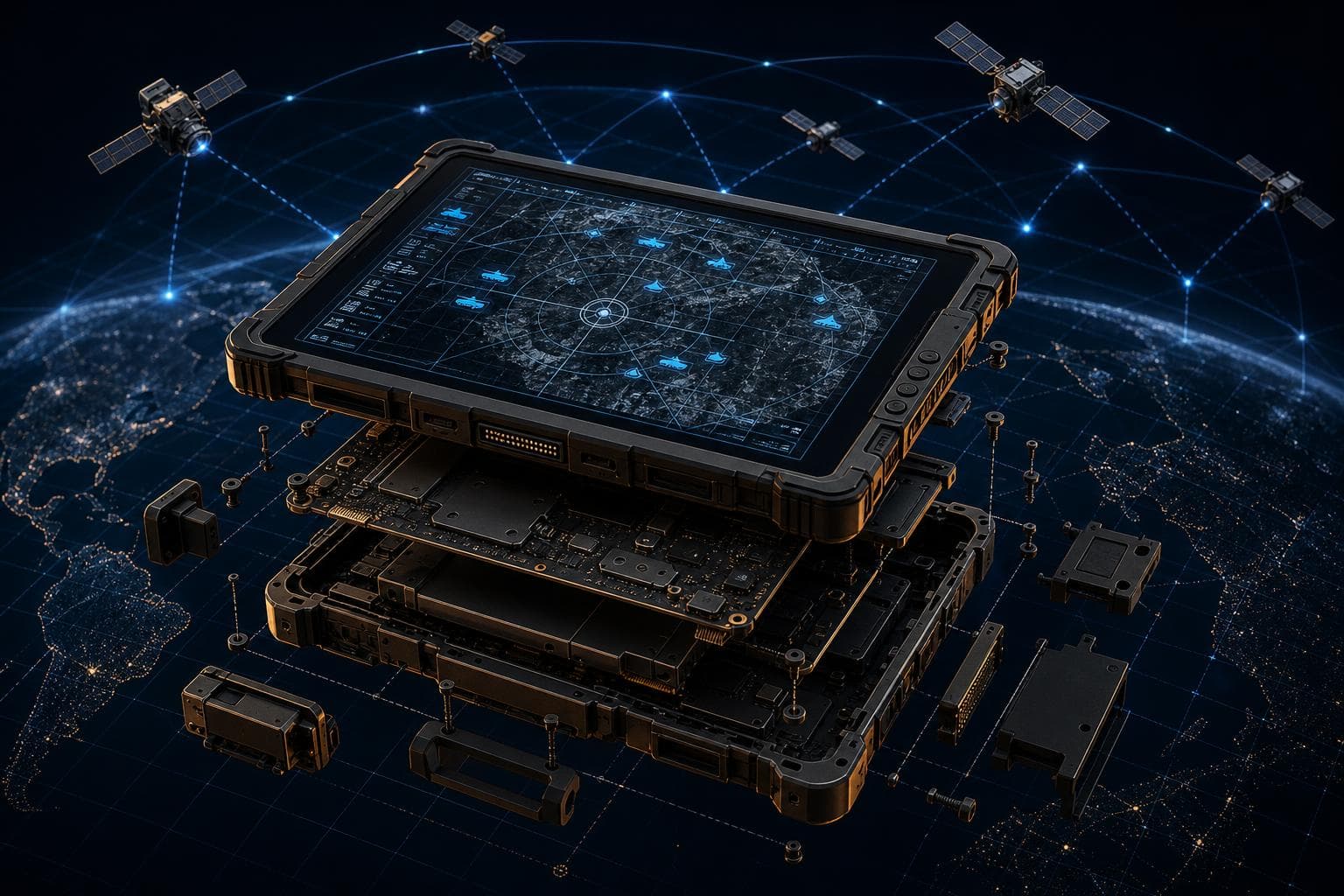
Last week, Breaking Defense reported that US Special Operations Command contracted Texas startup SkyFi to test a software platform that delivers unclassified commercial satellite imagery directly to warfighters in the field — including the ability for commanders to task a satellite for near-real-time imagery via a plug-in to the Android Tactical Assault Kit (ATAK) application. The contract value wasn't disclosed. What matters is the speed at which it happened, and what it reveals about how SOCOM has built a procurement pathway that the rest of the Pentagon still can't replicate.
SkyFi isn't a defense prime. It's a Texas startup that has been selling a commercial version of its imagery plug-in for roughly a year. Last May, it was one of 13 companies added by the Defense Innovation Unit to its Hybrid Space Architecture program. Now it has a SOCOM contract to build what CEO Luke Fischer calls a "Sovereign Intelligence Platform" — a web application and ATAK plug-in that is, in his words, "SOC peculiar." That phrase is doing a lot of work. It means SOCOM isn't waiting for a joint program office to define requirements, run a multi-year acquisition, and eventually field something. It's pulling a commercial platform into its own stack, on its own timeline, with its own terminology.
That's the SOCOM model. And it's worth understanding precisely why it works, because the rest of the Pentagon is still trying to copy it.
SOCOM Doesn't Win on Budget — It Wins on Organizational Design
The standard explanation for SOCOM's procurement speed is that it has special acquisition authority. That's true but incomplete. The deeper reason is that SOCOM operates as a unified command with its own acquisition executive — currently Melissa A. Johnson, who is scheduled to deliver a dedicated acquisition keynote at SOF Week 2026 in Tampa, May 18–21. That structure means requirements, funding, and contracting authority sit inside the same organization. There's no handoff to a separate service acquisition command. No inter-service coordination tax.
The result is a command that can move from "we need this capability" to "we have a contract" in a timeline that would be considered a rounding error in a standard Pentagon program of record. The SkyFi deal is a Phase I assessment — a prototype test, not a production contract. But that's the point. SOCOM uses Phase I to learn fast and fail cheap, then scales what works. The announcement explicitly noted that insights from this effort "will inform potential follow-on activities, which may include expanded integration tasks, additional imagery delivery mechanisms, and further assessment of data processing and visualization approaches." That's not bureaucratic hedging. That's a structured on-ramp.
The DIU connection matters here too. SkyFi's inclusion in the Hybrid Space Architecture program last year gave it a credentialing signal that SOCOM could act on. DIU functions as a pre-qualification layer — companies that survive DIU's process have already demonstrated they can work within DoD security and contracting frameworks. For SOCOM, that dramatically reduces the due diligence burden. The pathway from DIU to SOCOM prototype is becoming a repeatable pattern, not an exception.
What SkyFi Actually Unlocks — and Why the Capability Gap It Fills Is Significant
The technical problem SkyFi is solving is worth examining closely, because it illustrates why commercial integration is so valuable at the edge.
Individual satellite companies let customers task satellites, but coverage at any given time over any given area is constrained by constellation size, orbital position, sensor type, and atmospheric conditions. A commander in the field who needs imagery of a specific location in the next 30 minutes can't reliably get it from a single provider. SkyFi's platform aggregates roughly 150 commercial remote sensing providers and routes requests to whichever partner has a satellite positioned to respond fastest — then fuses data from multiple providers to build a clearer composite picture.
That's a meaningful capability jump. SOCOM currently uses ATAK for blue-force tracking — knowing where your own forces are. Adding near-real-time commercial satellite tasking to the same interface means a team leader can, in principle, look at the same device that tells him where his people are and task a satellite to show him what's around the next ridgeline. The intelligence and operational layers are collapsing into a single mobile interface. That's not an incremental improvement. It's a different way of operating.
The broader implication is about the commercial satellite ecosystem maturing to the point where it can serve as a real-time intelligence layer for small units. A year ago, this would have required classified systems and dedicated ground infrastructure. SkyFi is building it as a web application with an ATAK plug-in. The classification level — unclassified commercial imagery — is a feature, not a limitation. It means the platform can be shared with partner nations without the friction of classified information-sharing agreements.
That partner-nation dimension is directly relevant to SOF Week's Battle in the Bay demonstration on May 20, where US Special Operations Forces will work alongside ten partner nations on the Tampa waterfront. Interoperability standards are increasingly shaping which platforms move from prototype to fielded use. A platform that works on unclassified commercial imagery, delivered via ATAK, is inherently more interoperable than one that requires classified infrastructure on both ends.
The DIU C-UAS Solicitation Shows the Same Pattern Running in Parallel
The SkyFi contract isn't an isolated case. The same week, Defense News reported on a DIU solicitation for AI-enhanced target recognition to help troops, vehicles, and ships destroy drones — the C-UAS Close-In Kinetic Defeat Enhancement project. The solicitation's structure mirrors the SOCOM approach: phased development, prototype requirements, and explicit performance thresholds rather than open-ended requirements documents.
The specifications are precise. Phase one targets remote weapons stations, specifically CROWS turrets, with detection at ranges greater than 600 meters and engagement at a minimum of 100 meters against drones moving at least 30 meters per second. Phase three — the most ambitious — seeks aided target recognition for dismounted troops, with systems that can engage drones moving at 7 meters per second and must be "adaptable to dismounted legacy small arms, scalable across calibers and configurations." The solicitation deadline was May 15.
That specificity is the tell. Legacy procurement documents describe desired outcomes in vague operational terms and leave contractors to interpret them. This solicitation names the exact platform (CROWS), the exact weight class (Groups 1 and 2, under 55 pounds), the exact speed threshold, the exact engagement geometry (minus 10 degrees depression to 90 degrees elevation). A startup reading this knows exactly what to build and exactly how it will be evaluated. That's not an accident — it's a deliberate design choice to lower the barrier for non-traditional vendors who don't have decades of experience translating Pentagon requirements-speak.
The requirement that prototypes "be fired in land and maritime environments, rather than just a laboratory setting at time of pitch" is equally telling. DIU is explicitly filtering for companies that have moved beyond simulation — that have hardware that works in the real world. That's a maturity signal, not a bureaucratic hurdle. It's designed to surface companies that are ready to move toward production, not just toward another prototype.
The Structural Advantage That's Hard to Copy
Here's what the rest of the Pentagon keeps missing when it tries to replicate the SOCOM-DIU model: speed isn't the primary output. Learning is.
SOCOM's Phase I contracts are structured to generate information — about what works, what doesn't, what the operational integration challenges actually are when you put a new system in the hands of a team in the field. The SkyFi contract will tell SOCOM whether commercial satellite tasking via ATAK is operationally viable, what the latency actually looks like under field conditions, and whether the fusion of 150 providers produces imagery that's actually useful or just technically impressive. That information is worth more than the contract value.
The DIU C-UAS solicitation is designed the same way. The phased structure — remote weapons stations first, then maritime platforms, then dismounted troops — isn't just a sequencing choice. It's a learning architecture. Each phase generates data that informs the next. By the time the program reaches dismounted small arms, the fundamental detection and tracking algorithms will have been validated in two prior operational contexts.
Emil Michael, the Pentagon's technology chief, told the Washington Post that his job is to incubate a fleet of new companies that could rival the legacy primes. That framing gets the incentive structure right but misses the harder organizational problem: the bottleneck isn't finding companies, it's building the institutional capacity to learn from them fast enough to make production decisions. SOCOM has that capacity. The broader Pentagon is still building it.
What to Watch at SOF Week
SOF Week runs May 18–21 in Tampa, and the acquisition keynote from SOCOM Acquisition Executive Melissa A. Johnson is the session worth tracking most closely. If SOCOM is moving toward formalizing the DIU-to-SOCOM pipeline as a standard pathway — rather than a series of one-off arrangements — that announcement would likely come in that context.
Watch also for how partner-nation interoperability gets framed in the Battle in the Bay demonstration. If allied SOF units are operating with the same ATAK-based tools as US forces, that's a signal that the commercial integration model is already past the bilateral coordination stage. And watch for any SkyFi follow-on announcement: the Phase I assessment is structured to move fast, and a Phase II expansion would confirm that the Sovereign Intelligence Platform is on a production trajectory, not just a test one.
The companies that understand SOCOM's learning architecture — and build their products to generate useful operational data, not just impressive demos — are the ones that will convert prototype contracts into production relationships. That's the actual investment thesis here, and it's more durable than chasing contract values.


