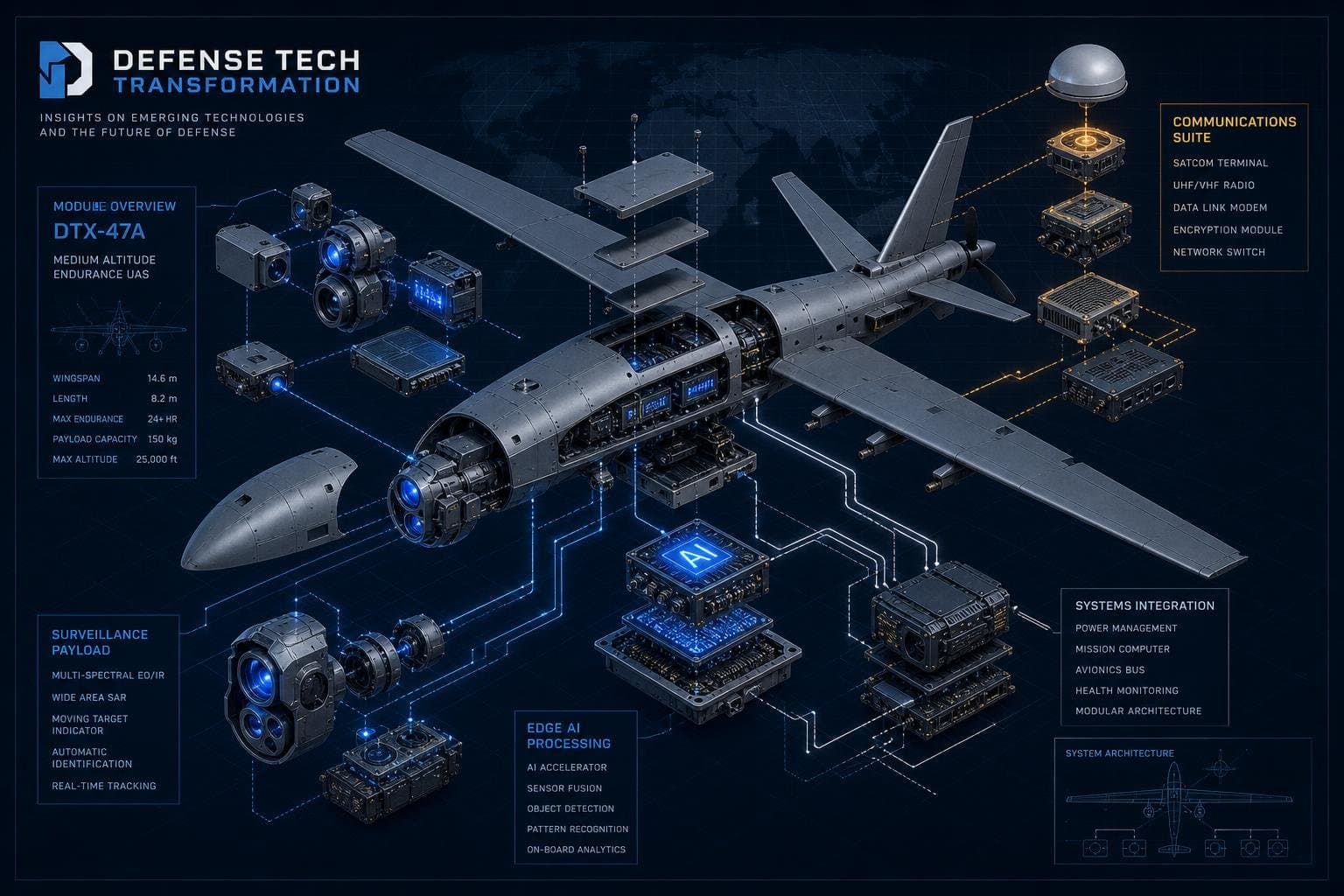

Seven hundred companies pitched. Fifteen made the cut. And the problems they were asked to solve — surveillance payloads for medium-sized drones, beyond-line-of-sight comms that don't depend on low Earth orbit satellites — weren't theoretical. They came directly from operational commands.
That's the signal buried inside Breaking Defense's report on the first-ever Accelerator Event hosted by the office of the Assistant Secretary of Defense for Special Operations and Low-Intensity Conflict (SO/LIC). The Pentagon's special operations office didn't just run an industry day. It ran a competitive filter designed to surface companies that can deliver capabilities SOF operators need now — not after a decade-long acquisition program grinds to completion.
"We have to break away from the tradition of grading our success on our ability to follow a process that we created," said Cara Teeter, deputy assistant secretary of Defense for Special Operations Analysis, Resources, and Capabilities, addressing attendees. SO/LIC Assistant Secretary Derrick Anderson framed it even more directly: this is "the direct manifestation of acquisition reform."
That framing matters. SOCOM has historically been one of the Pentagon's more agile buyers, but even it has struggled to move at the speed that modern battlefield intelligence demands. The Accelerator Event is an institutional admission that the old model — annual touch points with senior leaders, proposals that could be "obsolete within six months" — no longer fits the operational tempo.
The Problems Named Are the Investment Thesis
Read the specific capability gaps SO/LIC put on the table and you're essentially reading a venture pitch brief for edge AI.
Surveillance payloads for Group 3 medium-sized drones. Beyond-line-of-sight comms that bypass LEO satellite dependency. Both problems share a common architecture requirement: intelligence processing that happens at or near the sensor, not after a data packet makes a round trip to a cloud server. That's edge AI — the ability to run inference on compressed, power-constrained hardware in environments where latency or connectivity loss is mission-critical.
The broader defense tech funding wave confirms the demand signal is real. TechCrunch reports that venture funding into defense tech more than doubled in the first half of 2026 to over $12 billion, eclipsing the nearly $10 billion the sector raised across all of 2025. Anduril alone is reportedly in talks to raise at a $100 billion valuation — more than triple its mark from a year ago. Shield AI raised $1.5 billion in March. Helsing closed $1.8 billion this month at an $18 billion valuation.
The common thread across those rounds, per TechCrunch: a shift toward cheaper, more expendable hardware — "attritable" systems — rather than the expensive, irreplaceable platforms that defined defense contracting for decades. Edge AI is what makes attritable hardware operationally useful. A cheap drone that can't process what it sees is just a flying camera. One that can classify, prioritize, and act on sensor data locally is a battlefield intelligence node.
The Procurement Reform Angle Is the Real Story
What SO/LIC is doing structurally deserves as much attention as the specific technologies it's sourcing. The Accelerator Event isn't a contract vehicle — reporters weren't even allowed to stay for the pitches. But it's a proof-of-concept for a procurement philosophy that the broader Pentagon is trying to institutionalize.
Deputy Secretary Stephen Feinberg has been pushing a similar message from the top. Bloomberg reports that Feinberg announced a major overhaul of how the military buys weapons, warning that "we do things in a very old manner, a slow manner, a bureaucratic manner, and we must change that" — and putting contractors on notice that those who resist change "will be gone." His Economic Defense Unit is explicitly designed to accelerate production and counter China's industrial capacity.
The SO/LIC event and the Feinberg initiative are running on parallel tracks toward the same destination: a Pentagon that can identify, contract, and deploy new capabilities in months rather than years. For venture-backed startups, that's the structural unlock they've been waiting for. The technology has been ready. The procurement pathway is what's been missing.
New Market Pitch's analysis of the defense AI startup field puts the stakes in context: defense startups collectively still receive less than 1% of Pentagon contract spending. Anduril dominates the startup layer, but the wider defense industry remains overwhelmingly controlled by legacy primes. The gap between startup capability and startup contract share is where the reform pressure is building.
What to Watch Next
The SO/LIC Accelerator Event was explicitly framed as a pathfinder — a model for the broader department, not a one-off exercise. Watch for whether the 15 finalists convert pitches into OTA contracts, and how quickly. That timeline will be the real test of whether the new acquisition philosophy has teeth or is still mostly rhetoric.
The specific capability gaps named — drone surveillance payloads, resilient comms — also point toward which edge AI companies are worth tracking in the next funding cycle. The ones with demonstrated hardware integration at Group 3 drone scale, and comms architectures that don't depend on LEO connectivity, are solving exactly the problems SOCOM just said it can't wait on.


