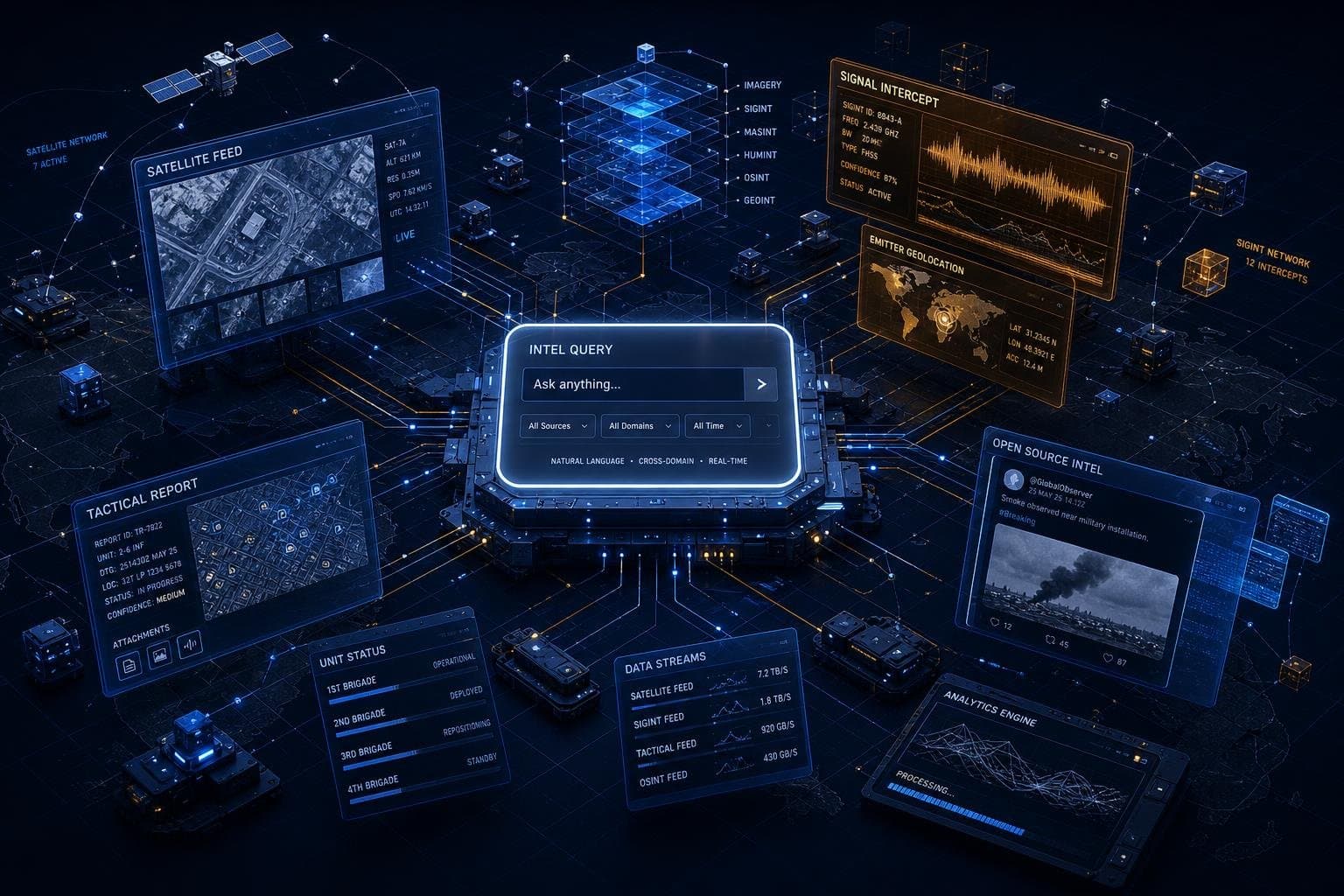

The assigned topic — venture-backed AI threat intelligence startups winning SOCOM intelligence fusion modernization contracts — is a compelling thesis. It's also one the current source pool can't confirm with the specificity it deserves. What the sources do show is a defense tech funding environment that's genuinely accelerating, and a set of capability gaps that make the broader thesis directionally credible. So let's work with what's real.
The Funding Signal Is Loud, Even If the SOCOM Contracts Aren't Named
This week's biggest venture rounds tell a clear story about where capital is flowing. Castelion, a hypersonic strike missile startup, pulled in $800 million in Series C equity plus $250 million in debt — a $13 billion valuation — led by JPMorgan Chase, Andreessen Horowitz, and Carlyle. Muon Space closed $250 million in Series C for satellite constellation work. These aren't seed bets on unproven ideas; they're institutional capital making large, confident wagers on defense tech companies that have moved past the demo phase.
The pattern I keep tracking in this newsletter is the gap between funding events and deployment events. Capital is necessary but not sufficient. What matters is whether these companies are actually getting embedded in operational workflows — and for intelligence fusion specifically, that question remains harder to answer from public sources than the funding story suggests.
QueryStory Points at the Real Problem
The most interesting company in this week's source pool for the intelligence fusion thesis isn't a defense contractor at all. QueryStory, which emerged from stealth today, was founded by Shapor Naghibzadeh — a Google engineer who spent years building tools for security analysts to query complex, disparate data during active cyberattacks, including during Operation Aurora in 2009. The company raised a $6 million seed round in late 2025 from Brightmind Ventures and New York Life Ventures at a $60 million valuation.
QueryStory's pitch is exactly what intelligence fusion modernization requires: the ability to assemble verified narratives from complex, heterogeneous data sources without requiring armies of analysts or data scientists. "You get this pattern of an investigation — you ask a bunch of questions of the data, and after you have been able to ask a number of questions, you assemble that together into a narrative," Naghibzadeh told TechCrunch. "That became the genesis for the name QueryStory."
QueryStory is currently aimed at enterprise customers — sales teams, operations managers — not SOCOM. But the underlying capability is precisely what intelligence fusion modernization needs: a system that can pull from disparate classified and unclassified data streams, surface verified answers, and present them in a form that a decision-maker can act on under time pressure. The founder's background in cybersecurity investigation is the kind of prior-domain expertise that tends to produce defense-relevant products even when the initial go-to-market is commercial.
This is the pattern worth watching: commercial AI tools built by founders with intelligence or security backgrounds, initially deployed in enterprise settings, then adapted for defense customers once the product has matured and the company has navigated the clearance and integration hurdles. It's slower than the SOCOM-contract-this-quarter narrative implies, but it's more durable.
The Capability Gap Is Real — The Contract Story Is Thinner
The broader context reinforces why intelligence fusion modernization is a genuine priority. Ukraine's accelerating domestic missile development — Fire Point's FP-7 ballistic missile is now weeks from combat use, striking targets up to 186 miles away — demonstrates how quickly adversary capabilities are evolving and how much pressure that puts on ISR and targeting systems to keep pace. The Navy's Silent Anvil air-launched torpedo program is explicitly designed around standoff engagement — which only works if the targeting intelligence is fast and accurate enough to justify the weapon's range advantage.
These aren't intelligence fusion contracts, but they're the operational context that makes intelligence fusion investment inevitable. Every standoff weapon system creates a corresponding demand for better sensor fusion and faster kill-chain integration. You can't shoot the archer if you can't find the archer.
What to Watch Instead of What to Assume
The honest investor read here: the SOCOM intelligence fusion modernization story is real as a direction, but the specific contract wins by named AI startups aren't confirmed in this week's reporting. What is confirmed is that capital is flowing into defense AI at scale, that the underlying capability gaps are genuine and growing, and that founders with intelligence and cybersecurity backgrounds are building tools that map directly onto those gaps.
Watch for DIU and SOCOM Other Transaction Authority awards in the next 60-90 days — that's where early-stage AI companies tend to get their first operational foothold before any larger contract vehicle becomes public. The funding rounds are the leading indicator; the OTA awards are the proof point. We're still waiting on the latter.


