


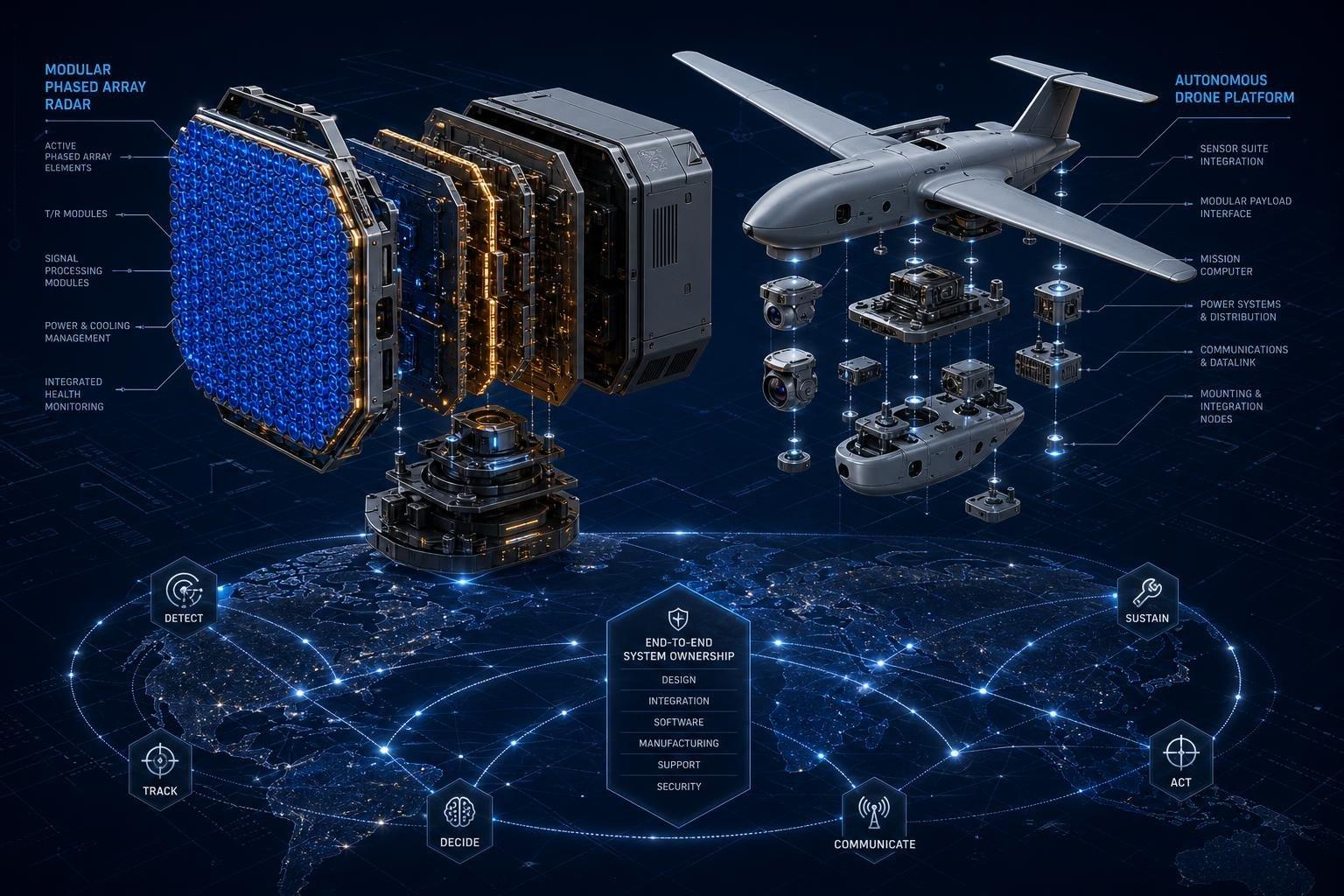

Shield AI just told you what it thinks the next decade of autonomous warfare actually requires: not just better software, but owning the sensor that feeds it. The company is acquiring radar maker Echodyne for $5.3 billion and raising $2.5 billion to fund it, including a $1 billion Series H that pushes its valuation to $28.8 billion — more than double the $12.7 billion mark it hit in a March raise, according to Bloomberg.
That valuation jump is the headline, but it's not the interesting part. The interesting part is what Shield AI is buying: a radar sensor company, folded directly into an autonomy stack. Most drone and robotics startups treat sensing as a supplier relationship — buy the radar, buy the EO/IR payload, integrate, hope the interfaces hold up under contract. Shield AI just decided that risk was expensive enough to acquire its way out of it.
Compare that to what the Space Force is dealing with right now. Breaking Defense reported this week that the service's marquee laser-communications backbone — built by SpaceX to link missile-tracking satellites for the Golden Dome architecture — can't actually talk to other Pentagon satellite constellations without an entirely new $1 billion layer of "translator" satellites, because the systems were built by different programs on different optical waveform standards (Breaking Defense). That's the cost of procuring sensors and comms as separate contracts awarded to separate primes on separate timelines. Nobody owned the integration risk until it was already baked into orbit.
Shield AI's bet is that owning the sensor stack end-to-end is cheaper than discovering, years into a program, that your radar and your autonomy software were never designed to speak the same language. It's the same logic playing out at smaller scale in the sensing world generally — Dutch startup Optics11 is fielding fiber-optic underwater listening tech directly with multiple navies rather than subcontracting through a prime, and its CEO describes the sensing requirements as tightly coupled to the platform they're mounted on, not a bolt-on commodity (Defense News).
The pattern across both stories is the same: sensing is becoming the thing companies vertically integrate, not the thing they outsource. If you're underwriting autonomy plays over the next two years, the question worth asking isn't whose software is smartest — it's who controls the sensor that feeds it, and whether that control was designed in from day one or bolted on after a billion-dollar integration bill arrived.