



The number that matters in Shield AI's latest funding round isn't $2 billion. It's 130.
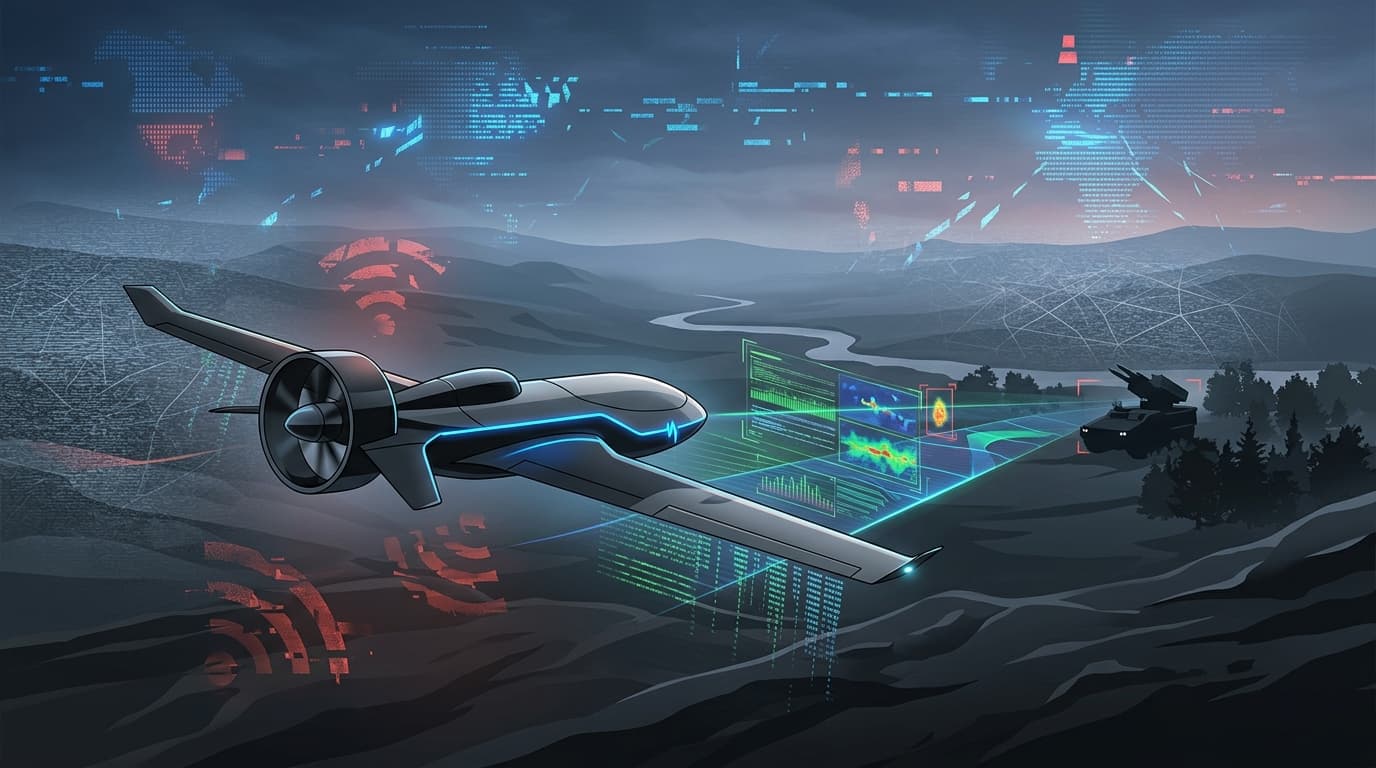
That's the number of sorties Shield AI's V-BAT reconnaissance drone has logged in Ukraine since June 2024 — operating in conditions of pervasive electronic warfare where GPS is jammed and communications are unreliable. According to reporting via The Next Web, Ukrainian forces used the V-BAT to locate a Russian SA-11 Buk-M1 mobile air defense system — a task that required the drone to navigate without GPS at all. That's not a demo. That's a capability proof in the hardest possible environment.
Shield AI closed a $2 billion raise at a $12.7 billion valuation, comprising a $1.5 billion Series G led by Advent International and co-led by JPMorgan Chase, plus $500 million in preferred equity from Blackstone. The valuation has grown nearly fivefold since October 2023, when the company was valued at $2.7 billion. That's a remarkable compression of time for a company selling hardware to governments under export controls — exactly the kind of deal that would have seemed unbankable to most Silicon Valley partnerships just a few years ago.
The Capability Gap This Round Is Actually Filling
Shield AI was built around a specific military problem: how do you conduct reconnaissance and strikes when the enemy has degraded your communications and jammed your GPS? The military calls these DDIL environments — disconnected, degraded, intermittent, or low-bandwidth. Most autonomous systems fall apart in them. Hivemind, Shield AI's AI pilot, is designed specifically to operate in them.
The system uses onboard sensors and onboard reasoning rather than relying on external navigation signals. That's the architectural bet. And Ukraine has been validating it in real time.
What the new capital unlocks is scale — and simulation fidelity. Part of the proceeds will fund the acquisition of Aechelon Technology, a simulation platform that supports the Pentagon's Joint Simulation Environment. That's a quiet but important move. You can't train autonomous combat pilots at scale in the real world. You need simulation infrastructure that accurately replicates the electromagnetic environments, sensor degradation, and adversarial conditions where these systems actually have to perform. Acquiring that capability rather than licensing it gives Shield AI control over its own training pipeline — a meaningful competitive advantage as the company pushes Hivemind onto larger and more complex platforms.
Why the Money Is Flowing Now
Shield AI's round doesn't exist in isolation. Venture capital firms deployed over $9 billion into defense technology in 2025, the highest annual allocation in over a decade, according to Axios Pro (via Angel Investors Network). S&P Global confirms that VC investment in defense tech hit record highs in 2025, even as M&A activity slowed.
The investor logic has shifted. Defense tech used to be the category serious venture firms avoided — long sales cycles, government customers, export controls, hardware risk. Now those same features look like moats. A DoD contract customer can't churn overnight. Multi-decade procurement cycles create revenue visibility that consumer software can't touch. And geopolitical tension isn't abating.
I'd argue the deeper driver is that investors have finally internalized what Ukraine demonstrated: modern warfare is an autonomous systems competition, and the companies building the foundational AI pilots, navigation stacks, and simulation environments are the platform plays — not the drone manufacturers assembling commodity hardware on top of them. Hivemind is closer to an operating system than a product. That's the bet Advent and Blackstone are making.
Pentagon Pulse
The Shield AI round lands alongside a significant institutional signal: Reuters reported that a Pentagon memo indicates plans to adopt Palantir's AI as a core U.S. military system. The Pentagon awarded Palantir a contract worth up to $480 million in 2024, and Palantir's CTO told the House Armed Services Committee that Maven — the AI targeting and intelligence platform — had "tens of thousands" of users across the military.
Two data points in the same week: the Pentagon formalizing AI infrastructure at the institutional level, and the market pouring $2 billion into autonomous systems that operate when that infrastructure goes dark. Those aren't competing bets. They're complementary ones. The question worth watching is whether Shield AI's next major contract announcement reflects that institutional momentum — or whether it has to keep proving the capability one combat sortie at a time.