


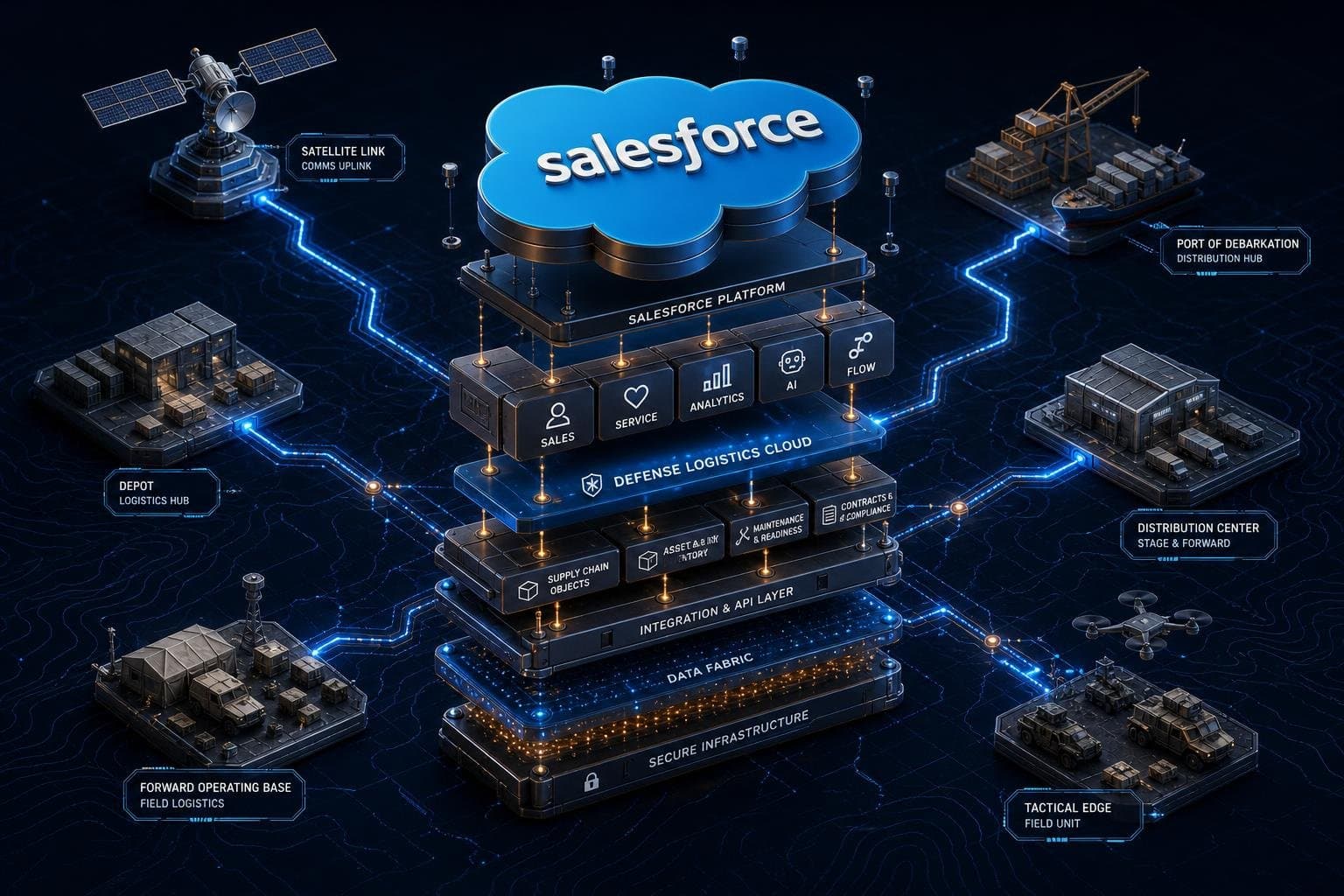

A CRM company now owns a battlefield logistics startup. That sentence should sit with you for a second, because it's not a metaphor — Salesforce agreed to acquire Rune Technologies for $375 million in cash and stock, a company that builds AI software to help the U.S. military predict supply needs and manage logistics from the field.
Rune is young — founded in 2024, and it had raised just $30 million total from Andreessen Horowitz, Point72 Ventures, and In-Q-Tel's venture arm before this deal, according to TechCrunch. A $127 million Series A valuation turning into a $375 million exit inside two years is a good outcome by any founder's math. But the more interesting number is Missionforce, Salesforce's national security business unit, which has grown 80% year over year since launching last year and already holds a 10-year, $5.6 billion Army contract. Rune doesn't get bolted onto Salesforce as a trophy — it extends Missionforce from back-office planning into actual frontline data, which is the harder, messier, more valuable layer of the stack.
This is the tell I keep coming back to. The acquirer here isn't Lockheed, isn't Palantir, isn't even a defense-focused prime. It's a $300 billion enterprise software company treating defense logistics software as a bolt-on to a buying spree that also grabbed Intercom for $3.6 billion and Qualified for $1.2 billion. Defense tech isn't being absorbed by the defense industrial base anymore — it's being absorbed by whoever already owns the enterprise software relationship with the Pentagon's back office.
That matters for how you read the capital flowing into this space right now. Disruptive just closed a $10 billion fund. Billion-dollar checks into late-stage defense and AI companies assume there's an exit path waiting on the other end. Rune just drew that path in ink: not an IPO, not a merger with a prime, but acquisition by a software giant that wants the data layer, not the hardware.
If you're underwriting a defense logistics or C2 startup right now, the exit comp isn't Anduril. It's Rune — a $30 million raise that became a $375 million sale to a company that had never built a tank or a drone in its life. Watch which other enterprise software players start sniffing around battlefield data companies next; that's where the next acquisition is going to come from, not from the primes everyone keeps watching.