


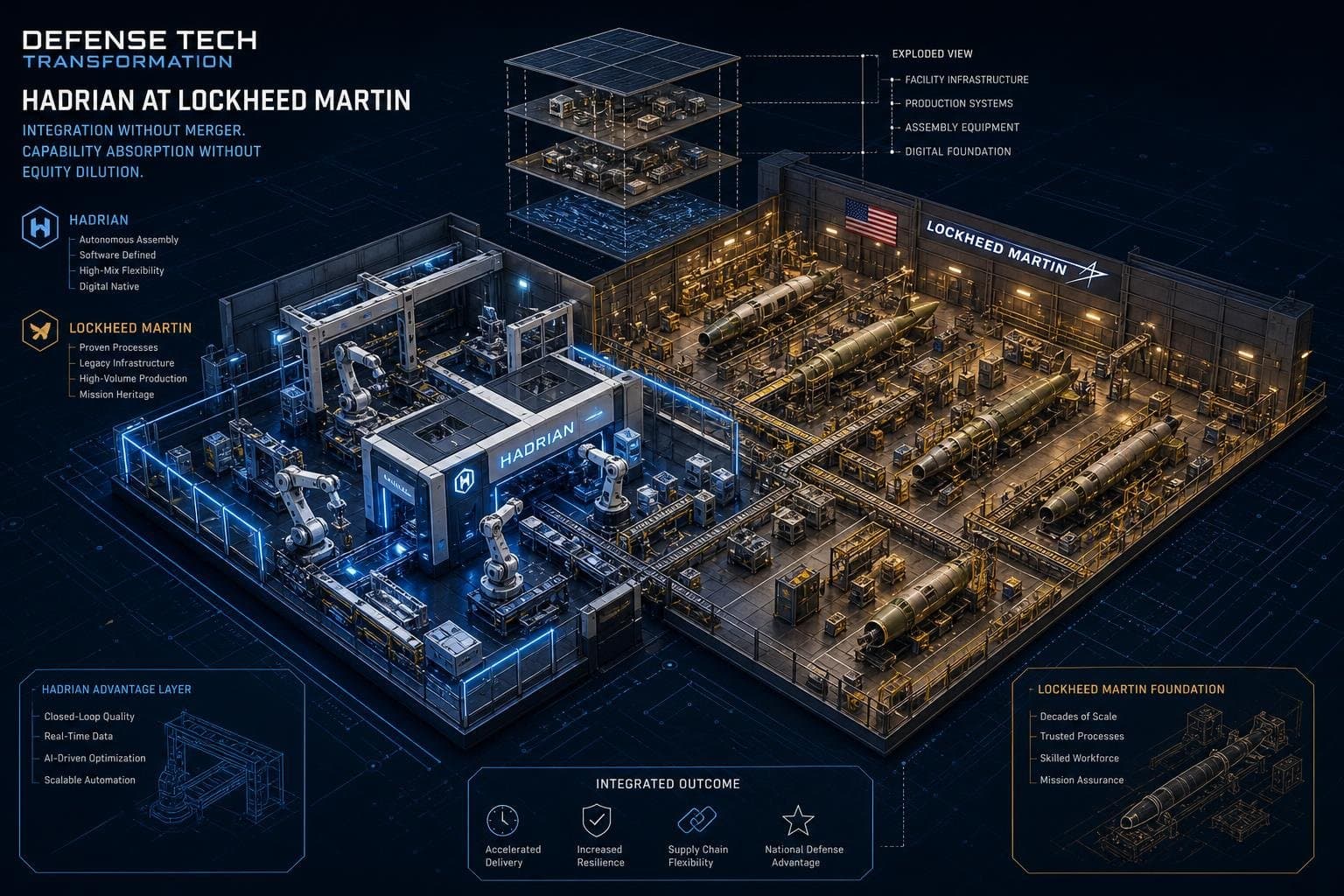

Lockheed Martin didn't write Hadrian a check. It gave the startup floor space.
Under the deal detailed by Defense News, Hadrian is installing 24 automated machines inside Lockheed's Grand Prairie, Texas missile plant as part of a $300 million expansion — but Lockheed employees will run the equipment, not Hadrian's. That's not a corporate venture arm cutting an equity check into a disruptive startup and hoping for a return. It's a manufacturing integration deal, following a memorandum of understanding the two companies signed back in December 2025. If you were expecting Lockheed, RTX, or Northrop to start running Anduril-style venture funds to get ahead of the startups eating their lunch, the current evidence points somewhere else: primes are either absorbing disruptive capability directly into their factories, or private equity is doing the consolidating for them.
The Capital Isn't Missing — the Structure Is
The AIA and Bain & Company spent months interviewing primes, startups, investors, and banks for a study released in late September, and their conclusion cuts against the "primes need venture arms" framing entirely. As Breaking Defense reported, venture funding into defense has grown tenfold since 2019, and defense stocks have nearly doubled their market capitalization to roughly $1.6 trillion. The problem isn't volume — it's that capital pools like private equity remain "relatively untapped" by defense companies, and the money that does flow skips over unglamorous bottlenecks like critical mineral refining and solid rocket motor production. AIA President Eric Fanning put it plainly: the issue is "how you incentivize it, move it towards defense, and things that you do that inadvertently create barriers to that type of investment."
That's a structural diagnosis, not a venture-arm diagnosis. If primes were quietly building CVC funds to get first look at disruptive startups, you'd expect the AIA-Bain study — which surveyed exactly those relationships — to say so. It doesn't. What it describes instead is a capital market that's grown dramatically richer in aggregate while still leaving the industrial base's hardest problems underfunded.
Private Equity Is Doing What a Venture Arm Would Do — Just Bigger
The closest thing to a prime-adjacent investment vehicle disrupting the disruptors isn't coming from inside Lockheed or RTX at all. It's coming from Blackstone. The firm is committing more than $1 billion in debt and equity to merge two companies it already owns, Applied Systems Engineering and Technology Service Corp, into a single defense-technology venture aimed at countering the kind of cheap, mass-produced drone threats that have rattled the Pentagon, according to Bloomberg.
That's the AIA-Bain gap being filled — just not by a prime's balance sheet. Private equity is stepping into exactly the role a prime venture arm might have played: aggregating smaller technical capability, injecting capital at scale, and building a platform company that can compete for Pentagon contracts without going through an existing prime's org chart at all. If this pattern holds, the disruption to incumbents isn't going to come from Lockheed quietly co-investing in its own competitors. It's going to come from financial sponsors building competitors from parts the primes never bothered to acquire themselves.
Meanwhile, Bloomberg's venture capital data shows just how concentrated the broader funding environment has become — 54% of 2026 venture dollars flowing to AI startups, and 88 billion-dollar-plus rounds now accounting for more than 60% of disclosed deal value. Defense tech is riding that wave, but it's riding it through traditional VC and PE channels, not through prime-sponsored vehicles built to co-opt the threat.
What I'm Actually Watching
The honest version of this story is less tidy than "primes build venture arms to defang disruptors." What's actually happening is a prime integrating a startup's hardware directly into its own factory floor, a private equity giant building a billion-dollar defense platform from the outside, and an industry-wide capital pool that keeps growing richer while still skipping the unglamorous industrial bottlenecks AIA and Bain flagged. For investors, that argues for watching where PE firms assemble platforms rather than waiting for a Lockheed Ventures to show up on a cap table. The Hadrian-Lockheed model — absorption without equity — may turn out to be the more common path for primes that want the capability without creating a shareholder in their own disruption.