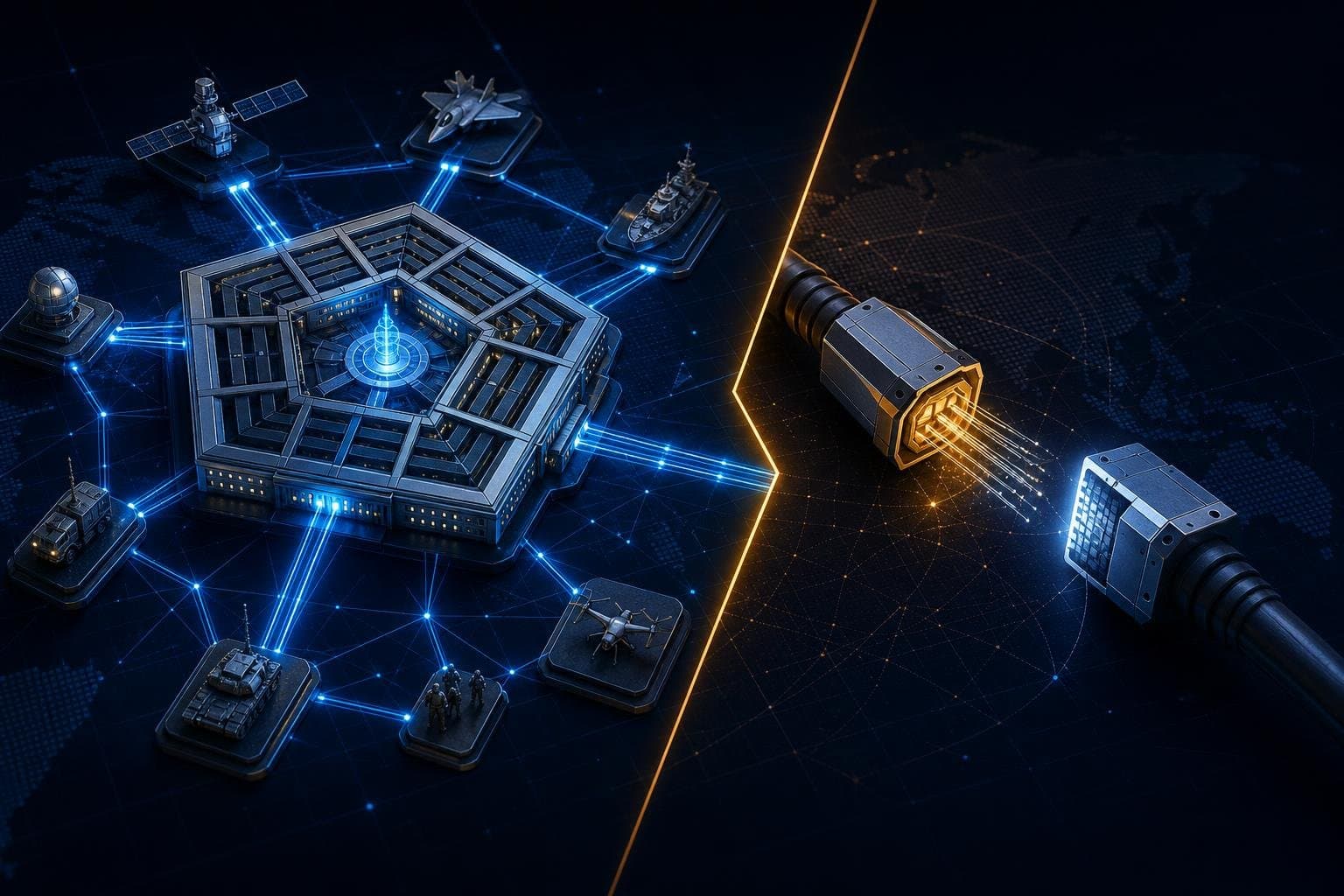

Palantir had two very different weeks depending on which side of the Atlantic you were watching.
In Washington, the Army announced that Anduril will lead the common data layer baseline for its Next Generation Command and Control program — with Palantir's Foundry as the data mesh backbone alongside Anduril's Lattice. In Paris, Reuters reported that France's domestic intelligence agency DGSI is terminating its Palantir contract in favor of a French rival, ChapsVision. Same company, same week, opposite trajectories.
The contrast is worth sitting with, because it tells you something real about where Palantir's competitive position is actually strong — and where it's becoming structurally vulnerable.
The Army Contract Is a Platform Validation, Not Just a Revenue Line
The NGC2 award matters more than its dollar figure suggests — and there isn't even a disclosed dollar figure. The contract was awarded under Anduril's existing 10-year, $20 billion ceiling enterprise licensing agreement with the Army, which means Palantir's Foundry rides in as a subcomponent of a larger platform play rather than as a standalone win.
That framing is significant. Breaking Defense reported that Anduril and Palantir have been prototyping the full NGC2 stack with the 4th Infantry Division for the past year, with the culmination sprint wrapping in May and Project Convergence testing scheduled for July. This wasn't a cold pitch — it was a year-long field trial that earned a production role.
What Palantir's Foundry actually provides here is the edge-to-cloud data mesh: the connective tissue that lets battlefield sensors, command systems, and AI decision tools share a common operating picture. That's a capability that didn't exist at this scale in legacy C2 architectures. The Army's NGC2 program is specifically about replacing the patchwork of incompatible data systems that have slowed decision cycles for decades. Foundry being embedded in that baseline means Palantir isn't just selling software — it's becoming part of the Army's data infrastructure at the architectural level.
That's the kind of position that compounds. Once a data layer is load-bearing, replacing it requires rebuilding everything above it.
The French Exit Is a Geopolitical Signal, Not Just a Contract Loss
The DGSI decision is a different kind of story. French Prime Minister Sébastien Lecornu was explicit about the reasoning: Reuters quoted him saying "we cannot rely on tools developed by foreign powers" and calling for France to develop its own AI tools. Bloomberg's coverage framed it in the context of a broader European reckoning with U.S. tech dependency — a reckoning accelerated by Trump administration unpredictability on trade, security commitments, and, most recently, the Anthropic access ban that cut off foreign nationals from advanced AI models.
Palantir's founding story — CIA-backed, Peter Thiel-led, built explicitly for intelligence and military applications — is a feature in Washington and a liability in Paris. The same provenance that makes it a trusted Pentagon partner makes it politically radioactive for European governments trying to demonstrate strategic autonomy.
ChapsVision, the French replacement, is a relatively obscure domestic player. The DGSI isn't switching because ChapsVision is technically superior. It's switching because the political cost of staying with Palantir now outweighs the switching cost. That's a different kind of competitive pressure than losing a contract to a better product — and it's harder to solve with better engineering.
The Asymmetry That Defines Palantir's Next Chapter
When I covered Palantir's dispute with the DIA last month, the story was about whether Palantir could maintain access to the procurement processes it needed to compete. The NGC2 award suggests that fight is going well domestically. The DGSI loss suggests the international picture is deteriorating for structural reasons that have nothing to do with product quality.
The Maven Smart System context makes this sharper. Fast Company reported that Palantir's Maven Smart System — the Pentagon's flagship AI targeting program — helped strike more than 1,000 targets in the first 24 hours of Operation Epic Fury. That operational record deepens Palantir's U.S. government moat considerably. It also makes the company's technology more politically charged for any allied government trying to maintain independent foreign policy positioning.
The investment environment reinforces this split. The Washington Times reported that defense tech companies have raised more than $14.6 billion in private investment so far this year, up from $9.6 billion in all of 2025. That capital is overwhelmingly flowing into U.S.-focused defense applications. The market is pricing in a world where American defense tech dominates American procurement — and where European governments increasingly build their own alternatives.
For investors, the question isn't whether Palantir is winning. It's whether the market they're winning is the one that matters most for long-term growth. The Army's NGC2 baseline suggests the answer is yes — for now. Watch whether Germany's Bundeswehr follows France's lead before the end of the year. That would confirm a pattern, not just an incident.


