
The Army doesn't hand out production-track contracts to companies that haven't proven their software in the field. That's what makes Overland AI's $20 million award for the Engineer Autonomous Breaching Capability initiative worth examining closely — not for the dollar figure, but for what it reveals about where the Army's autonomous ground vehicle program actually stands.
Breaching is one of the most dangerous tasks in ground combat. Engineers have to clear obstacles — minefields, barriers, fortified chokepoints — while under fire, to open routes for follow-on forces. The Army's EABC initiative is designed to shift that exposure from soldiers to machines, and Overland AI's selection signals that the service believes autonomous coordination software is mature enough to start doing it for real.
The Software Stack Is the Actual Product
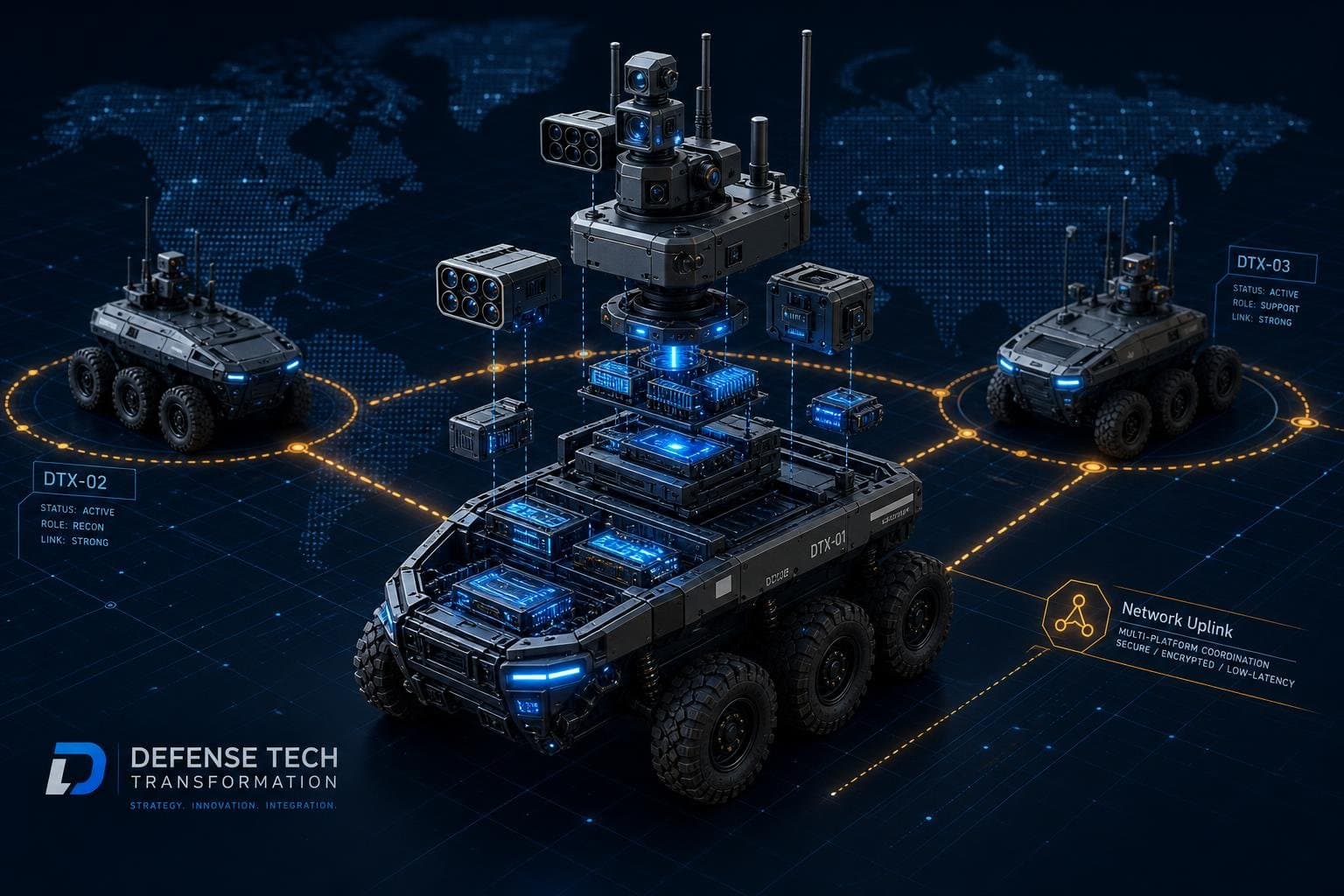
What Overland AI is selling the Army isn't a specific vehicle — it's OverDrive, a vehicle-independent autonomy software layer that can be integrated across different ground platforms. The key capability here is multi-vehicle coordination: a single operator managing several unmanned vehicles working together to clear obstacles, rather than requiring dedicated operators for each robot.
That's the architectural bet that matters. Vehicle-agnostic software means the Army isn't locked into a single hardware platform — OverDrive can theoretically ride on whatever ground vehicle the service decides to field next. For a procurement institution that has historically bought hardware first and figured out software integration later, this represents a meaningful inversion. The company will work with partners and subcontractors to deliver the full breaching package, which means the software is the prime, not an add-on.
Overland AI also didn't arrive at this contract cold. The company points to more than 25 government demonstrations with DARPA, the Defense Innovation Unit, and the Army itself — a track record that explains why the Army's Capability Program Executive Mission Autonomy selected them. That demonstration pipeline is increasingly how venture-backed defense tech companies earn their way into production contracts: prove the system works in front of the customer repeatedly before asking for a check. It's the same logic driving the Army's broader push to streamline acquisition and gain faster access to commercial technologies — a posture the service has been building across multiple programs, not just autonomous ground vehicles.
CEO Byron Boots framed the operational logic directly: "A breaching mission can be executed most effectively with truly autonomous vehicles." That's not marketing language — it's a statement about what the technology enables that human-operated systems can't match at the same risk profile.
The Logistics Gap Is the Next Frontier — And It's Harder
The EABC contract is about tactical mobility under fire. But the broader Army modernization push also encompasses last-mile logistics — getting supplies forward in contested environments where sending a human driver is an unacceptable risk. That problem is structurally similar to breaching (autonomous coordination, contested terrain, multi-vehicle operations) but operationally more complex because the mission profile is less defined.
The pressure is real and compounding. With stockpiles being drawn down by the Iran conflict and large-scale programs like Golden Dome creating new supply chain demands, the gap between what the military needs delivered and what it can safely deliver is widening. As one Accenture Federal Services executive put it at the Defense Industrial Base Accelerator in late August, the traditional model — years from whiteboard to operational deployment — "is a strategic liability." Autonomous ground vehicles that can move materiel forward without putting drivers in harm's way are the harder, more valuable piece of that equation.
The companies that solve last-mile autonomous logistics at scale will be operating in a much larger addressable market than tactical breaching. Breaching is a specialized mission with a defined operational context. Logistics runs continuously, across every theater, at every echelon. The autonomy software architecture Overland AI is building for EABC — vehicle-agnostic, multi-platform coordination, single-operator management — maps directly onto what last-mile logistics requires.
What the Investment Thesis Actually Says
I've been tracking autonomous ground vehicle contracts for this publication since the Army's autonomous ground vehicle prime contractor award in mid-2024. The pattern that's emerged is consistent: companies that built their credibility through government demonstration programs, rather than trying to sell finished products, are the ones converting into production contracts. Overland AI fits that model precisely.
The broader venture community is clearly paying attention to where autonomous systems and AI infrastructure intersect. Bain Capital Ventures just closed a $1.6 billion fund explicitly targeting early-stage companies in infrastructure and the physical world — the category that defense autonomy startups increasingly occupy. That capital is looking for exactly the kind of durable, government-anchored revenue that a program-of-record win represents.
The $20 million figure is modest by defense program standards, but the EABC contract is a development award — the production numbers come later if the system performs. For investors watching this space, the signal to track isn't the contract value. It's whether Overland AI's OverDrive platform gets written into the Army's program of record for autonomous ground systems. That's the decision that determines whether this is a $20 million contract or the foundation of something much larger.
Watch for the Army's next EABC milestone review and whether additional vendors get pulled into the program as subcontractors — that will indicate how seriously the service is treating this as a scalable architecture versus a one-off demonstration.


