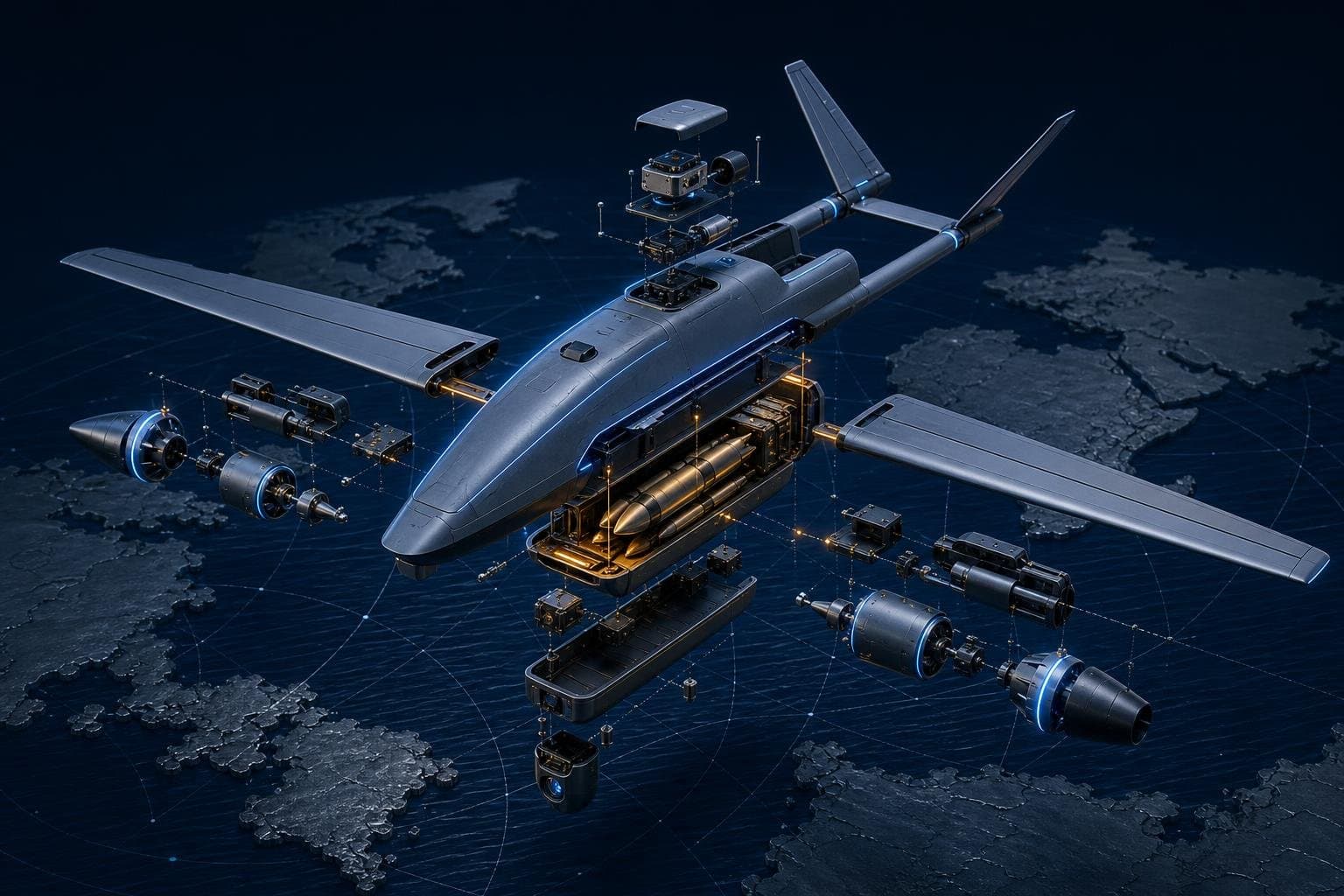

A 23-year-old who dropped out of MIT to build weapons with Home Depot parts just closed a $300 million Series C and won a DIU contract to deliver a 4,000-pound strike drone that can launch from a destroyer. That is not a pitch deck. That is a program.
Mach Industries founder Ethan Thornton told TechCrunch's StrictlyVC event last week that his company has now raised roughly $485 million altogether, is running six simultaneous weapons programs, and has won around 13 government contracts. Most of those contracts sit in the middle tier of defense procurement — past initial design, into range testing, but not yet at rate manufacturing. The goal, Thornton said, is to push three of the six programs into rate manufacturing by the end of this year.
The DIU contract announced this month is the most operationally ambitious of the six. The Runway Independent Maritime Expeditionary Strike (RIMES) program is the Navy's answer to a specific tactical problem: surface combatants like Arleigh Burke-class destroyers lack the flight deck infrastructure to support conventional fixed-wing strike aircraft, which limits their long-range punch in contested environments. The DIU solicitation called for a drone with a one-way range of at least 1,400 nautical miles capable of carrying 1,000-pound munitions — the same class of weapons that arm the F/A-18 Super Hornet — while launching from ships without large flight decks or from expeditionary locations with minimal infrastructure.
Mach's answer is a system called Atlas, developed in partnership with propulsion startup Whisper Aero. The aircraft uses Whisper's JetFoil propulsion system to achieve near-vertical takeoff without the thrust-to-weight ratio required for full vertical flight — which, according to Mach, results in significantly extended range and a dramatically reduced acoustic signature. That combination matters operationally: a quieter, longer-legged strike drone that doesn't need a carrier deck is a genuine capability the Navy currently lacks.
The Bet Thornton Is Making That Most Investors Won't
The standard venture playbook says focus. Pick one product, nail it, then expand. Thornton is explicitly rejecting that model, and his reasoning is worth taking seriously.
"It is a chess game you're playing with an adversary," he told TechCrunch, "with hundreds of different products that need to be shipped if we want security." The logic is that in defense, a single-product company is a single point of failure — both strategically and commercially. If one program gets canceled, a focused startup dies. If one capability gets countered, a focused program becomes irrelevant.
What Thornton is building instead looks more like a defense prime in miniature: six programs across strike, intercept, logistics, and stratospheric domains, all running simultaneously, all competing for rate manufacturing. The risk is obvious — none of the six is in full production yet, and the jump from a 13-foot aircraft to a 40-foot, 4,000-pound Navy strike platform is not incremental. But the upside, if even two or three of these programs reach rate manufacturing, is a company with diversified revenue streams and genuine multi-domain relevance.
That structure is increasingly what the Pentagon says it wants. The broader defense tech funding environment reflects the same logic: more than $14.6 billion flowed into military and national security startups in the first five months of 2026, according to Crunchbase data — already surpassing the previous full-year record of $9.6 billion set in 2025. Capital is chasing companies that can deliver across multiple capability gaps, not just one.
What the RIMES Win Reveals About DIU's Evolving Selection Logic
The RIMES award is also a signal about how DIU is thinking about vendor selection. Mach is not the obvious choice for a program of this scale. The company's largest aircraft to date has been roughly 13 feet long. Atlas, at 40 feet and 4,000 pounds, is a different category of system entirely.
DIU awarded it anyway — and paired Mach with Whisper Aero specifically for propulsion, rather than requiring a single-vendor solution. That structure suggests DIU is comfortable with a systems-integration model where a startup serves as prime and assembles best-of-breed components, rather than demanding a vertically integrated manufacturer. It's the same logic that made Anduril's Lattice platform attractive to the Army — not because Anduril builds every sensor and effector itself, but because its architecture connects them.
The parallel to Anduril is instructive but imperfect. Anduril's $20 billion Army enterprise contract consolidated over 120 separate procurement actions into a single vehicle — a level of institutional integration Mach is nowhere near. What Mach has demonstrated is something earlier and arguably more important: that a venture-backed startup with no legacy infrastructure can win a technically demanding DIU contract on the strength of a novel propulsion approach and a credible systems-integration plan.
Thornton says several Mach systems should reach operational deployment by the end of 2026. Watch that timeline closely. The gap between "won a DIU contract" and "operationally deployed" is where most defense startups lose the thread — and where Mach will either validate the multi-program bet or expose it.


