
A satellite startup just raised half a billion dollars at a $6.8 billion valuation — and the investors backing it read like a who's who of serious capital: Kleiner Perkins, Iconiq, Lightspeed, Alphabet's CapitalG, and Altimeter. That's not a speculative bet on space tourism. That's a conviction play on the Pentagon's growing dependence on commercial satellite infrastructure for intelligence, surveillance, and reconnaissance.
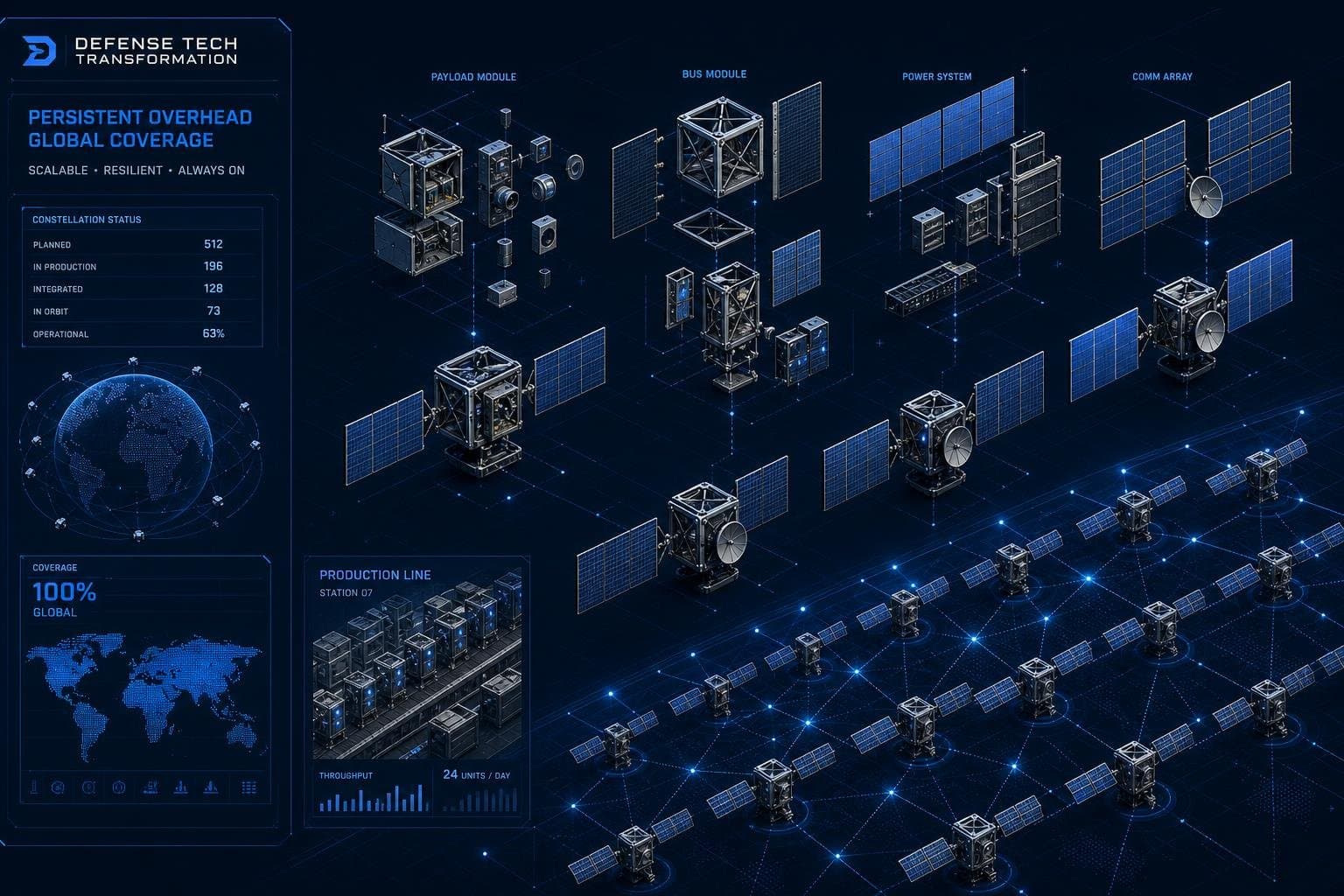
K2 Space, the Torrance-based company behind the round, builds large satellites optimized for high-power tasks — data-heavy communications and defense missions — and has already secured contracts with the Space Force. The company has now raised more than $1 billion cumulatively and is targeting production of 100 satellites per year. That manufacturing ambition is the tell. This isn't a company building one-off exquisite systems for a single government customer. It's building a production line — the kind of industrial capacity that changes what's possible for persistent overhead coverage.
The timing matters. The Pentagon's appetite for space-based ISR has never been higher, and the traditional model — a handful of classified national technical means, built over years, operated by a small priesthood of cleared analysts — is visibly straining under the demands of modern multi-domain operations. What's replacing it is messier, faster, and arguably more capable: a layered commercial ecosystem where startups compete on cost, revisit rate, and integration speed rather than classification level.
The Old Model Was Built for a Different War
The Cold War ISR architecture made sense for its era. You needed to surveil fixed targets — missile silos, airfields, naval bases — on a predictable schedule. A small number of high-resolution national technical means, tightly controlled and exquisitely capable, was the right answer when the threat was static and the decision cycle was measured in days or weeks.
That model started cracking in the 2010s and is now functionally obsolete for the conflicts the Pentagon actually fights. Modern battlefields — whether the drone-saturated skies over contested waters in the Persian Gulf or the fluid front lines in Ukraine — demand persistent coverage, rapid tasking, and the ability to push imagery directly to tactical users rather than routing it through a multi-day intelligence production chain.
The Pentagon's response has been to lean harder on commercial providers, and the commercial sector has responded by building toward that demand. The Space Force's contracts with K2 Space are part of a broader pattern: the military increasingly treating commercial satellite capacity as a core part of the ISR stack rather than a supplementary source of unclassified imagery.
What K2's $500 million raise signals is that the market believes this shift is durable and accelerating — not a temporary procurement experiment but a structural realignment of how the Pentagon sources overhead intelligence.
Why "Large Satellites for High-Power Tasks" Is the Right Bet Right Now
The commercial ISR conversation has been dominated for years by small satellite constellations — the Planet Labs model of many cheap birds providing frequent revisit rates at moderate resolution. That approach solved the revisit problem but created a different one: the data volume and processing demands of running hundreds of satellites often outpaced the Pentagon's ability to actually use the imagery at speed.
K2 Space is making a different architectural bet. Large satellites with high power budgets can carry more capable sensors, process more data on-orbit, and support the kind of data-heavy communications links that tactical users actually need. The tradeoff is cost and production complexity — which is exactly why the company's 100-satellites-per-year manufacturing target is the most important number in its pitch.
If K2 can actually hit that production rate, it changes the economics of the large-satellite segment the same way SpaceX changed the economics of launch. You stop treating each satellite as a bespoke program of record and start treating them as production units with predictable cost curves. That's the transition the Pentagon has been trying to force on its prime contractors for decades with limited success. A venture-backed startup with a manufacturing-first mindset might actually pull it off.
The investor syndicate reinforces this read. Alphabet's CapitalG brings obvious interest in the data processing and AI integration layer — the part of the ISR chain that turns raw satellite imagery into actionable intelligence at machine speed. Kleiner Perkins and Lightspeed have both made sustained bets on defense-adjacent infrastructure. This isn't tourist capital; these are investors who've done the diligence on the Pentagon's procurement trajectory and concluded that commercial satellite infrastructure is a durable growth market.
The Procurement System Is Trying to Keep Up — Unevenly
The institutional side of this shift is moving, but not uniformly. The Defense Innovation Unit and the Space Force have been the most aggressive in creating procurement pathways for commercial space companies. K2's Space Force contracts are evidence that at least some parts of the acquisition system have figured out how to move fast enough to be relevant.
But the broader Pentagon is still working through the cultural and bureaucratic implications of depending on commercial infrastructure for sensitive ISR missions. The SO/LIC Accelerator Event that Breaking Defense covered this week is instructive here. Special operations officials explicitly cited the need for "surveillance payloads on Group 3 medium-sized drones" and "beyond-line-of-site comms that don't use low Earth orbit satellites" as operational problems they're trying to solve through accelerated commercial procurement. The fact that SOCOM is running Shark Tank-style pitch events to find solutions that can be fielded now — not in five years — tells you how acute the capability gap feels at the operational level.
SO/LIC Assistant Secretary Derrick Anderson put it plainly: "The time for action is now. We cannot afford to wait. We cannot afford to let legacy bureaucratic acquisition process dictate our readiness." That's not boilerplate. That's an admission that the traditional system is too slow for the threat environment, and that the department is actively looking for ways around it.
The DIU's parallel solicitation for robot boats that can launch attack drones — with a 120-day deployment requirement and $100 million in prize money — follows the same logic. The Pentagon is increasingly willing to pay for speed and integration over traditional acquisition certainty. That's the procurement environment where commercial ISR startups thrive.
The Decision Cycle Is the Real Prize
Here's the frame I keep coming back to when evaluating space-based ISR investments: the satellite is not the product. The compressed decision cycle is the product.
The value of persistent overhead coverage isn't the imagery itself — it's the ability to detect, characterize, and respond to threats faster than an adversary can adapt. Every hour shaved off the intelligence production cycle is a tactical advantage. Every capability that pushes processed intelligence directly to a forward operator rather than routing it through a multi-echelon production chain is a force multiplier.
This is why the AI integration layer matters as much as the satellite hardware. Raw imagery at high revisit rates is necessary but not sufficient. The bottleneck in modern ISR isn't collection — it's the speed at which collected data becomes actionable intelligence in the hands of someone who can do something with it. Alphabet's CapitalG participation in K2's round is interesting precisely because it suggests the company is thinking about the full stack: collection, processing, and delivery.
The competitive pressure here is real and getting more acute. Anduril's discussions about raising at a roughly $100 billion valuation — reported by Reuters via Defense News — reflect the same underlying dynamic: investors believe that companies building integrated defense technology stacks, rather than point solutions, will capture disproportionate value as the Pentagon consolidates its vendor relationships. Anduril's Thunder drone, announced at Farnborough, is designed to fly alongside military helicopter units — a capability that only makes sense if you have the ISR infrastructure to cue it effectively.
The startups that win this market won't be the ones with the best sensors. They'll be the ones that close the loop fastest between collection and action — and that requires getting the satellite architecture, the data processing, and the tactical integration right simultaneously. K2's manufacturing ambition suggests it understands that the hardware is table stakes; the real competition is on the integration and delivery side.
What to Watch in the Next 90 Days
K2's Series D closes a funding chapter but opens an execution one. The company's 100-satellites-per-year production target is ambitious enough that it will face real tests in the near term. Watch for Space Force contract expansions or new OTA awards that would validate the company's trajectory beyond its existing customer base — a second major government customer would be a meaningful signal that K2's architecture is winning on merit rather than early-mover advantage.
The SO/LIC Accelerator's August 10 response deadline for its surveillance payload solicitation is worth tracking closely. The specific call-out for Group 3 drone surveillance payloads that don't rely on LEO satellites suggests the special operations community is hedging against LEO congestion and jamming risks — a constraint that plays directly into the case for large, high-power satellites with more robust link budgets.
And Anduril's fundraising discussions, if they close anywhere near the reported $100 billion valuation, will reset the benchmark for what defense tech scale looks like. The gap between Anduril's potential valuation and the commercial ISR startups below it represents both a competitive pressure and an acquisition opportunity — and the next 90 days will tell us a lot about which direction that pressure resolves.
The Pentagon's satellite imagery monopoly didn't disappear overnight. But K2's $6.8 billion valuation is a pretty clear market verdict on where it's headed.


