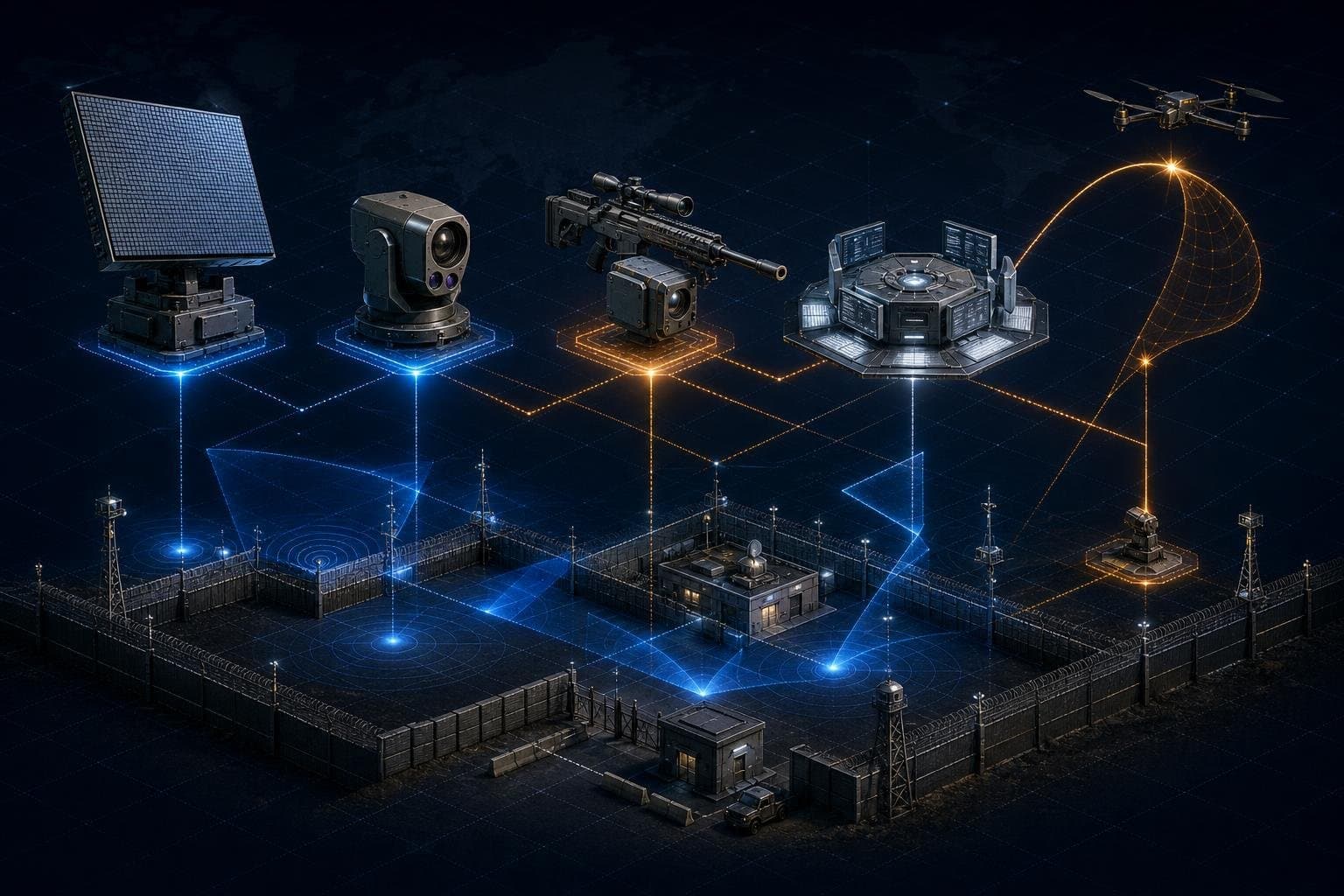

Here's the number that matters: ten companies, up to $7 billion, one acquisition vehicle. On September 28, the Pentagon's Joint Interagency Task Force 401 announced a slate of indefinite-delivery/indefinite-quantity awards for counter-unmanned aircraft systems — sensors, effectors, and command-and-control, bundled together rather than sold piecemeal (OpenPR, citing DataM Intelligence). This is the contract I've been waiting to see named names on, and now it has: DroneShield, SRC, RADA, Echodyne, and SmartShooter all made the cut, alongside PVP Advanced EO Systems and Digital Force Technologies.
That list tells you something an $7 billion topline never could.
The Winners Aren't One Thing — They're a Stack
What's notable isn't that five-plus companies split a big number. It's what each of them actually does. RADA and Echodyne are radar and sensing specialists — the detection layer. SmartShooter builds fire-control systems that turn a rifle into a precision-guided interceptor against small drones — the effector layer. DroneShield and SRC sit somewhere in between, doing detection-to-identification work that increasingly leans on AI classification rather than human operators squinting at radar blips.
JIATF-401 didn't pick a single winner because the threat doesn't have a single shape. A Group 1 quadcopter buzzing a flight line and a coordinated swarm testing a perimeter require different sensor dwell times, different engagement geometries, different cost-per-kill math. Building ten vendors into one IDIQ is an admission that no single company — prime or startup — currently owns the whole kill chain, and that trying to force one to would slow fielding down. That's the layered, multi-vendor logic Pentagon counter-drone officials have been talking about for over a year, now showing up as an actual contract structure.
Leonardo DRS picked up a separate award on October 14 — up to $500 million for tactical expeditionary sensing under the same JIATF-401 umbrella (OpenPR). A legacy prime landing a sensing-specific slice next to five sensor and effector startups is the adaptation story in miniature: the incumbents aren't getting frozen out, they're getting narrowed into the lanes where their scale advantage still counts.
The Base-Defense Logic Runs Through the Same Procurement Playbook
This isn't happening in isolation. At AUSA 2026 in Washington, drones and counter-drone systems dominated the show floor, and the Army's Chief Technology Officer, Alex Miller, used the moment to explain why the service is deliberately avoiding locking into single-vendor solutions too early — instead building acquisition pathways meant to keep emerging companies competing for years, not just winning one demo (Breaking Defense).
The Defense Innovation Unit's unmanned surface vessel prize challenge, which I covered two weeks ago, follows the identical shape. Its newest sprint — submissions due November 30 — wants vessels carrying "mature hard-kill Counter-Air effectors and clutter-resilient sensor suites" that can engage Group 1–3 drones at a sustainable cost, with up to $40 million in prize money per phase (Breaking Defense). Same vocabulary, same structure, different domain — maritime base perimeter instead of a garrison fence line. When three separate offices (JIATF-401, Army acquisition, DIU) converge on "layered, multi-vendor, cost-exchange-favorable" as the design principle within weeks of each other, that's not coincidence. That's the Pentagon finally internalizing that a $2 million interceptor against a $500 drone is a losing trade, no matter how good the intercept rate is.
Where I'd Pump the Brakes
The market-sizing numbers circulating around this moment — projections of a near-$20 billion global anti-drone market by 2035 — come from a single market-research press release, and I'd treat that trajectory as directional at best, not a number to build a thesis on (OpenPR). The more grounded signal is regulatory, not financial: Europe is wrestling with who even has legal authority to shoot a drone down near critical infrastructure, with France's parliament passing authorization law in August and other governments still sorting out liability (Defense News). The U.S. base-defense contracts move faster precisely because that authority question is already settled on a DoD installation. That's an underrated structural advantage for American counter-drone startups: they're selling into a buyer who can already legally pull the trigger.
Watch November 30 — the SWAP-USV Sprint 2 submission deadline — and whatever JIATF-401 does next with the IDIQ's task-order flow. The award list was the headline. Which vendors actually get tasked, and how fast, is the real test of whether this procurement structure delivers capability at the speed the threat demands.


