


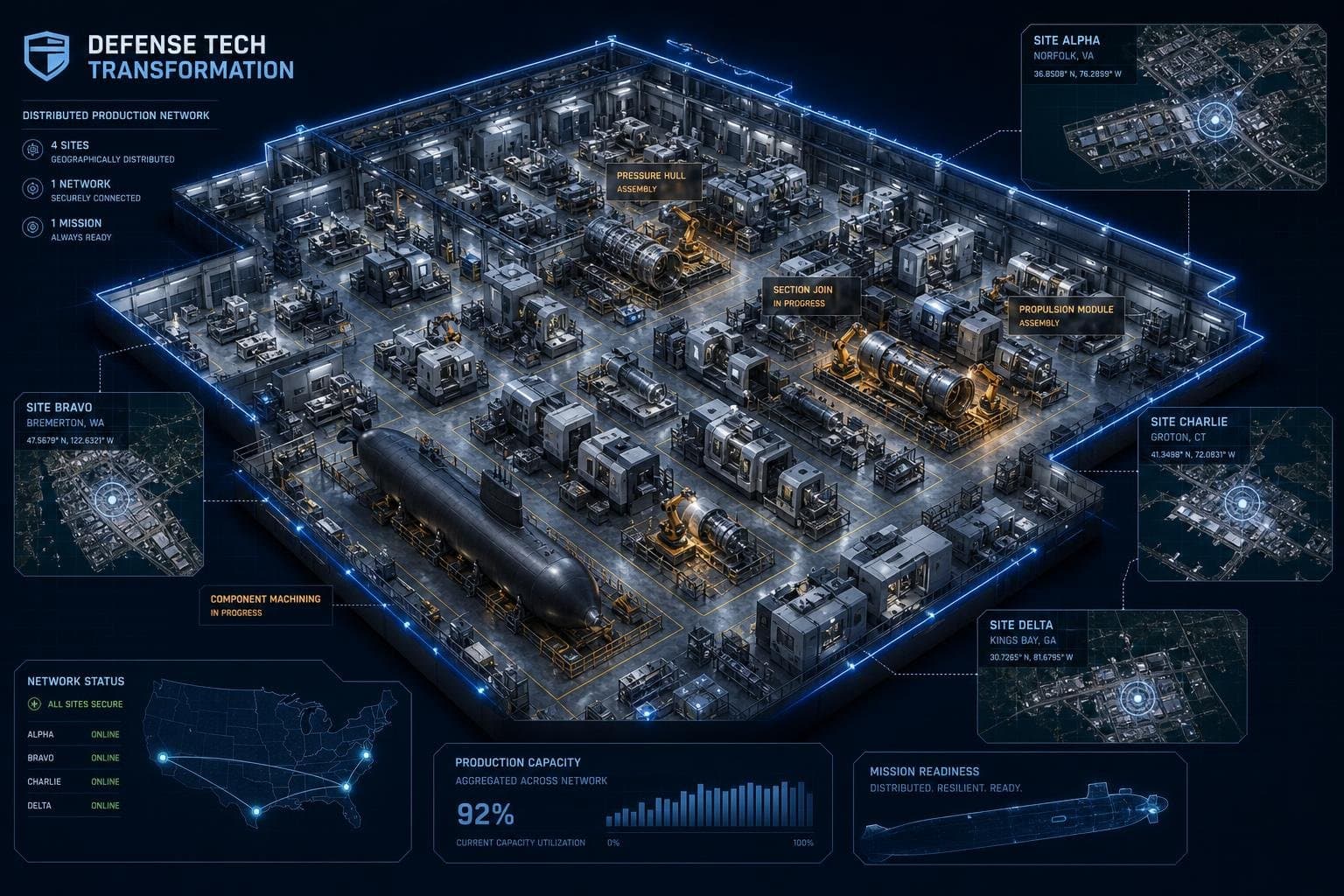

The funding rounds in defense tech have gotten so large that it's easy to become numb to them. But Hadrian's $1.37 billion Series D, which values the company just shy of $8 billion, deserves a second look — because it's funding something different from the software and autonomy plays that have dominated this space.
Hadrian builds factories. Precision parts, factories-as-a-service, AI-augmented human workforces. Its customers include Lockheed Martin, RTX, and Anduril. In March, the Navy tapped the company to mass-produce components for Virginia-class and Columbia-class submarines in Alabama — which puts Hadrian directly inside the supply chain for the Navy's $76.6 billion submarine contract awarded last week to General Dynamics Electric Boat and Huntington Ingalls.
That's the thread worth pulling. The submarine program is one of the most demanding manufacturing challenges in American defense — Columbia-class delays have already pushed the lead boat's delivery to 2028 — and the bottleneck has never been design. It's been production capacity. Hadrian's pitch is that highly automated, design-agnostic factories can compress timelines that legacy primes have struggled to hold.
CEO Chris Power's line to Axios captures the moment: "We were early. This has been a five-year slog, and only 18 months ago everyone went, 'Oh, God, manufacturing is super important.'" That's not false modesty — it's an accurate read of how slowly the reindustrialization thesis moved from niche conviction to mainstream capital. The $1.37 billion says the mainstream has arrived.
The investor logic here is straightforward from a capabilities standpoint: software eats the mission layer, but someone still has to machine the parts. Hadrian is betting that the factory itself is the moat — nearly 3 million square feet across four sites, with a proprietary software stack called Opus running underneath. If the Pentagon's production demands keep scaling, the constraint won't be contracts. It'll be floor space and skilled labor. Watch