
Here's the uncomfortable truth about Golden Dome that nobody in the program office wants to say out loud: the architecture is being questioned by the same Senate committee that controls its funding, even as the first real venture bet on the interceptor side just closed. Benchmark — a firm that spent two decades steering clear of pure defense plays — put $25 million into a one-year-old missile startup called Furientis, valuing it at $125 million (TechCrunch). That round landed in the same week Sen. Angus King stood up in a Senate Armed Services subcommittee hearing and asked, essentially, who Golden Dome actually protects (Axios).
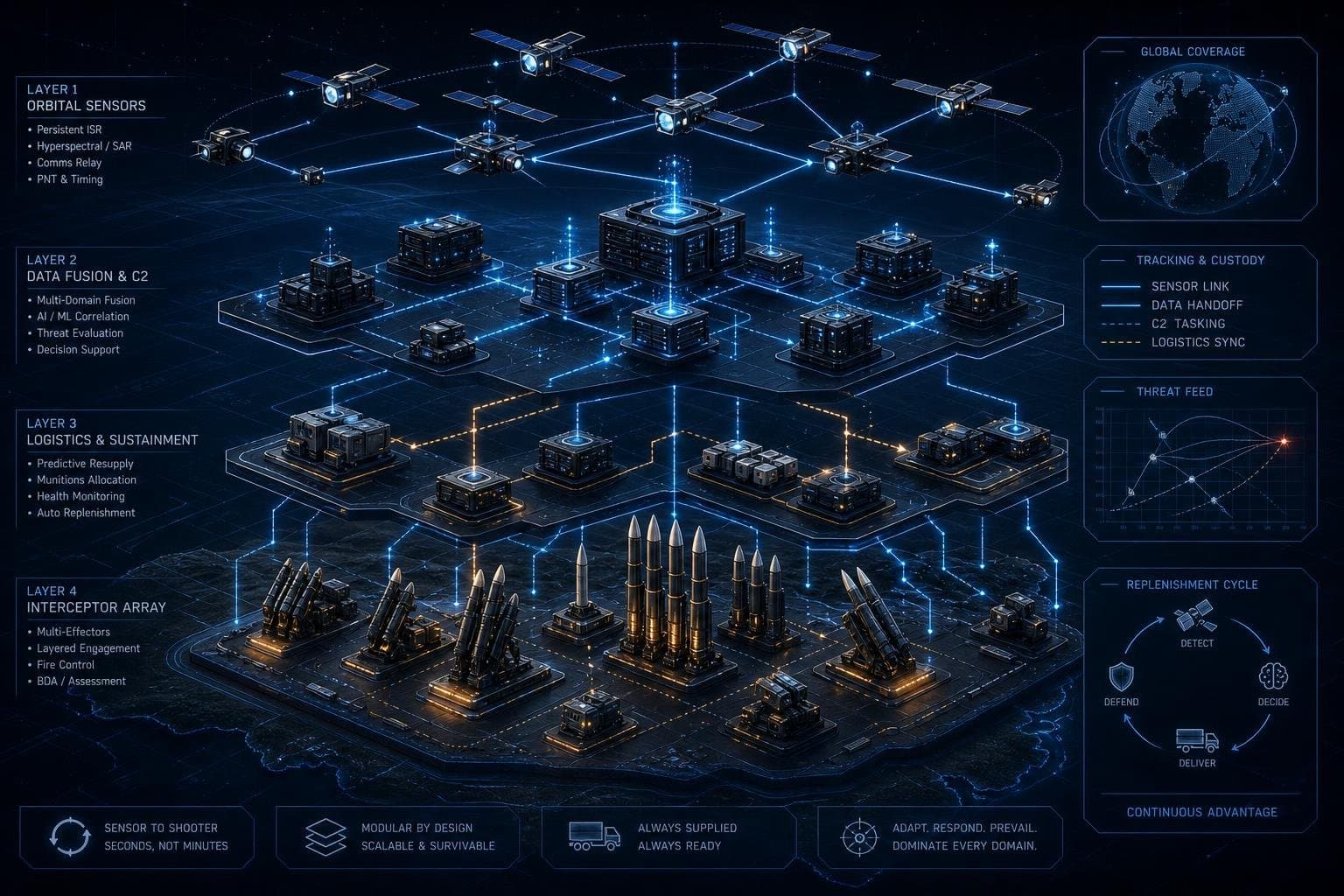
Both things are true at once, and that tension is the real story. Golden Dome as a program is wobbling on political and fiscal legs. Golden Dome as a thesis — that the homeland needs a layered, sensor-dense, rapidly replenishable defense architecture against a wider menu of threats — is attracting serious capital regardless of whether the top-line program survives in its current form.
The CBO Fight Is About Architecture, Not Just Money
The headline number everyone fixates on is the gap: the Congressional Budget Office pegged Golden Dome's potential cost at up to $1.2 trillion over 20 years back in May, while program manager Gen. Michael Guetlein insists the system will stay within a $185 billion budget (Axios). That's not a rounding error — it's two entirely different programs. And the process failure matters as much as the dollar gap: CBO's national security analysis director told lawmakers his office got its first substantive briefing from the Golden Dome office just five days before the hearing (Axios).
When an oversight body is operating nearly blind on a program this size, it tells you the architecture itself is still being negotiated in real time — which systems, which orbits, which interceptor classes, which sensor layers actually make the cut. That's exactly the kind of ambiguity that creates openings for companies willing to bet on a piece of the puzzle rather than wait for the whole blueprint to firm up.
Trey Obering, the former Missile Defense Agency director now advising on orbital logistics, framed the shift in threat character that's driving this complexity: the Cold War's mutually-assured-destruction calculus has given way to what adversaries call "escalate to deescalate" — smaller, more surgical strikes meant to shock rather than annihilate, layered on top of a wider menu that now includes hypersonics, maneuvering warheads, fractional orbital bombardment, and proliferating drone swarms (Breaking Defense). That's not a single interceptor problem. It's a sensor-fusion, custody-handoff, replenishment-at-scale problem — and that's precisely where the startup opportunity sits, not in winning the one big prime contract but in owning a layer of the stack.
Furientis Is the Clearest Proof Point So Far
If you want to see what "owning a layer" looks like in practice, Furientis is the cleanest example on the board right now. The company isn't trying to out-engineer Raytheon or Lockheed on a best-in-class interceptor. It's betting that the Pentagon's real problem is production rate, not performance ceiling. Co-founder Brody Franzen told TechCrunch the U.S. Navy receives roughly 300 to 500 interceptor missiles a year, against a Chinese claimed production rate of 3,000 anti-ship cruise missiles a month — "we're being outproduced by a factor of 100 plus" (TechCrunch).
That's the investor thesis in a single sentence. Furientis isn't chasing the $3 million "exquisite" missile market — it's designing interceptors from readily available components so unit costs fall far enough to actually replenish an arsenal at the rate modern conflicts burn through munitions (TechCrunch). The founding team's pedigree matters here too: Franzen came from Castelion, the hypersonic missile startup now valued at $13 billion, and Aris Simsarian ran rocket engine testing at Virgin Orbit (TechCrunch). Benchmark's Chetan Puttagunta called out the velocity specifically — prototypes built and launches completed on a $5 million pre-seed, before the firm ever wrote a check (TechCrunch). That's the kind of capital efficiency that makes a legacy prime's multi-year design cycle look like a liability rather than a moat.
What makes this a Benchmark story and not just a defense-tech story is who's writing the check. This is a storied Silicon Valley generalist firm making its first pure defense bet, four years into the post-Ukraine defense tech cycle (TechCrunch). Generalist capital entering a sector it spent years avoiding on moral and bureaucratic grounds is a signal in itself — it says the procurement friction that used to scare off venture money is thinning out faster than the headline program drama suggests.
Why Sensor and Logistics Startups Matter More Than the Interceptor Headlines
Interceptors get the funding headlines, but the deeper architectural bet — the one Obering is pointing at — is logistics and sustainment in orbit. His argument is blunt: an architecture this complex, spanning persistent tracking, custody handoff between sensor layers, and rapid-response interceptors, can't function without the ability to service, refuel, and reposition assets on orbit (Breaking Defense). He credits the technology convergence that makes this newly possible to sensors, processing power, mesh communications, AI/ML, modern manufacturing, and — above all — collapsing launch costs (Breaking Defense).
That's the investor lens applied correctly: not "how much does Golden Dome cost" but "what capability does cheap, frequent launch plus on-orbit servicing unlock that wasn't possible a decade ago?" The answer is persistent, maintainable space infrastructure instead of exquisite, unserviceable satellites that degrade and die. A sensor constellation you can refuel and reposition behaves like a living system rather than a depreciating asset — that's a fundamentally different procurement conversation, and it's one legacy primes, built around build-and-launch-once contracts, aren't structurally positioned to win on their own.
The regional posturing tells a similar story from the ground up. Colorado Springs and Huntsville — longtime rivals over U.S. Space Command's permanent headquarters — are now forming a formal "twin city partnership" specifically to chase Golden Dome work, according to Space Command commander Gen. Stephen Whiting (Axios). More than 90 economic development officials made the trip to broker it (Axios). You don't see that kind of coordinated civic hustle around a program people think is vaporware. Whatever Congress decides about the top-line budget, the regional industrial base is already positioning as if the work is real and distributed across multiple supply chains — which, in practice, is exactly the kind of multi-vendor, multi-site build that favors smaller specialized contractors over a single prime sweeping the whole architecture.
The Budget Fight Isn't Going Away, and That's the Risk Startups Need to Price In
None of this erases the fiscal reality. Golden Dome has been funded exclusively through the reconciliation process — a maneuver that let the Republican majority push through extra spending without the normal appropriations fight — and it pulled in $24.4 billion last year through that mechanism (Axios). Reconciliation funding is politically durable only as long as the majority holds, and it's the kind of funding stream that evaporates the moment control of Congress shifts or appetite for the program's cost curve sours further.
Layer onto that the broader continuing-resolution drag hitting the Pentagon right now: Breaking Defense counted more than 150 new program starts — including billions tied to drones, the Golden Fleet program, and hypersonic weapons — that can't begin funding under the current CR (Breaking Defense). Sen. Chris Coons warned of a possible $500 billion to $700 billion gap between what the Pentagon says it will get through reconciliation and supplemental funding versus what's actually likely to materialize (Breaking Defense). Space Force's new chief of space operations, Gen. Douglass Schiess, put the operational cost plainly: "It's gonna slow us down, and the threat is not slowing down" (Breaking Defense).
For investors, that's the real risk variable — not whether the underlying capability gap is real (it clearly is), but whether the specific funding vehicle called "Golden Dome" survives contact with a divided Congress and a CR-bound Pentagon long enough to turn architecture studies into sustained procurement. Companies like Furientis have hedged this well by landing a funded Pentagon contract independent of the Golden Dome label itself (TechCrunch) — the underlying demand for cheap, fast-production interceptors exists whether or not the program keeps its current name or budget ceiling.
What to Watch
The next real test isn't another Senate hearing — it's whether the Golden Dome office can give CBO and Congress an architecture briefing detailed enough to close the gap between the $185 billion and $1.2 trillion estimates before the reconciliation window narrows further. Watch also for how the CR resolves by its Dec. 11 deadline and whether any of the 150-plus delayed new starts tied to drones and hypersonics get unstuck in a fiscal 2027 deal (Breaking Defense). On the capital side, Benchmark's entry into Furientis is worth tracking as a bellwether — if other generalist venture firms follow with pure-play defense bets in the next two quarters, that's a stronger signal than anything coming out of the program office itself. The architecture argument will get settled in budget documents and contract awards, not in committee rooms, and that's where the real capability story is going to show up first.


